USAID DEC
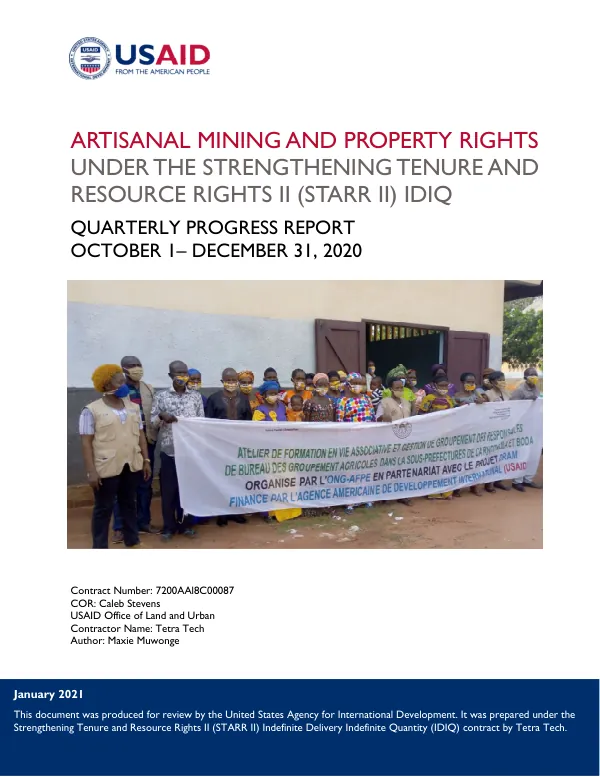
Quarterly Progress Report: Artisanal Mining and Property Rights under the Strengthening Tenure and Resource Rights II (STARR II) IDIQ
Sign inTETRA TECH
Quarterly Progress Report: Artisanal Mining and Property Rights under the Strengthening Tenure and Resource Rights II (STARR II) IDIQ
The Artisanal Mining and Property Rights (AMPR) project in the Central African Republic (CAR) aims to improve compliance with Kimberley Process requirements and promote licit economic activities.
2020 · 40 pages
Sign in to readA free account is required to download.
Abstract
The project is implemented by Tetra Tech under the Strengthening Tenure and Resource Rights II (STARR II) Indefinite Delivery Indefinite Quantity (IDIQ) contract, with funding from the United States Agency for International Development (USAID). The project focuses on four objectives: improving compliance with Kimberley Process requirements, strengthening community resilience and social cohesion, increasing awareness and understanding of responsible gold supply chains, and improving USAID programming through increased understanding of linkages between artisanal mining and development issues. The project is implemented in collaboration with the Government of the Central African Republic (GoCAR) and other stakeholders. The project's activities include supporting the GoCAR to improve its legal, policy, and institutional framework for conflict-free diamond production, expanding formalization of land and resource rights in artisanal diamond mining communities, increasing awareness of Kimberley Process requirements, and strengthening the capacity of GoCAR to manage and expand KP-compliant zones effectively. The project also supports inclusive community dialogue, promotes women's economic and social empowerment, and strengthens cooperation between GoCAR ministries and agencies and other stakeholders on social cohesion and Kimberley Process compliance. The project's quarterly progress report for October 1–December 31, 2020, highlights several achievements, including the completion of a research study on the opportunities and challenges of establishing responsible gold supply chains in CAR, the development of a policy brief on the link between artisanal mining and development issues, and the implementation of a training program for community leaders on conflict resolution and social cohesion. The project also reports on its inclusion of women and other vulnerable populations, coordination and collaboration with USAID missions and other USAID partners, and project-specific performance indicators. The report includes annexes with additional information on project staff, generated data, and a list of media coverage. The project's activities are implemented in collaboration with various stakeholders, including the GoCAR, the European Union, the Belgian Development Agency, and the International Conference of the Great Lakes Region. The project's success is measured through a range of indicators, including the number of KP-compliant zones established, the number of community leaders trained, and the level of awareness and understanding of responsible gold supply chains among stakeholders. The project's quarterly progress report provides an update on the project's activities and achievements during the period from October 1 to December 31, 2020. The report highlights the project's progress towards its objectives and provides recommendations for future activities. The report is intended for USAID and other stakeholders interested in the project's progress and achievements.