CHEMONICS
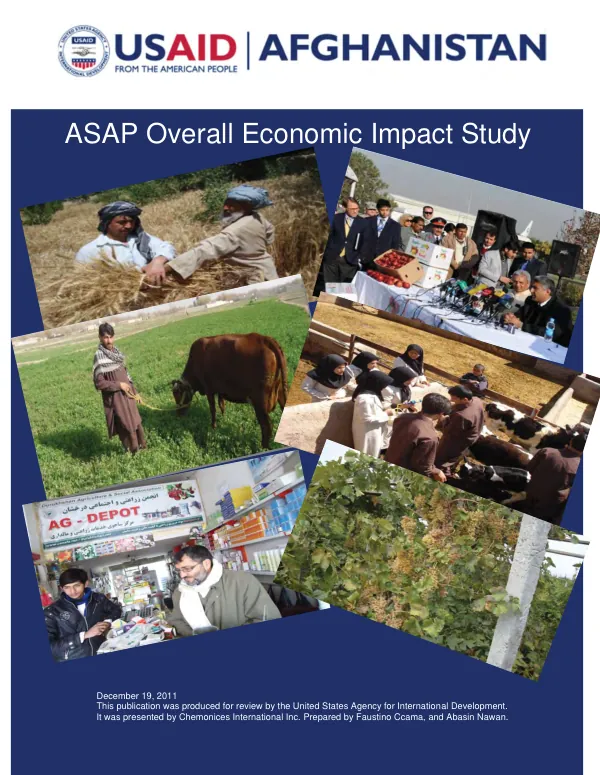
ASAP Economic Impact Study: AgDepot Economic Impact Study in Afghanistan
The Accelerating Sustainable Agriculture Program (ASAP) is a nationwide program in Afghanistan that aims to revitalize the country's agricultural sector and improve its global competitiveness.
2011 · 45 pages
Sign in to readA free account is required to download.
Abstract
Funded by the United States Agency for International Development (USAID), ASAP began in November 2006 and will conclude in September 2011. The program is managed by Chemonics International and implemented in close coordination with the Ministry of Agriculture, Irrigation, and Livestock (MAIL). ASAP has two primary objectives: to increase agricultural sector jobs and income by improving farmers' access to inputs, establishing effective extension services, and invigorating agribusinesses; and to increase Afghans' confidence in their government by strengthening the capacity of the Ministry of Agriculture, Irrigation, and Livestock to deliver services and promote private sector and farmer associations. One of the initiatives developed by ASAP to achieve its objectives is to strengthen the AgDepot network. AgDepots are privately owned rural farm stores that provide agricultural inputs and services to farmers to improve the quality and size of their production. ASAP expanded the existing network of AgDepots from 300 in 19 provinces to 373 in 26 provinces across the country. Each AgDepot has the potential to serve between 1,000 and 1,500 farmers. The AgDepot network has seen solid demand for their products as farmers sought out high-quality agricultural services. ASAP has used the AgDepot system to introduce Afghanistan farmers to improved agriculture methods and to boost their productivity through new technologies such as grape trellising, soil testing in laboratories, laser land leveling, and drip- and flexi-flume irrigation. The economic impact of AgDepots has been significant. Since ASAP started supporting the AgDepots, their sales have risen from about $2.5 million annually to $10.2 million. Training programs in how to use new agricultural products and equipment were viewed by both AgDepot owners and farmers as very beneficial. Over 80% of the AgDepots suggest that production has increased and quality of produce has been improved due to the services, inputs/tools, and trainings they provided to the farmers. AgFairs and other fairs and exhibitions developed by ASAP have helped 50% of AgDepot owners establish links with bigger national agriculture input companies. 98% of the farmers surveyed said that they purchase agriculture inputs and tools from the AgDepots. 89% of the farmers said they had been introduced to new methods and technology by the AgDepots. 90% of the farmers stated that their production has increased due to the services/inputs provided by the AgDepots. The AgDepot network has created 993 full-time employment opportunities. Each AgDepot has extended its services to an average of 1,050 households, benefiting a total of 391,934 households in all. ASAP estimates that each AgDepot has the potential of serving between 1,000 and 1,500 farmers. ASAP helped create 12 regional AgDepot Associations that bring together 194 individual AgDepot owners to address common concerns. The purpose of this study is to measure the economic impact of AgDepots and to determine their sustainability without ASAP support after ASAP concludes in September 2011. Separate surveys were conducted of AgDepot owners and the farmers who benefit from the goods and services supplied by AgDepots. The findings of the study indicate that the AgDepot network has had a significant impact on the agricultural sector in Afghanistan, improving production, increasing sales, and creating employment opportunities.