AFGHANISTAN MINISTRY OF AGRICULTURE, IRRIGATION AND LIVESTOCK
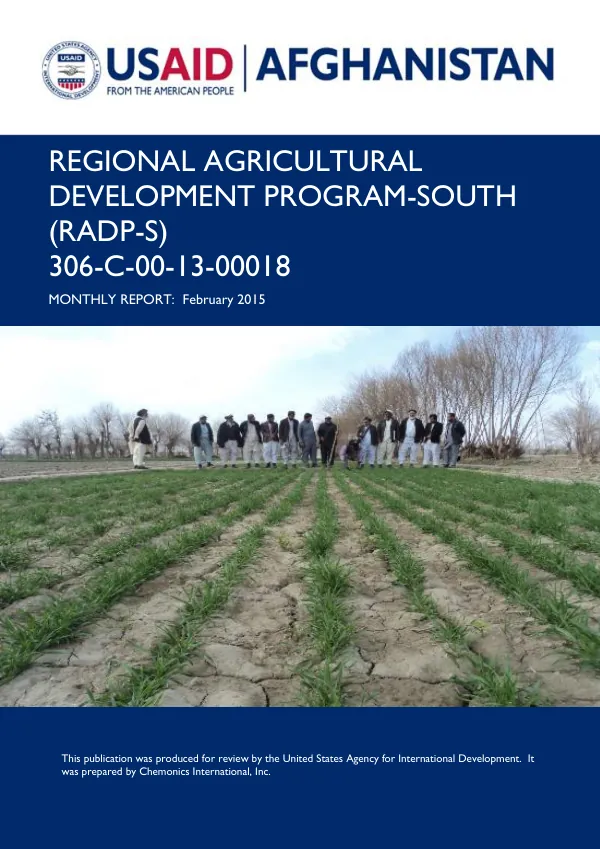
Regional Agricultural Development Program-South February 2015 Monthly Report
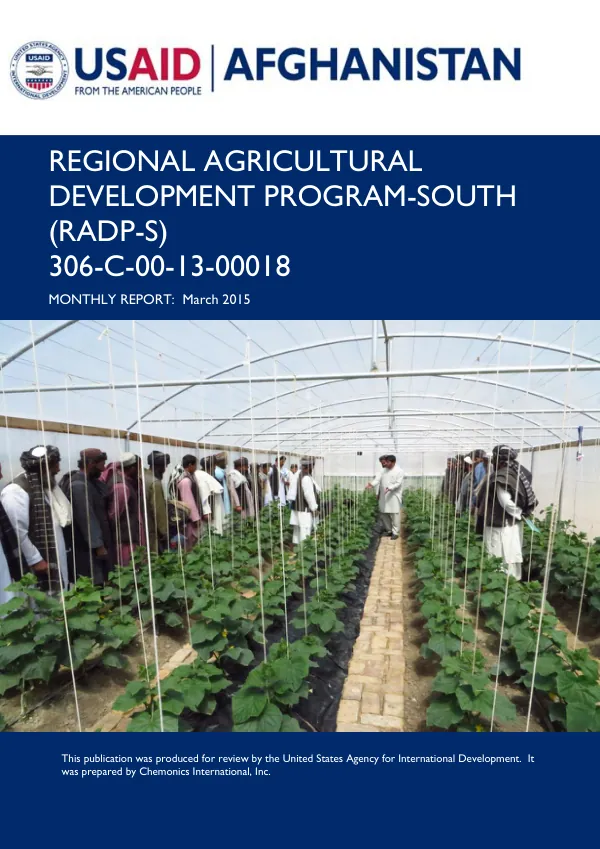
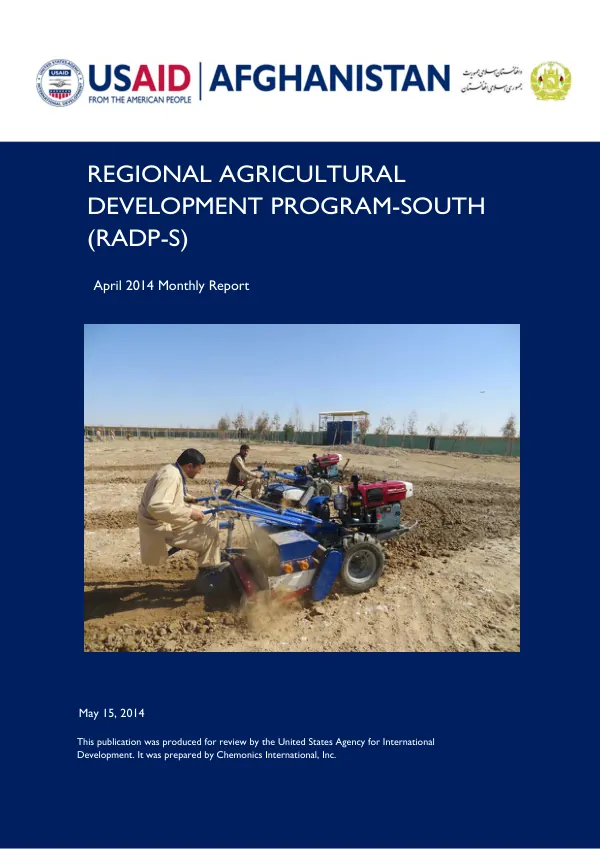
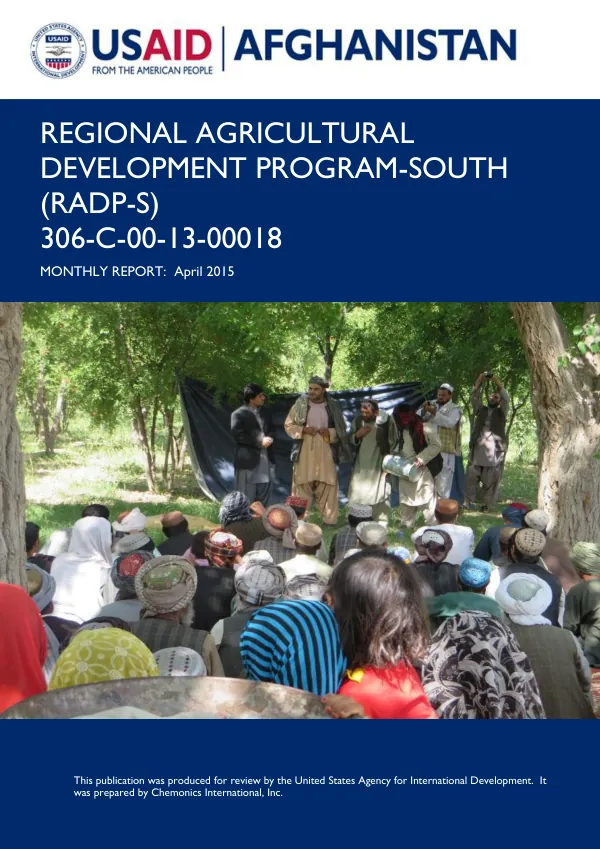
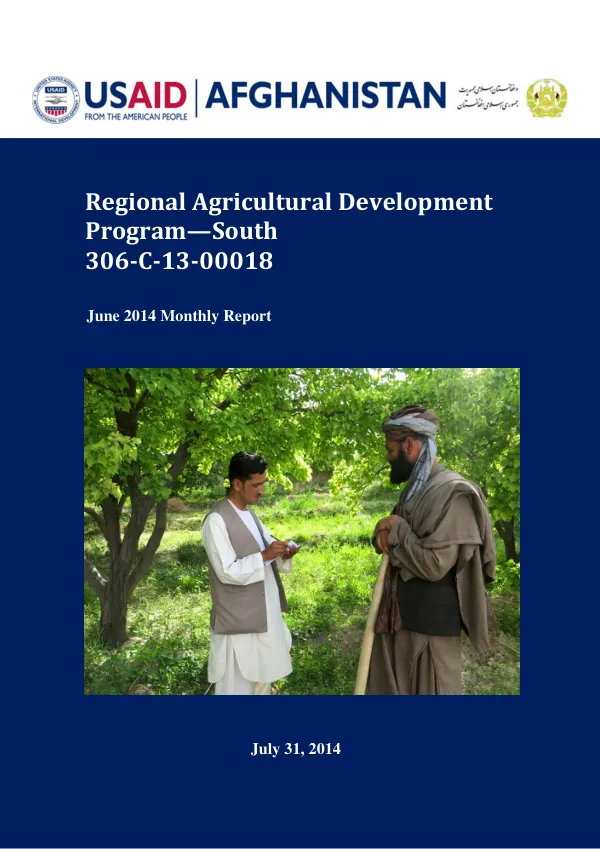
The Regional Agricultural Development Program-South (RADP-S) aims to improve food and economic security for rural Afghans in the provinces of Kandahar, Helmand, Zabul, and Uruzgan.
2015 · 10 pages
Sign in to readA free account is required to download.
Abstract
The program focuses on improving the productivity and profitability of the wheat, high value crops, and livestock value chains, while addressing policy, legal and regulatory constraints affecting value chain development. RADP-S supports the consolidation of licit economies to fuel sustainable long-term economic growth, including providing alternatives to poppy cultivation. In February, RADP-S master trainers provided classroom and demonstration trainings for farmers in 15 targeted districts of Kandahar, Helmand, Uruzgan, and Zabul province. A total of 6,710 farmers were trained in wheat and high value crop cultivation. Trainings focused on new methods and technologies for wheat seed cultivation in order to increase production. The design and layout of 9 demonstration farms in Qalat and Shah Joy in Zabul province were completed and winter wheat planted. RADP-S's Enabling Environment Unit surveyed farmers' associations, farmers' cooperatives, and agribusinesses in Kandahar, Helmand, Uruzgan, and Zabul. The purpose of this survey was to identify public and private stakeholders involved in agriculture and gauge the potential of building their public-private partnership capacity. During the reporting period, 40 women in Helmand province participated in nutrition training led by RADP-S key implementing partner (KIP) Coordination of Humanitarian Assistance (CHA). The RADP-S Gender Team followed up with participants who emphasized that the training improved their ability to handle food properly and the value of maintaining a healthy diet. RADP-S participated in the Kandahar Provincial Development Council (PDC) meeting to brief the governor and other government officials on RADP-S's progress and successes, as well as future planned activities. RADP-S team members also participated in the sectorial meeting of Directorates of Agriculture, Irrigation, and Livestock to share programming objectives in the four southern provinces. RADP-S anticipates continued coordination with the provincial government in order to ensure information sharing and the alignment of development goals. In terms of productivity and production, RADP-S master trainers conducted classroom and field demonstration trainings on wheat Integrated Pest Management (IPM), orchard maintenance, greenhouse vegetable harvest and post-harvest techniques, and vineyard maintenance. Wheat trainings emphasized researching, diagnosing, and controlling for common pests and diseases specific to Afghanistan. The wheat IPM training included instruction on mechanically, culturally, biologically, and chemically controlling for pests in an easy and safe manner for farmers to utilize on a regular basis. High Value Crop (HVC) trainings focused on orchard and vineyard maintenance specifically with regard to tree pruning, thinning, stem liming, intercropping, and mulching. In total, RADP-S trained 6,710 farmers in wheat and HVC topics. RADP-S wheat and HVC experts collaborated with District Directorate of Agriculture, Irrigation, and Livestock (DDAIL) and District Development Assembly (DDA) members to organize farmer participation. Demonstration farm activities included capacity building trainings for lead farmers on techniques to increase productivity. Master trainers applied sulfur powder to orchards, vineyards, and greenhouses to lower soil pH levels at all 78 demonstration farms. In addition, the master trainers and lead farmers dug pits and marked for planting seven varieties of saplings, including almond, apricot, and pomegranate.