AFGHANISTAN MINISTRY OF AGRICULTURE, IRRIGATION AND LIVESTOCK
Regional Agricultural Development Program-South April 2015 Monthly Report
The Regional Agricultural Development Program-South (RADP-S) aims to improve food and economic security for rural Afghans in the provinces of Kandahar, Helmand, Zabul, and Uruzgan.
2015 · 19 pages
Sign in to readA free account is required to download.
Abstract
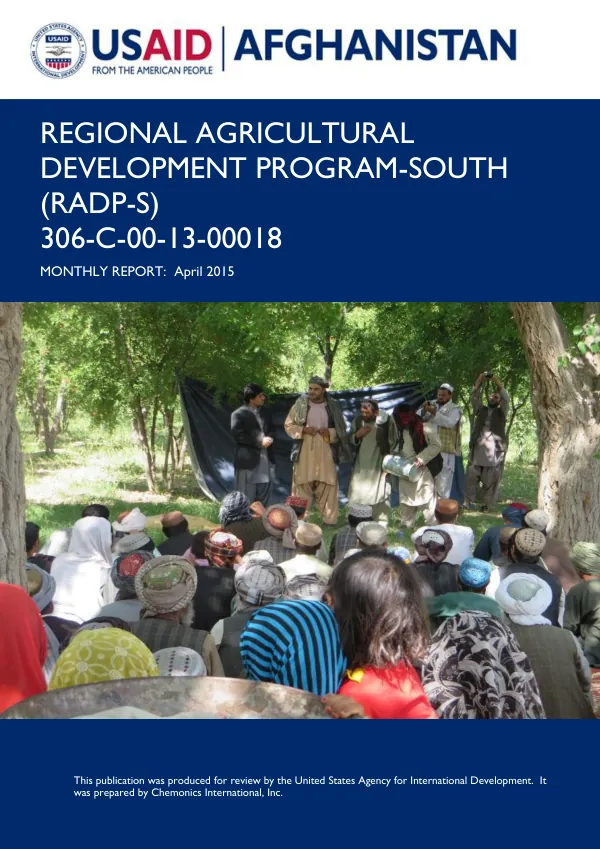
The program focuses on improving the productivity and profitability of the wheat, high value crops, and livestock value chains, while addressing policy, legal, and regulatory constraints affecting value chain development. RADP-S supports the consolidation of licit economies to fuel sustainable long-term economic growth, including providing alternatives to poppy cultivation. Implementation of RADP-S is aligned with Afghan and U.S. government strategies in advancing food security, regenerating agribusiness, and increasing agriculture sector jobs and incomes. The program strengthens the capacity of producers, associations, traders, and agribusinesses to respond to market demands; facilitates lasting market linkages between value chain actors; and supports an enabling environment that allows the private sector to thrive. RADP-S places the Afghan private sector at the forefront of implementation and addresses key cross-cutting issues of women's empowerment, agribusiness value chain facilitation, and alternative development in all facets of the program. In April 2015, RADP-S trained 4,785 farmers in wheat water management and an additional 3,984 farmers in orchard and vineyard integrated pest management (IPM) and weed control and greenhouse vegetable water management. RADP-S also contracted four additional veterinary field units (VFUs) in April, bringing the total number of RADP-S supported VFUs to 23 across 14 districts. The VFUs will provide technical support to improve service delivery, and paravets will attend refresher trainings to hone their skills in animal care and training. RADP-S signed grant agreements with three wheat input supply companies operating in Kandahar province. The companies will hold promotional trainings for farmers to learn about the benefits of certified wheat seeds, proper input applications, and wheat irrigation schedules. Field visits by farmers to contracted demonstration plots will show the differences in wheat cultivated from certified seeds. These activities will link agribusinesses with producers, provide more information on available services for farmers, and provide companies with potential customers that can result in increased sales. The RADP-S Gender and Productivity and Production (PPU) teams participated in a Purdue Improved Crop Storage (PICS) Bag Hermetic Storage Training, facilitated by the Afghanistan Agricultural Extension Program (AAEP) II in Herat City. The PICS bags provide a reliable wheat storage mechanism that prevents insect infestations and keeps wheat dry. The Gender Unit will lead trainings for women beneficiaries in the proper usage and storage of the bags, as women actively participate in the post-harvest management of wheat. RADP-S began listening circles and mobile theatre performances in the month of April. Mobile theatre performances occurred in all four provinces and covered wheat plant nutrition. The performances disseminate information to large groups in an entertaining and comedic manner. Mobile theatre performances and listening circles provide innovative methods of knowledge sharing for largely illiterate populations. RADP-S master trainers conducted training on wheat water management on all 78 demonstration farms. Beneficiary farmers were taught to identify the moisture content of soil, proper water application methods, the effects of under and overwatering, and water conservation techniques. RADP-S trainers also demonstrated the "look and feel" method of soil moisture identification as a simple and inexpensive technique for farmers to use.