AFGHANISTAN MINISTRY OF AGRICULTURE, IRRIGATION AND LIVESTOCK
Regional Agricultural Development Program-South March 2015 Monthly Report
The Regional Agricultural Development Program-South (RADP-S) aims to improve food and economic security for rural Afghans in the provinces of Kandahar, Helmand, Zabul, and Uruzgan.
2015 · 19 pages
Sign in to readA free account is required to download.
Abstract
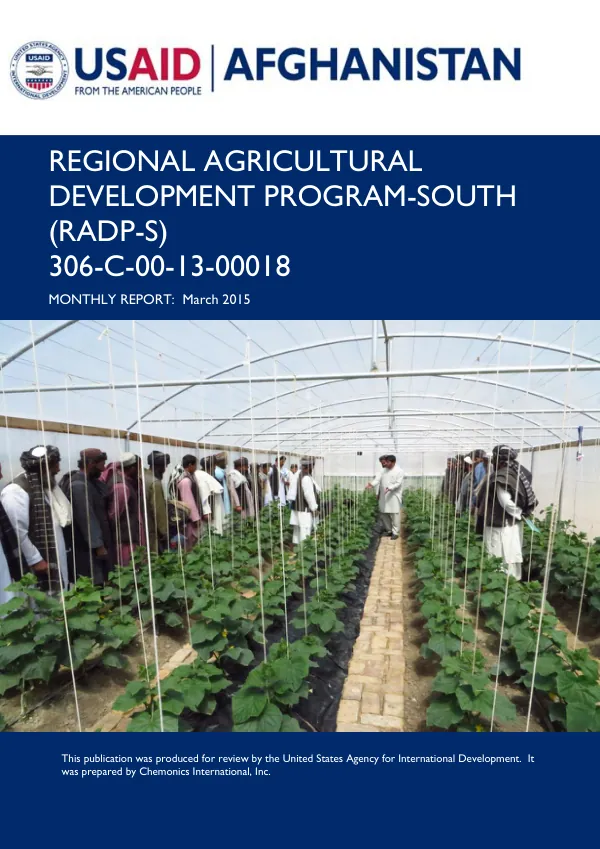
The program focuses on improving the productivity and profitability of the wheat, high value crops, and livestock value chains, while addressing policy, legal, and regulatory constraints affecting value chain development. RADP-S supports the consolidation of licit economies to fuel sustainable long-term economic growth, including providing alternatives to poppy cultivation. In March, RADP-S conducted training in 15 targeted districts of Kandahar, Helmand, Uruzgan, and Zabul for 8,732 farmers in wheat and high value crop (HVC) topics. The training highlighted the potential for yield loss if wheat plants are deficient in one or more nutrient and what farmers can do to maximize growth potential. In addition, RADP-S continued to enhance the training capacity of its demonstration farms by installing greenhouses on 54 demo farms in Kandahar and Helmand province and planting saplings at all 78 demonstration farms throughout the four provinces. RADP-S facilitated the signing of a Memorandum of Understanding (MOU) between the Kandahar Department of Women's Affairs (DOWA) and USAID, witnessed by the Kandahar Provincial Governor, to support the establishment of a women's demonstration farm. The first of its kind in Kandahar City, the demonstration farm will serve as a safe environment for women to gain skills in vegetable cultivation, livestock care, nutritional health, and business development. RADP-S also signed grant agreements with the Ahmad Baryali Improved Seeds Company (ABISC) and the Dehrawood Chemical Providing Company (DCPC). These input suppliers provide improved seed and pest management solutions in Dand, Daman, Panjwai, and Arghandab districts of Kandahar province. RADP-S will support ABISC trainings which demonstrate the use and benefits of certified wheat seeds as well as provide marketing and promotional materials. DCPC plans to train farmers in the effective control of powdery mildew for grapes in order to increase production. On March 15, RADP-S conducted a workshop in coordination with the Ministry of Agriculture, Irrigation and Livestock (MAIL) to advance the creation of a public private partnership (PPP) policy at MAIL and other government ministries. Representatives from the Ministry of Finance (MOF), Ministry of Public Health (MOPH), Ministry of Commerce and Industry (MOCI), and the Afghanistan Chamber of Commerce and Industries (ACCI) attended to share perspectives on challenges to establishing PPPs, opportunities for private sector engagement, and creating an enabling environment for PPP. The program places the Afghan private sector at the forefront of implementation and addresses key cross-cutting issues of women's empowerment, agribusiness value chain facilitation, and alternative development in all facets of the program. Embodying USAID's vision for sustainable Afghan-led development, RADP-S lays the foundation for greater and more socially inclusive growth in the agricultural economy. RADP-S master trainers conducted training on the effectiveness of soil nutrients, specifically nitrogen, phosphorus, and potassium, on wheat plant growth. The training highlighted the potential for yield loss if wheat plants are deficient in one or more nutrient and what farmers can do to maximize growth potential. In March, 4,585 farmers participated in wheat training on all 78 demonstration farms. Wheat trainings are meant to provide farmers with new techniques for increasing wheat productivity, leading to higher yields utilizing less land.