USAID DEC
Asia and Middle East Economic Growth Best Practices Program (AMEG) Quarterly Report—FY2015, Quarter 3
Sign inBLACK AND VEATCH, INTERNATIONAL
Asia and Middle East Economic Growth Best Practices Program (AMEG) Quarterly Report—FY2015, Quarter 3
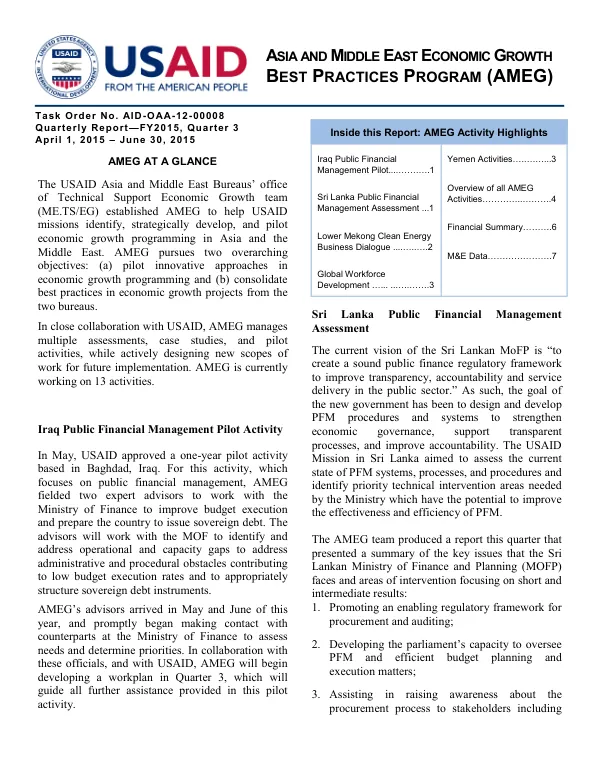
The Asia and Middle East Economic Growth Best Practices Program (AMEG) is a USAID initiative established by the office of Technical Support Economic Growth team (ME.TS/EG) to help USAID missions identify, strategically develop, and pilot economic growth programming in Asia and the Middle East.
2015 · 7 pages
Sign in to readA free account is required to download.
Abstract
AMEG pursues two overarching objectives: pilot innovative approaches in economic growth programming and consolidate best practices in economic growth projects from the two bureaus. AMEG manages multiple assessments, case studies, and pilot activities, while actively designing new scopes of work for future implementation. The program is currently working on 13 activities. One of these activities is the Iraq Public Financial Management Pilot, which aims to improve budget execution and prepare the country to issue sovereign debt. Two expert advisors from AMEG are working with the Ministry of Finance to identify and address operational and capacity gaps. In Sri Lanka, AMEG conducted a public financial management assessment to identify priority technical intervention areas needed by the Ministry of Finance and Planning (MOFP) to improve the effectiveness and efficiency of public financial management. The assessment identified four key areas of intervention: promoting an enabling regulatory framework for procurement and auditing, developing the parliament's capacity to oversee public financial management and budget planning and execution, raising awareness about the procurement process, and supporting the government in enhancing the quality, timeliness, and access of budget and procurement information to the public. The Lower Mekong Clean Energy Business Dialogue was held in Manila, Philippines, on June 15-16, 2015, to address growing energy consumption in the region. The dialogue brought together government officials from the U.S., Burma, Cambodia, Laos, Thailand, and Vietnam, along with businesses eager to implement clean energy solutions in the region. The event combined technical discussions with networking opportunities to foster new peer-to-peer technical and business relationships. In the Middle East and North Africa (MENA) region, AMEG is identifying the most cost-effective approaches to job creation and placement. The program is developing case studies to document successful programs and will use these case studies to develop MENA-focused technical guides for three approaches: Enterprise Competitiveness, Demand-driven Vocational Training and Job Matching, and Sustainable Livelihoods. AMEG conducted research and developed three case studies of Enterprise Competitiveness programs in MENA this quarter. In Yemen, AMEG's work was suspended due to the country's descent into chaos following the Houthi takeover and subsequent bombing campaign. USAID's decision to fully suspend all activities in Yemen became effective on June 15th, and AMEG's support ended during the targeted time for job placements. Despite the suspension, nearly all of the targeted students were trained and put into internships, and 552 have been placed into internships, and 177 have been placed into jobs.