WINROCK INTERNATIONAL FOUNDATION
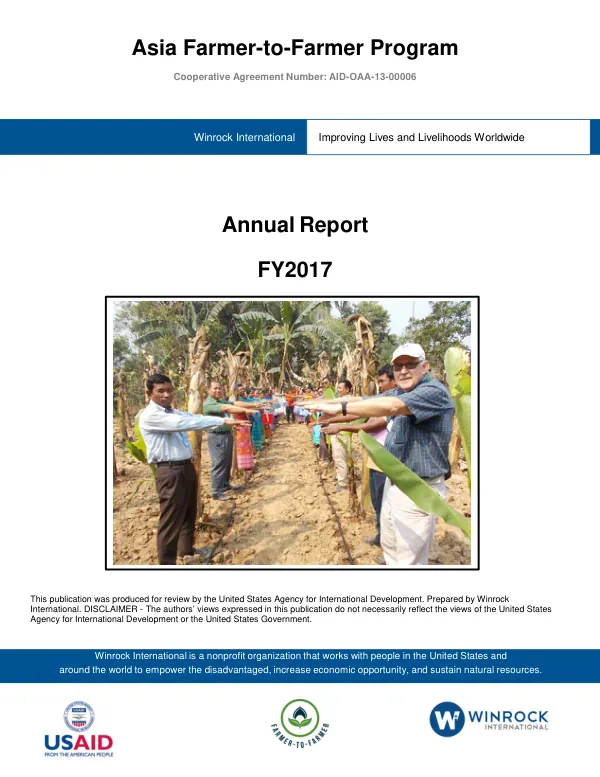
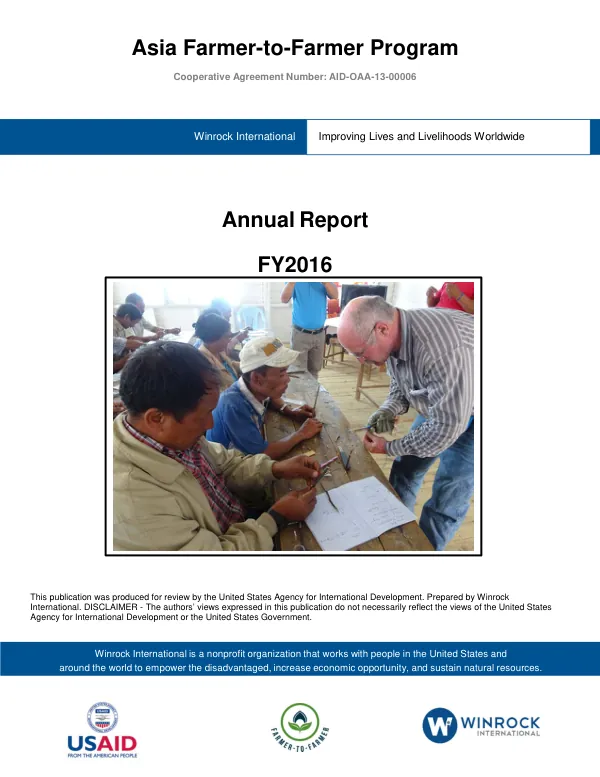
Asia Farmer To Farmer Program Annual Report FY2015
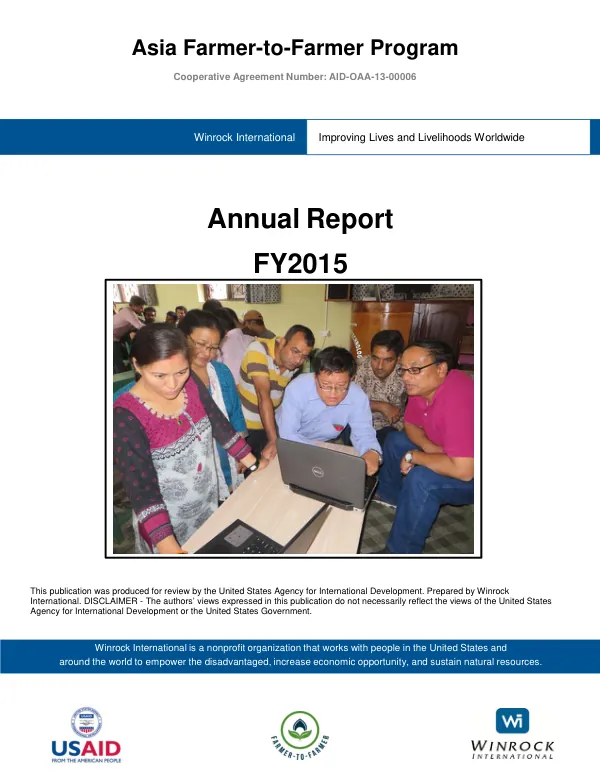
The Asia Farmer-to-Farmer Program is a five-year initiative implemented by Winrock International, a nonprofit organization that works to empower disadvantaged individuals and increase economic opportunities worldwide.
2015 · 33 pages
Sign in to readA free account is required to download.
Abstract
The program aims to introduce new technologies and innovations, develop local capacity for more productive and sustainable agricultural systems, and increase the American public's understanding of international development issues. In Fiscal Year 2015, the program completed 67 volunteer trips and directly assisted more than 5,000 participants in Bangladesh, Burma, and Nepal. Volunteers supported 83 hosts, including public and private education institutions, NGOs, private agribusinesses, and farmers' cooperatives/associations, providing AET or other support services to farmers and youth. Despite challenges related to political unrest in Bangladesh, the magnitude 7.8 earthquake in Nepal, and severe flooding in Burma, the program completed 89% of volunteer trips targeted for FY15. The program's activities in Bangladesh support USAID/Bangladesh's Development Objective 2 (Food Security Improved) and the Mission's Feed the Future (FTF) focus on strengthening the country's food security system. In FY15, Bangladesh F2F focused predominantly on the Agriculture Education and Training (AET) Country F2F Project, which strengthens the capacity of public and private AET institutions to provide relevant training, applied research, and service learning opportunities. During the reporting period, F2F completed 14 volunteer trips working with 16 formal and informal AET hosts. Through these efforts, volunteers provided training and assistance to 863 faculty, administrators, trainers, and students, with 13% being women. Volunteer assignments addressed high-priority needs identified by AET hosts, particularly in the horticulture, livestock, aquaculture, and apiculture subsectors, which contribute substantially to smallholder livelihoods, food security, and nutrition. AET hosts are successfully disseminating F2F information and replicating volunteer training with relevant stakeholders. For example, after participating in F2F training on postharvest management of spices and fruits, one agribusiness host trained 150 lead farmers (10% women) on these topics at four product collection centers; these farmers are now disseminating the information to other farmers through group meetings. Informal AET assignments demonstrate quicker results and impacts, with formal AET hosts sometimes needing more time to implement volunteer recommendations due to higher levels of bureaucracy. The program's impacts and accomplishments include the successful dissemination of F2F information and replication of volunteer training with relevant stakeholders. For example, Heifer International Bangladesh staff incorporated F2F training on improved dairy cattle health management into their field training tools and trained 34 community facilitators who, in turn, trained 1,000 women farmers. The farmers have since made improvements in the management of dairy and beef cattle, including improved cattle housing, vermicomposting facilities, and fodder grass production. In Nepal, the program supported USAID/Nepal's Development Objective 1 (Economic Growth Improved) and the Mission's FTF focus on increasing agricultural productivity and improving market access. In FY15, Nepal F2F completed 17 volunteer trips, with volunteers providing training and assistance to 1,200 farmers, 30% of whom were women. Volunteer assignments addressed high-priority needs identified by host organizations, particularly in the horticulture, livestock, and aquaculture subsectors. The program's impacts and accomplishments in Nepal include the successful dissemination of F2F information and replication of volunteer training with relevant stakeholders. For example, after participating in F2F training on improved dairy cattle health management, one host organization trained 150 lead farmers (20% women) on these topics at four product collection centers; these farmers are now disseminating the information to other farmers through group meetings. In Burma, the program supported USAID/Burma's Development Objective 1 (Economic Growth Improved) and the Mission's FTF focus on increasing agricultural productivity and improving market access. In FY15, Burma F2F completed 10 volunteer trips, with volunteers providing training and assistance to 500 farmers, 25% of whom were women. Volunteer assignments addressed high-priority needs identified by host organizations, particularly in the horticulture, livestock, and aquaculture subsectors. Overall, the Asia Farmer-to-Farmer Program has made significant progress in FY15, with the completion of 67 volunteer trips and direct assistance to more than 5,000 participants in Bangladesh, Burma, and Nepal. The program's activities have supported USAID's Development Objectives and the Mission's FTF focus on strengthening the country's food security system and increasing agricultural productivity and improving market access.