DEPARTMENT FOR INTERNATIONAL DEVELOPMENT
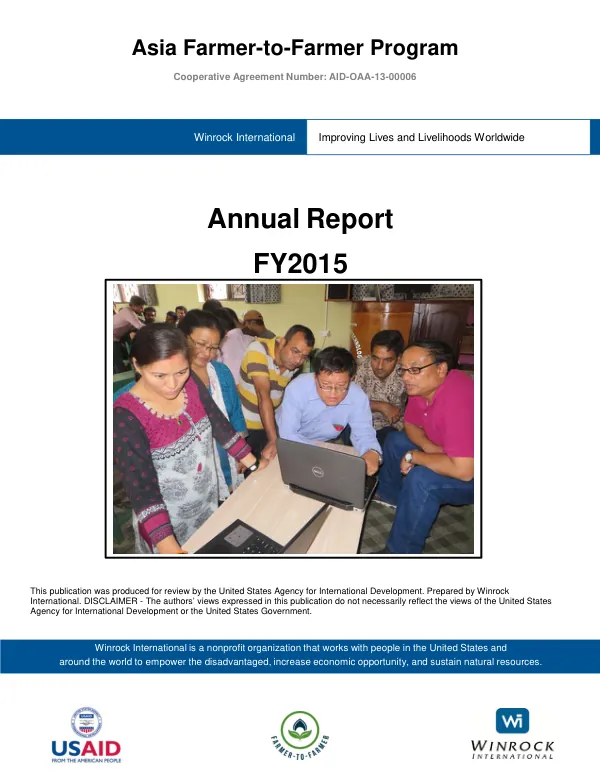
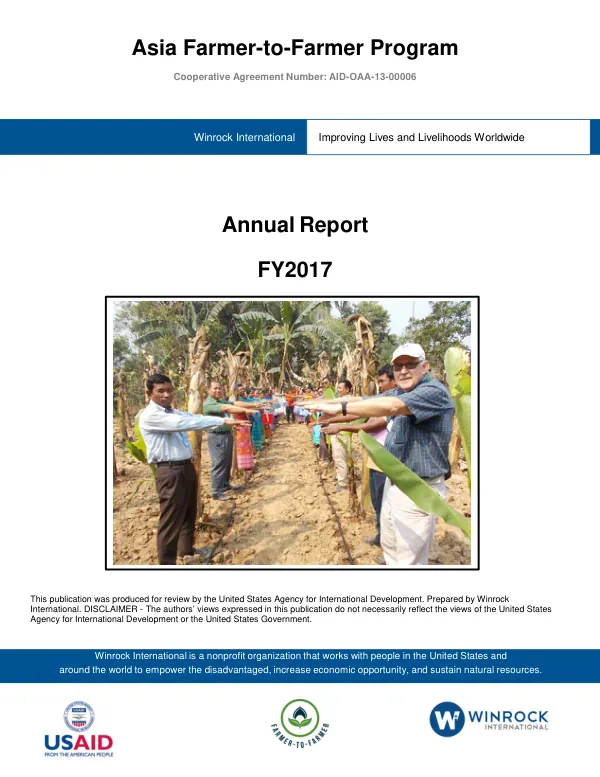
Winrock Asia F2F FY16 Annual Report
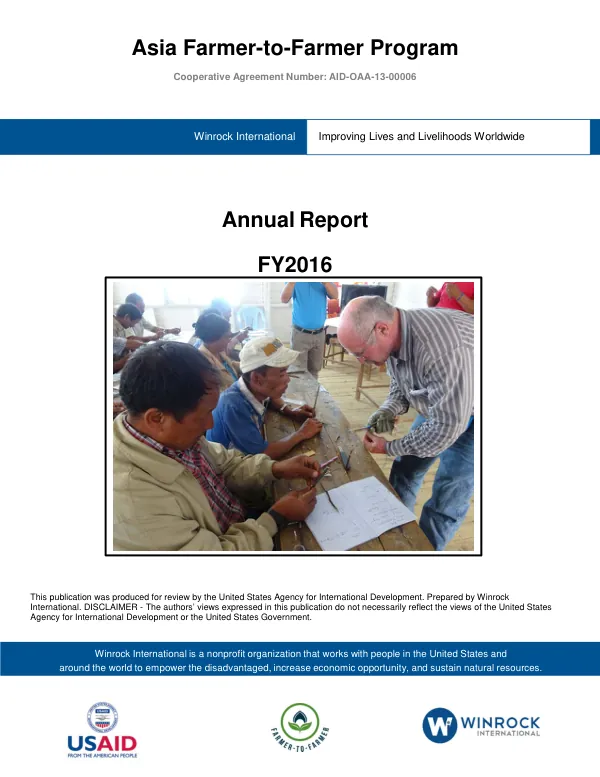
The Asia Farmer-to-Farmer Program is a five-year initiative aimed at generating rapid, sustainable, and broad-based food security and economic growth in the agricultural sector.
2016 · 38 pages
Sign in to readA free account is required to download.
Abstract
The program's secondary goal is to increase the American public's understanding of international development issues and programs and international understanding of the U.S. and U.S. development programs. The program was awarded to Winrock International on September 27, 2013, and this report covers Fiscal Year 2016 (FY16), as well as a summary of midterm impacts and key lessons from the first three years of the program. During FY16, F2F volunteers completed 73 volunteer trips and an associated 76 scopes of work in Bangladesh, Burma, Cambodia, Nepal, and Turkmenistan. These volunteers directly assisted more than 4,773 individuals and 72 hosts, including public and private education institutions, NGOs, private agribusinesses, farmers' cooperatives/associations, public sector technical agencies, and individual farmers. Bangladesh faced difficulties with fielding volunteers due to hartals and security concerns throughout the year, but was still able to complete 68% of the planned volunteer trips for FY16. By the end of the third year of implementation, Asia F2F achieved 55% of the life of project (LOP) target for volunteer trips. Eight volunteers completed assignments in multiple countries during the same trip, thus contributing to program-wide cost savings. Asia F2F engaged one consultant and three volunteers to assist staff, partners, and hosts with midterm assessments. Highlights of progress against input and output indicators are summarized in Table 1. Major impacts, accomplishments, and lessons are summarized in Section III. The program's activities in Bangladesh support USAID/Bangladesh's Development Objective 2 (Food Security Improved) and the Mission's Feed the Future (FTF) focus on strengthening the country's food security system. In Bangladesh, F2F activities focused on agriculture education and training, youth entrepreneurship, and other topics. Volunteers provided training and assistance to 2,019 faculty, administrators, trainers, and students under the agriculture education and training project. In the second half of FY16, volunteers supported formal AET hosts to strengthen agricultural education management and improve curriculum. Volunteers also conducted training of trainers (TOT) for informal AET hosts to provide improved training and services in livestock production and organic farming. Seven volunteers trained and assisted 269 individuals from four formal and informal AET hosts. The program's activities in Burma focused on rural development and increased incomes for smallholder farmers. By the end of year three, Burma F2F completed 56 volunteer trips, including 20 trips in FY16, to support rural development and increased incomes for smallholder farmers. These volunteers trained and assisted 4,530 farmers and other agriculture sector stakeholders to improve productivity, increase food safety, and strengthen farmer-serving organizations in Mandalay, Sagaing, Bago, Ayeyarwaddy, Magway, and Yangon regions, as well as Chin and Southern Shan states. In the second half of FY16, F2F Burma supported regional and national level farmers' associations, federations, and NGOs to train large groups of smallholders working in oil crops, tropical fruits and tree crops, and livestock. Volunteers also worked with these entities to develop manuals, guidelines, and indices for future trainings and dissemination. Through these efforts, F2F volunteers directly assisted 12 hosts and 541 individuals. Specific assignments included training apple farmers on improved orchard production, improving good agricultural practices of mango and vegetable growers, strengthening integrated pest management skills of tropical fruit farmers, and training small-scale and commercial-scale producers on improved swine production management practices. The program's activities in other countries, including Cambodia, Nepal, and Turkmenistan, also focused on improving agricultural productivity, increasing incomes for smallholder farmers, and strengthening farmer-serving organizations. Overall, the Asia Farmer-to-Farmer Program has made significant progress in achieving its goals and objectives, and has contributed to improved food security and economic growth in the agricultural sector.
Related documents