USAID DEC
ASPIRES Family Care Process Assessment: Cash Transfers for Family-Child Reintegration and Prevention of Separation
Sign inAVSI FOUNDATION
ASPIRES Family Care Process Assessment: Cash Transfers for Family-Child Reintegration and Prevention of Separation
The ASPIRES Family Care Process Assessment: Cash Transfers for Family-Child Reintegration and Prevention of Separation was conducted in July 2018.
2018 · 44 pages
Sign in to readA free account is required to download.
Abstract
The assessment aimed to evaluate the effectiveness of cash transfers as an economic strengthening intervention for preventing family-child separation and reintegration of children in family care in low- and middle-income countries. The study focused on two projects implemented by ChildFund and the AVSI Foundation in Uganda, which integrated case management, social support, and economic strengthening interventions. The Economic Strengthening to Keep and Reintegrate Children into Families (ESFAM) intervention was one of the economic strengthening interventions incorporated into the two projects. ESFAM aimed to provide limited-scale cash transfers to high-risk families to prevent family-child separation and support the reintegration of separated children into family care. The cash transfers were designed to help households meet their basic needs and invest in their children's education and health. The assessment used a mixed-methods approach, combining both qualitative and quantitative data collection and analysis methods. The study involved in-depth interviews with 30 households, focus group discussions with 20 households, and key informant interviews with 10 community leaders and social workers. The assessment also collected data on household income, expenditure, and savings, as well as data on children's education and health outcomes. The findings of the assessment indicated that the cash transfers had a positive impact on household income and expenditure. Households that received cash transfers reported a significant increase in their income and a reduction in their expenditure on basic needs such as food and shelter. The cash transfers also enabled households to invest in their children's education and health, leading to improved outcomes in these areas. The assessment also found that the cash transfers had a positive impact on household differentiation, with households that received cash transfers reporting a reduction in poverty and an increase in their ability to meet their basic needs. The cash transfers also enabled households to build social capital and strengthen their family relationships, leading to improved social cohesion and reduced conflict. However, the assessment also identified some challenges and limitations in the implementation of the cash transfers. These included difficulties in targeting the most vulnerable households, inadequate training and support for community workers, and challenges in disbursement and accounting procedures. The assessment made several recommendations for improving the implementation of the cash transfers, including improving targeting and targeting communications, enhancing training and support for community workers, and improving disbursement and accounting procedures. Overall, the assessment found that the cash transfers had a positive impact on household income, expenditure, and savings, as well as on children's education and health outcomes. The assessment also identified some challenges and limitations in the implementation of the cash transfers, but made several recommendations for improving their effectiveness.
Related documents
Documents in this collection
 2018
2018USAID DEC
Let's Stop Trying to Quantify Household Vulnerability: The Problem With Simple Scales for Targeting and Evaluating Economic Strengthening Programs
Open record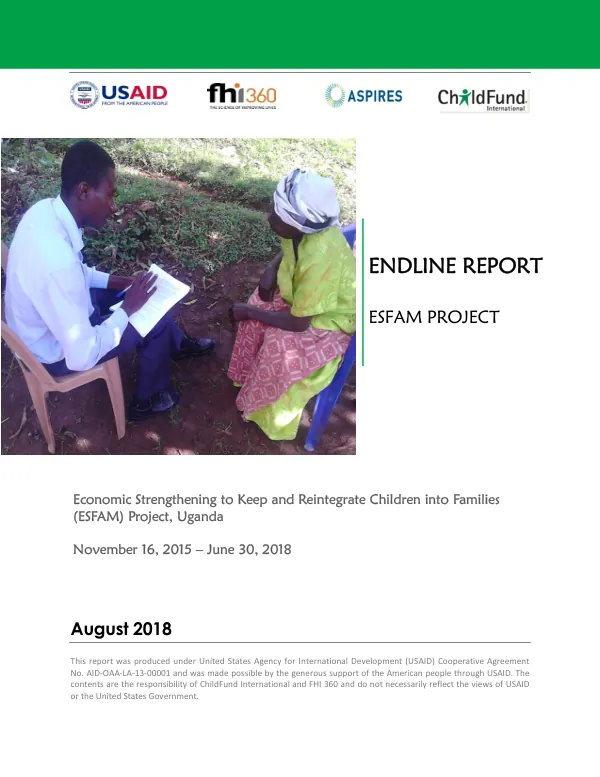 2018
2018USAID DEC
Economic Strengthening to Keep and Reintegrate Children into Families (ESFAM) Project, Uganda: Endline Report
Open record