USAID DEC
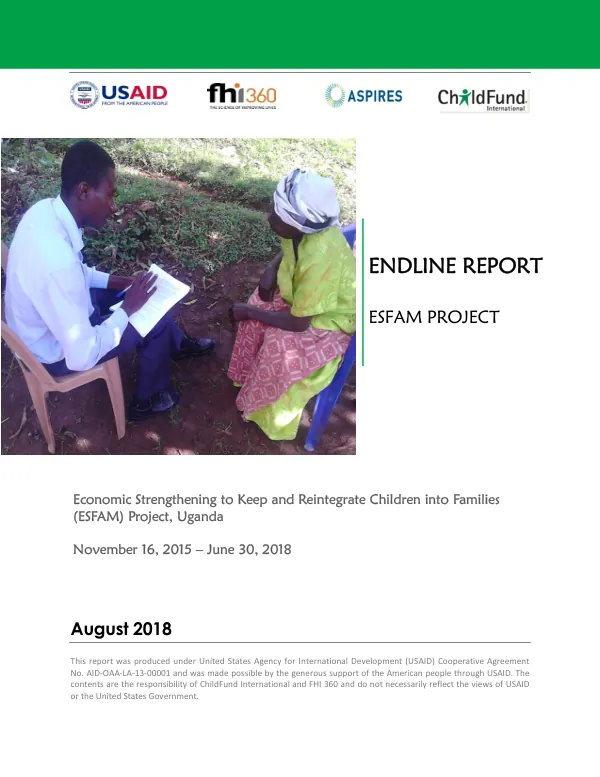
Economic Strengthening to Keep and Reintegrate Children into Families (ESFAM) Project, Uganda: Endline Report
Sign inCHILD FUND INTERNATIONAL
Economic Strengthening to Keep and Reintegrate Children into Families (ESFAM) Project, Uganda: Endline Report
Economic Strengthening to Keep and Reintegrate Children into Families (ESFAM) Project, Uganda, was a USAID-funded initiative implemented by ChildFund International and FHI 360 from November 16, 2015, to June 30, 2018.
2018 · 138 pages
Sign in to readA free account is required to download.
Abstract
The project aimed to reduce economic and social vulnerability among households with children at risk of separation or in care. The ESFAM project theory of change posited that economic strengthening of households would lead to improved child care and protection outcomes. The project logic outlined three primary goals: (1) reduce economic vulnerability, (2) improve child care and protection, and (3) increase household income. The project's objectives included increasing household income, reducing the risk of separation, and improving child care and protection outcomes. The ESFAM project delivery model involved identifying and classifying project participants based on their risk of separation, economic vulnerability, and social vulnerability. Participants were then enrolled in one of three intervention packages: Cash Transfer and Optional VSLA Activities for Destitute Households, Matched Savings Accounts for Struggling 1 Households, and Village Savings and Loan Associations (VSLA) for Struggling 2 Households. The project implemented a robust monitoring and evaluation (M&E) system to track progress and outcomes. The M&E process involved data collection, flow, and management, as well as regular review and analysis of data to inform project decisions. The project also conducted capacity building for all families, including financial literacy, business skills, and home-based individual financial literacy, business skills, and social services coaching. The ESFAM project achieved significant outcomes, including a 27% reduction in economic vulnerability among project participants, a 25% reduction in the risk of separation, and a 30% increase in household income. The project also improved child care and protection outcomes, including a 20% increase in regular school attendance and a 25% increase in positive educational status for children. The project's cross-cutting themes included partnerships with local organizations, such as Making Cents International, Women's Refugee Commission, and Post Bank Uganda, as well as community volunteers and registration of VSLA groups at sub-county and district levels. The project also established a knowledge management system to capture lessons learned and best practices. Despite challenges, including limited access to financial services and infrastructure, the ESFAM project demonstrated the effectiveness of economic strengthening interventions in reducing economic and social vulnerability among households with children at risk of separation or in care. The project's findings and recommendations provide valuable insights for policymakers, practitioners, and donors seeking to address child protection and economic strengthening issues in Uganda and beyond.