CHILD FUND INTERNATIONAL
Economic Strengthening to Keep and Reintegrate Children Into Families (ESFAM)
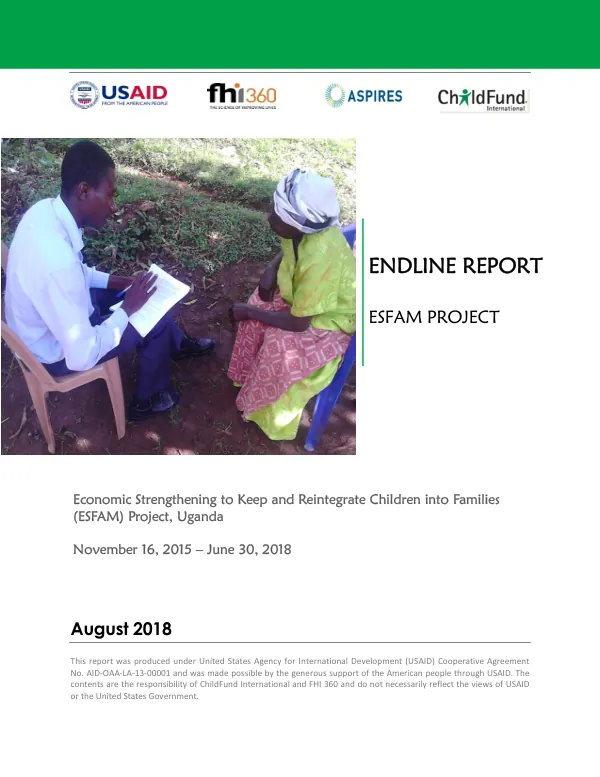
Economic Strengthening to Keep and Reintegrate Children Into Families (ESFAM) is a project implemented by ChildFund International in Uganda's Kamuli, Luwero, and Gulu Districts.
2018 · 10 pages
Sign in to readA free account is required to download.
Abstract
The project aimed to pilot and assess different economic strengthening interventions in programming aimed at preventing child-family separation and reintegrating separated children with their families. ESFAM was funded by USAID's Displaced Children and Orphans Fund (DCOF) through FHI 360's Accelerating Strategies for Practical Innovation and Research in Economic Strengthening (ASPIRES) project from November 2015 to June 2018. The project's theory of change hypothesized that equipping families with the means to improve their economic situations would also improve their abilities to keep children in the household. The 700 families targeted by the project were invited to participate in one of three intervention packages, based on an assessment of the level of their economic vulnerability and anchored on particular economic interventions. These packages included limited-term cash transfers, a bank savings account in which ESFAM matched households' deposits (matched savings account, or MSA), and participation in a village-based saving and lending association (VSLA). Each of these packages also included case management support to the child and family, development of family plans, and home visits including counseling and coaching on social and economic issues by para-social workers, training on child protection and parenting skills, and psychosocial support. Families reintegrating children also received a reunification package including food, bedding, clothing, and funds for school uniforms. The project used a multi-dimensional Family Status Vulnerability Index (FSVI) and Child and Caregiver Integration Status Tools (CIST and CGIST) to assess households at risk of separation. The FSVI tool measured five core program areas: household economic livelihood security, access to basic needs, health and care, psychosocial support and basic care, and child protection and legal support. The CIST and CGIST tools addressed domains of child well-being that the literature and practice wisdom identify as central drivers of family-child separation. Following the identification of the 155 Struggling 1 Households, community-based project Economic Strengthening Facilitators (ESFs) facilitated financial literacy training with the families using the first seven sessions of the Catalyzing Business Skills for Caregivers curriculum developed for ESFAM by Making Cents International. These sessions focused on money flow, managing needs and wants, reasons to save, where and how to save, managing household money flows, borrowing money in the community, and managing financial emergencies. ESFs and PSWs also promoted the MSA product the project had developed with PostBank Uganda, a local financial institution with which the ESFAM Project had established a Memorandum of Understanding for this purpose. As caregivers completed their financial literacy training, ESFs worked closely with PostBank Uganda and participating families to help caregivers open bank accounts. The MSA accounts were opened in a child's name to remind caregivers of the main intent or purpose of the MSA. However, since the children were under age, the accounts were accessed and utilized by the caregivers. The project aimed to encourage families to save for educational expenses, so that they would not have to send their children to residential care institutions for school. The project's experience with and learning from its MSA intervention is described in this Learning Brief, which draws on information collected via focus group discussions, individual interviews, and project data. The brief aims to provide insights into the effectiveness of the MSA intervention in promoting economic strengthening and preventing child-family separation in Uganda.
Related documents