USAID DEC
Assessing Access to and Quality of Urban Non-state Basic Education in Uganda One Year After COVID Closures
Sign inUSAID DEC
Assessing Access to and Quality of Urban Non-state Basic Education in Uganda One Year After COVID Closures
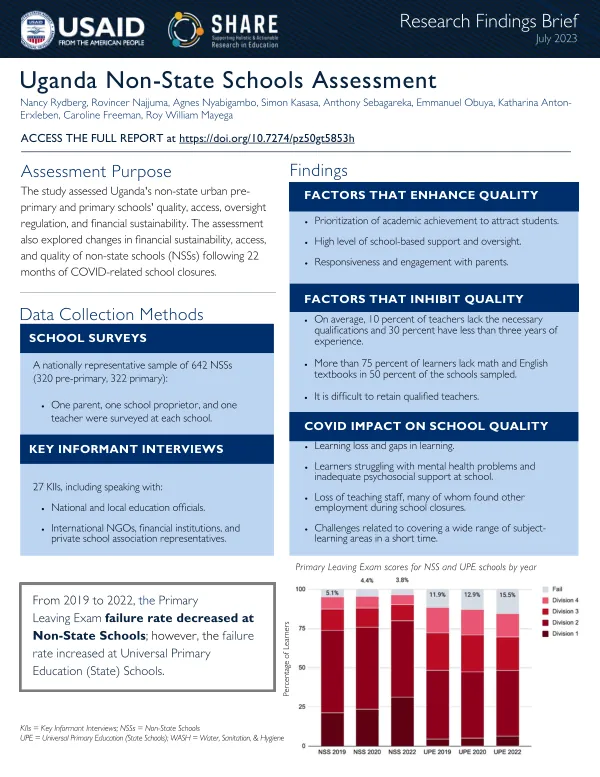
The assessment of Uganda's non-state urban pre-primary and primary schools' quality, access, oversight, and financial sustainability was conducted in July 2023.
2023 · 3 pages
Sign in to readA free account is required to download.
Abstract
The study aimed to evaluate the changes in financial sustainability, access, and quality of non-state schools (NSSs) following 22 months of COVID-related school closures. A nationally representative sample of 642 NSSs, including 320 pre-primary and 322 primary schools, was surveyed. The assessment identified several factors that inhibit quality in NSSs. These include prioritization of academic achievement to attract students, high levels of school-based support and oversight, and responsiveness and engagement with parents. However, the study also found that learning loss and gaps in learning, learners struggling with mental health problems and inadequate psychosocial support at school, and loss of teaching staff were significant challenges. Additionally, challenges related to covering a wide range of subject-learning areas in a short time were observed. The assessment revealed that primary leaving exam scores for NSS and UPE schools showed a decrease in failure rates at NSSs from 2019 to 2022, while the failure rate increased at UPE schools. It was also found that more than 75 percent of learners lacked math and English textbooks in 50 percent of the schools sampled. Furthermore, it was difficult to retain qualified teachers, and on average, 10 percent of teachers lacked the necessary qualifications and 30 percent had less than three years of experience. Faith-founded schools subsidized significantly more learners (60 percent) than other types of NSSs (30 percent). However, school fees were a barrier for learners from low-income families, especially at the pre-primary level. COVID reduced parents' ability to pay fees, leading to a decline in enrollment. Girls left due to pregnancy and marriage, while child labor was a barrier for boys. Barriers for learners with disabilities included 70 percent of schools lacking handicap-accessible infrastructure and 50 percent lacking accessible learning materials. Schools with diverse funding sources were more financially sustainable. Faith-founded schools received support from their religious bodies, and 70 percent of schools prepared annual budgets and financial statements, deposited cash in a bank, and had a school accountant. However, inadequate funding, staffing, and transportation, and lack of attention to non-state schools were significant challenges. The study also found that lack of mechanisms to enforce education standards and policies was a barrier to oversight and regulation. The assessment identified several key recommendations to improve access, quality, oversight, and financial sustainability of NSSs. These include providing teaching and learning materials, training teachers on how to address learning loss and education gaps, and providing school-based social-emotional learning interventions to support mental health. Additionally, addressing inadequate funding and staffing for school inspection and oversight, and complementing existing punitive enforcement mechanisms with incentive-based mechanisms to support NSS adherence to policies and standards were recommended.
Related documents