MEASURE EVALUATION PRH
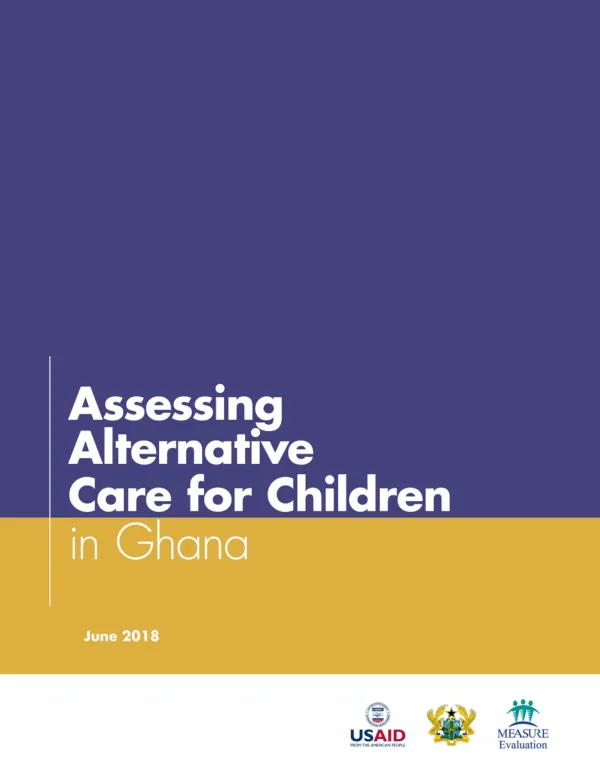
Assessing Alternative Care for Children in Ghana
The Care Reform Initiative in Ghana was launched in 2007 as a collaborative effort between the government, UNICEF, USAID, and the nongovernmental organization OrphanAid Africa.
2018 · 92 pages
Sign in to readA free account is required to download.
Abstract
The initiative aimed to establish a more comprehensive and sustainable alternative care system for children in need of care and protection. The National Plan of Action for Orphans and Vulnerable Children (OVC) served as the framework for the initiative. Residential care has been the primary alternative care placement option for children in Ghana, with approximately 2,900 children residing in 95 residential homes for children (RHCs) at the end of 2016. However, this number represents a decrease from 2015, when 127 RHCs were caring for 4,520 children. The majority of children in RHCs have at least one living parent, indicating that family or kinship care is still a viable option for many children. Adoption has also been a significant alternative care option in Ghana, with 1,179 children adopted between 2009 and 2011. Of these, 823 (70 percent) were intercountry adoptions, with the majority of children falling within the 0 to 5 years age range. The government of Ghana has implemented various policies and programs to support the adoption process, including the establishment of the Central Adoption Authority (CAA) and the development of standard operating procedures (SOPs) for adoption. The Care Reform Initiative has focused on improving the quality of care in RHCs and promoting family-based care as an alternative to institutional care. The initiative has also emphasized the importance of community-based care and support for families and children in need. The government of Ghana has made significant progress in implementing the CRI, including the development of a national care reform policy and the establishment of a country core team (CCT) to oversee the implementation of the initiative. The assessment framework used in this report is based on the United Nations Guidelines for Children in Alternative Care, which emphasizes the importance of prevention, family-based care, and community-based care. The framework consists of several key components, including prevention of unnecessary family separation, foster care, residential care, supervised independent living, formal kinship care, informal kinship care, other forms of alternative care, adoption, family reunification, and system deinstitutionalization. The assessment found that Ghana has made significant progress in implementing the Care Reform Initiative, but there are still challenges to be addressed. The report provides a comprehensive overview of the current state of alternative care in Ghana, including the strengths and weaknesses of the current system. The report also provides recommendations for improving the quality of care in RHCs and promoting family-based care as an alternative to institutional care. The assessment highlights the importance of community-based care and support for families and children in need. The report emphasizes the need for a more comprehensive and sustainable alternative care system that prioritizes prevention, family-based care, and community-based care. The government of Ghana has made significant progress in implementing the Care Reform Initiative, but there is still much work to be done to ensure that all children in need of care and protection have access to quality care and support.
Related documents