USAID DEC
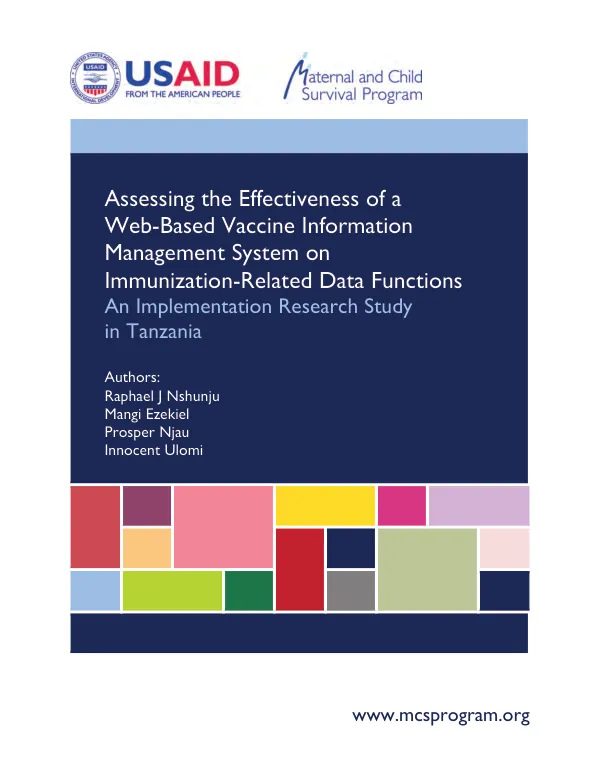
Assessing the Effectiveness of a Web-Based Vaccine Information Management System on Immunization-Related Data Functions
Sign inCLINTON HEALTHCARE ACCESS INITIATIVE
Assessing the Effectiveness of a Web-Based Vaccine Information Management System on Immunization-Related Data Functions
The Maternal and Child Survival Program (MCSP) provides technical support to the Ministry of Health, Community Development, Gender, Elderly, and Children (MOHCDGEC) in seven regions of Tanzania.
2018 · 47 pages
Sign in to readA free account is required to download.
Abstract
The Immunization and Vaccine Development (IVD) Program of the MOHCDGEC has focused on improving information and data management to monitor and improve immunization program performance. The IVD Program has primarily collected program-related data through the use of three tools: a district vaccine data management tool (DVDMT), a stock management tool (SMT), and a cold chain equipment inventory management tool (CCEIT). However, recent assessments have indicated that the quality, consistency, accessibility, and timely availability of data from these tools could be improved. To address this issue, the IVD Program piloted a new vaccine information management system (VIMS) that combines the three tools and streamlines data collection into one visualization platform. VIMS was developed under IVD leadership by John Snow, Inc. (JSI)/DELIVER and in partnership with the Clinton Health Access Initiative, PATH, World Health Organization (WHO), and MCSP. The new data management system provides IVD program stakeholders with a web-based "one-stop" source of information on vaccine and immunization commodities, cold chain assets, and routine immunization data. Beginning in August 2016, IVD piloted VIMS in 44 councils/districts in seven Tanzania mainland regions. After one year of piloting, IVD commissioned an implementation research study to examine the effectiveness of VIMS in improving immunization program data quality compared to the DVDMT, SMT, and CCEIT systems. The study objectives were to determine changes in data quality caused by VIMS use, explore the usability of the VIMS system, and explore the information management experiences of staff in non-VIMS districts. Most VIMS users reported feeling positively toward the new system, citing its ease of use, streamlined data collection and reporting functions, and accessibility. However, results from the study indicated that efforts are still needed to improve IVD program data reporting accuracy, consistency, or timeliness relative to the current DVDMT/SMT/CCEIT-based system. Several operational, infrastructural, and/or study-related factors may help explain why this was the case. The assessment provides an opportunity to identify gaps and lessons that will feed into the next phase of the rollout. Beyond easing the data collection burden, further adjustments and investments in VIMS refinement and training/mentoring support for VIMS users are needed to realize additional benefits of using VIMS. These investments will enable Tanzania to see similar benefits to other countries, such as Ethiopia and Pakistan, that have implemented similar electronic vaccine logistics management information systems (LMISs). The study found that VIMS users liked the auto-calculations and real-time reporting capabilities, as well as the ability to detect reporting errors and generate dashboard displays of statistics and trends. However, despite these positive features, the study results indicated that there is still room for improvement in data reporting accuracy, consistency, and timeliness. The study provides valuable insights into the effectiveness of VIMS and highlights the need for further refinement and support to maximize its benefits. The MCSP and IVD Program recognize the importance of consistent availability of timely and accurate program data for monitoring and improving immunization program performance. The VIMS system has the potential to provide a web-based "one-stop" source of information on vaccine and immunization commodities, cold chain assets, and routine immunization data. However, the study results indicate that further adjustments and investments are needed to realize the full potential of VIMS.
Related documents