USAID DEC
Assessment and Improvement of Children’s Rights in Health Care: Piloting Training and Tools in Uzbekistan
Sign inWORLD HEALTH ORGANIZATION
Assessment and Improvement of Children’s Rights in Health Care: Piloting Training and Tools in Uzbekistan
The World Health Organization (WHO) Regional Office for Europe, in collaboration with the Government of Uzbekistan, is implementing activities to enhance reproductive, maternal, child, and adolescent health services.
2015 · 5 pages
Sign in to readA free account is required to download.
Abstract
This effort is part of a broader strategy to adopt rights-based approaches to children's healthcare, as demonstrated by the European child and adolescent health strategy 2015-2020 and national programs. The WHO Regional Office for Europe has been providing continuous technical support to Uzbekistan in developing innovative policies and improving the quality of care by strengthening the child patient's rights in healthcare. A two-day training workshop on children's rights in healthcare took place in February 2015, with 21 healthcare professionals from national and regional levels participating. The workshop aimed to introduce the principles of the Convention on the Rights of the Child (CRC) relevant to healthcare and discuss how to use the CRC as a framework to plan, assess, monitor, and improve health services for children. The training was delivered through presentations, discussions, and group work, and participants received training handouts and a copy of the presentations in Russian. The WHO Regional Office for Europe also developed a series of tools to assess and improve quality of care for children through a human-rights based approach to health. The tools comprise a manual and five assessment tools that enable the assessment of adherence to eight standards on children's rights in primary healthcare. The tools were field-tested in February 2015 in the Kashkadarya region, with 21 health professionals selected by the Kashkadarya health authority participating. The field test aimed to verify the relevance and applicability of the tools to the care provided in facilities and identify areas of the tools that needed revision. The training workshop and field test revealed knowledge gaps among health professionals on the CRC and its applicability to healthcare and the national regulatory framework. The results of the field test provided evidence on the utility of the tools and their use in the context of quality of care improvement for children. The work will inform the finalization of the assessment tools and efforts to scale up related national processes in collaboration with other sectors. The Convention on the Rights of the Child (CRC) emphasizes the importance of adopting a human-rights based approach to health, which must encompass all of children's life settings and the relevant actors and institutions. This perspective contributes to the WHO Regional Office for Europe's Health 2020 policy framework and strategy by addressing and improving health and well-being of the population through strengthened leadership and governance, enhanced participation and empowerment of people, and improved quality of care for all. The WHO Regional Office for Europe has been working with the Government of Uzbekistan to develop innovative policies and improve the quality of care by strengthening the child patient's rights in healthcare. The training workshop and field test were part of this effort, aiming to introduce the principles of the CRC and assess the utility of the tools in improving quality of care for children. The results of the field test provided evidence on the utility of the tools and their use in the context of quality of care improvement for children.
Related documents
Documents in this collection
 2021
2021USAID DEC
LEGISLATIVE REVIEW OF GROUP CERTIFICATION OF SMALL AND MEDIUM-SIZED ORGANIC FARMERS IN CENTRAL ASIA
Open record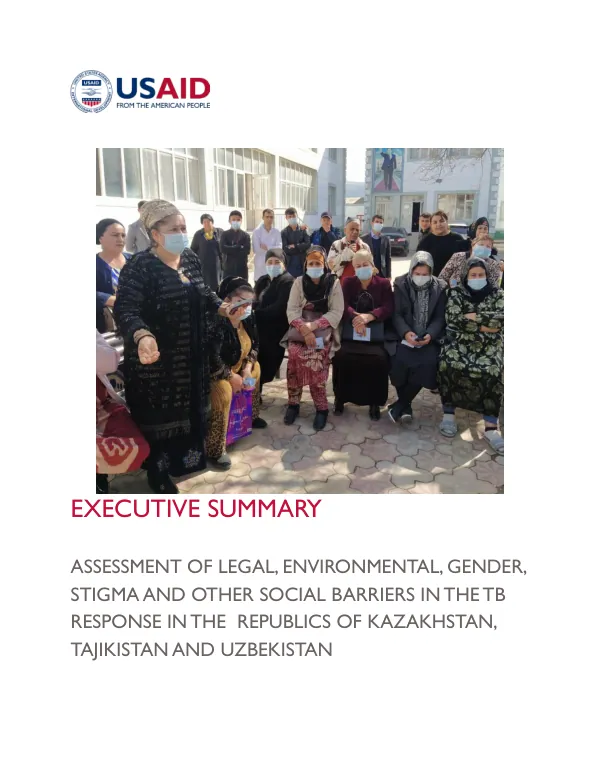 2021
2021USAID DEC
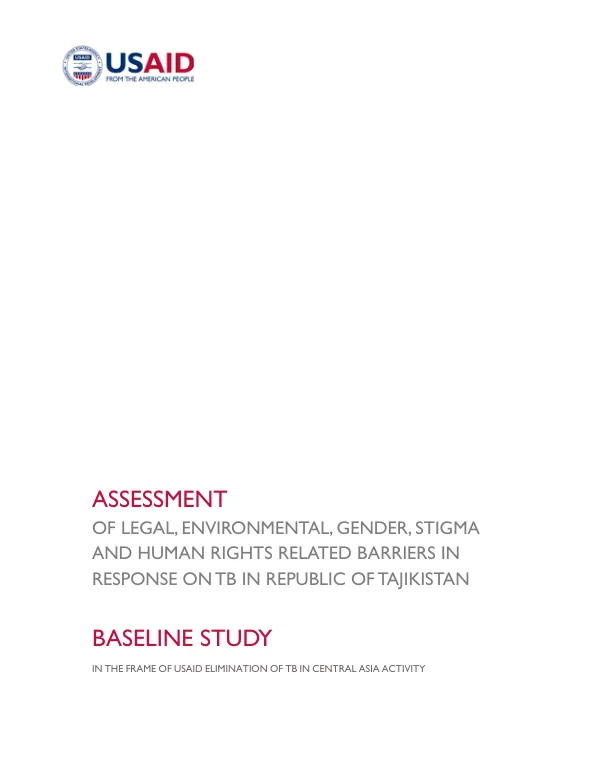
Assessment of Legal, Environmental, Gender, Stigma and Other Social Barriers in the TB Response in the Republics of Kazakhstan, Tajikistan and Uzbekistan
Open record