USAID DEC
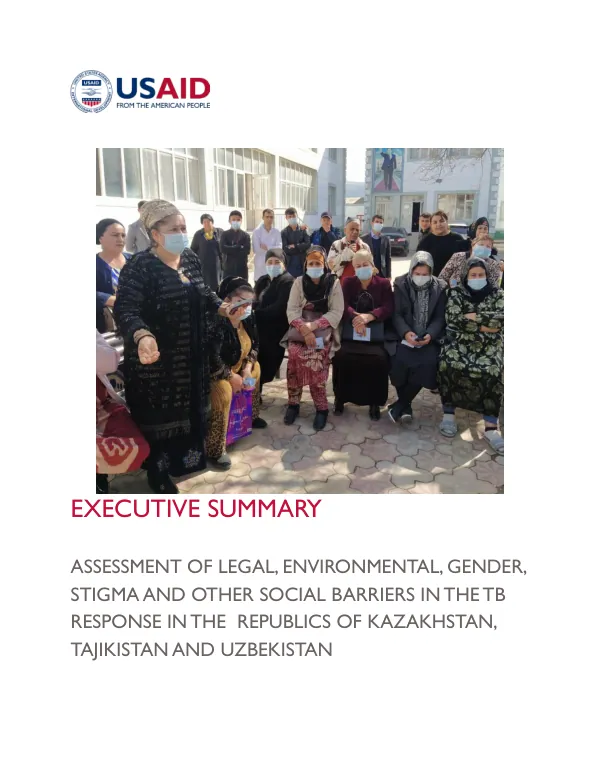
Assessment of Legal, Environmental, Gender, Stigma and Other Social Barriers in the TB Response in the Republics of Kazakhstan, Tajikistan and Uzbekistan
Sign inABT ASSOCIATES
Assessment of Legal, Environmental, Gender, Stigma and Other Social Barriers in the TB Response in the Republics of Kazakhstan, Tajikistan and Uzbekistan
The TB response in the Republics of Kazakhstan, Tajikistan, and Uzbekistan is hindered by various social barriers, including legal, environmental, gender, stigma, and other factors.
2021 · 30 pages
Sign in to readA free account is required to download.
Abstract
The assessment of these barriers is crucial to improving the effectiveness of TB control efforts in the region. The case detection rate in Kazakhstan is 63.4%, while in Tajikistan it is 44.1%, and in Uzbekistan it is 53.4%. The case notification rate in Kazakhstan is 64.1 per 100,000 population, while in Tajikistan it is 45.6 per 100,000 population, and in Uzbekistan it is 54.9 per 100,000 population. The incidence of tuberculosis in Kazakhstan is 143.4 per 100,000 population, while in Tajikistan it is 123.4 per 100,000 population, and in Uzbekistan it is 134.9 per 100,000 population. The assessment identified several key populations at risk of TB, including people who have increased exposure to TB bacilli, those with limited access to health services, and individuals with compromised immune function. Women and children in settings of poverty are disproportionately affected by TB, and remote populations, homeless individuals, and migrants face significant barriers to accessing health services. The assessment also highlighted the importance of addressing gender-based violence, which is a significant barrier to TB control efforts in the region. Women who experience violence are less likely to seek medical care, and those who do may face stigma and discrimination within the healthcare system. The report emphasizes the need for a comprehensive approach to addressing the social barriers to TB control in the region. This includes strengthening healthcare systems, improving access to health services, and addressing the root causes of poverty and inequality. The assessment also recommends increasing awareness and education about TB and its risks, particularly among key populations. Implementation of the recommendations from this assessment will require a collaborative effort from government, civil society, and international partners. The report provides a framework for action and highlights the importance of addressing the social determinants of health to improve TB control efforts in the region. The assessment was conducted in December 2021, and the report provides a comprehensive overview of the social barriers to TB control in the Republics of Kazakhstan, Tajikistan, and Uzbekistan. The findings and recommendations from this report will inform TB control efforts in the region and contribute to the development of effective strategies to address the social determinants of health. The report highlights the importance of addressing the social determinants of health to improve TB control efforts in the region. This includes strengthening healthcare systems, improving access to health services, and addressing the root causes of poverty and inequality. The assessment also recommends increasing awareness and education about TB and its risks, particularly among key populations.
Related documents