FAO
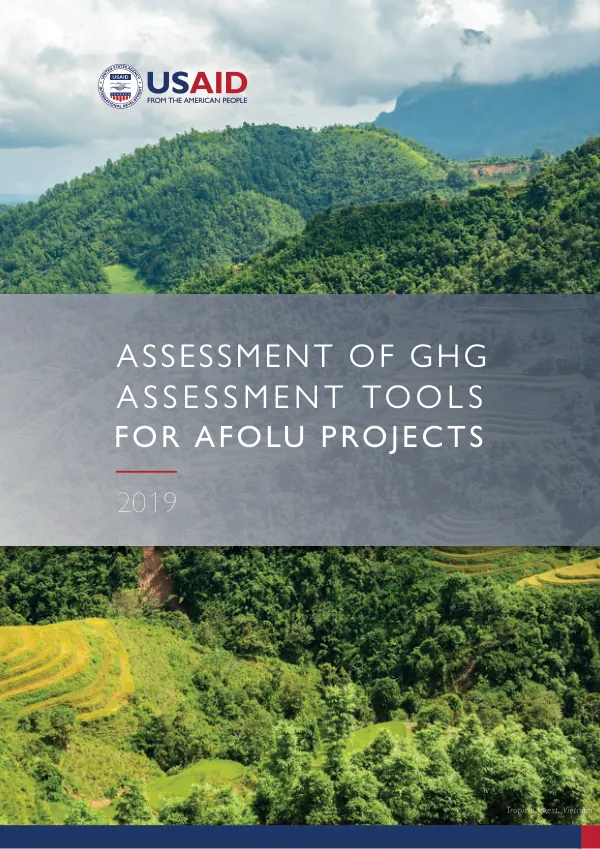
Assessment of GHG Assessment Tools for AFOLU Projects 2019
The USAID Green Invest Asia (GIA) initiative aims to mobilize $400 million of private finance for sustainable production in agriculture and forestry, resulting in a reduction or sequestration of 25 million tons CO2e of greenhouse gas (GHG) emissions.
2019 · 32 pages
Sign in to readA free account is required to download.
Abstract
To facilitate this goal, GIA requires a robust calculator or tool to assess the GHG impacts of projects at various levels, including project, enterprise, and portfolio levels. The GHG assessment for AFOLU projects involves estimating the quantity of GHG emissions using the multiplication of activity data (AD) by the emission factor (EF). The vast majority of GHG tools and methodologies are based on the IPCC guidelines for GHG accounting, specifically Volume 4: Agriculture, Forestry and Other Land Use. The IPCC guidelines specify that emissions and removals of CO2 and non-CO2 greenhouse gases are estimated separately for each of six land-use categories: Forest Land, Cropland, Grassland, Wetlands, Settlements, and Other Land. A tier structure for AFOLU methods has been established, with Tier 1 being the simplest to use, Tier 2 applying emission and stock change factors based on country- or region-specific data, and Tier 3 using higher-order methods, including models and inventory measurement systems tailored to national circumstances. The tier structure is designed to provide a framework for selecting the most suitable method for a given project or scenario. To identify a suitable GHG calculator or tool for GIA's purposes, 3Keel LLP assessed 78 tools relevant for AFOLU assessment. After a primary screening, 13 tools were selected for further evaluation using a multi-criteria analysis (MCA) with 18 criteria agreed upon with GIA. The MCA generated a short-list of 5 tools for detailed analysis, which involved assessing each tool's suitability for assessing simple case-studies involving forestry, cacao, and coffee production. The assessment concluded that a single assessment tool for all commodities and scenarios is not suitable to satisfy GIA's needs. Instead, it was recommended that GIA use two distinct tools: the EX-ACT tool, developed and maintained by FAO, for all forestry projects and simple crop systems, and the Cool Farm Tool, from the Cool Farm Alliance, for assessments involving detailed changes to agronomic practices for non-forestry systems. The EX-ACT tool is a robust calculator that can be used to assess forestry projects and simple crop systems, providing a high level of usability, rigour, and transparency. The Cool Farm Tool, on the other hand, is a more detailed tool that can be used to assess complex agricultural systems, providing a high level of accuracy and precision. In conclusion, the assessment of GHG assessment tools for AFOLU projects has identified two suitable tools for GIA's purposes: the EX-ACT tool and the Cool Farm Tool. These tools will enable GIA to assess the GHG impacts of projects at various levels, providing a robust and consistent framework for measuring the GHG impacts of sustainable production in agriculture and forestry.