USAID DEC
USAID Eliminating Tuberculosis in Central Asia Activity Quarterly Report: October – December 2019
Sign inABT ASSOCIATES
USAID Eliminating Tuberculosis in Central Asia Activity Quarterly Report: October – December 2019
The USAID Eliminating Tuberculosis in Central Asia Activity was awarded on September 8, 2019.
2019 · 19 pages
Sign in to readA free account is required to download.
Abstract
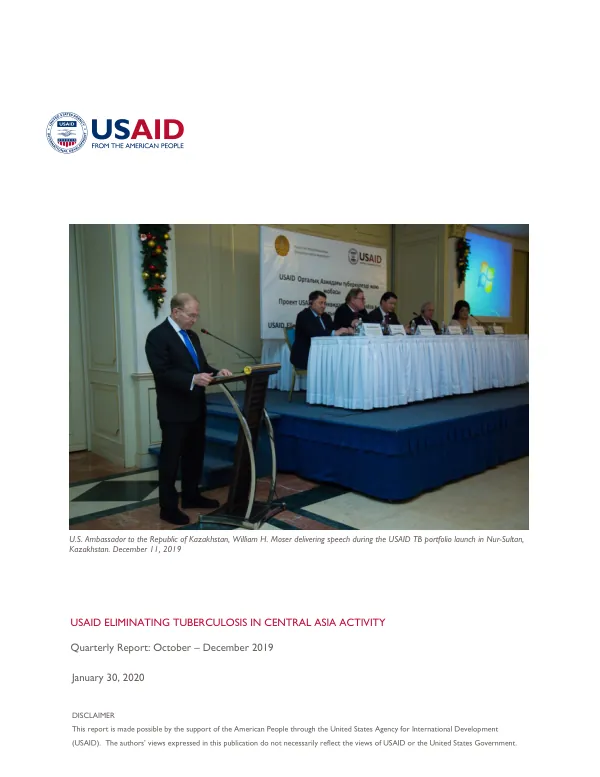
During the first quarter in operation, most project activities were concentrated in Dushanbe, Tajikistan, which is the regional center for the project. Top priority was given to the quick set-up of operations in Dushanbe to enable the project leadership to extend support for operations set-up in Uzbekistan and Kazakhstan. The opening of offices in these two countries was delayed until the next quarter due to reasons beyond the project's control. The project recruited and onboarded key staff, including the Chief of Party, Deputy Chief of Party, Finance Director, and Country Directors for Kazakhstan, Uzbekistan, and Tajikistan. Staffing for the Tajikistan office is almost complete, as is the hiring of regional advisors. Recruiting in Uzbekistan and Kazakhstan is ongoing, with advertising, review of candidate CVs, shortlisting, and interviewing. All but two positions in the two countries are expected to be filled in the second quarter. The project organized and held project launches in Tajikistan and Kazakhstan, which were honored by the attendance of dignitaries such as the Regional USAID Mission Director, US Ambassador to Kazakhstan, and Deputy Ministers of Health in Kazakhstan and Tajikistan, in addition to prominent representatives from the community of healthcare professionals in the two countries. In the first quarter, the project prepared and submitted to USAID its first year workplan, which was informed by a joint USAID ETICA and USAID planning meeting held in Dushanbe in early October 2019. The workplan was critically analyzed to identify and address areas of high priority and effective impact for tuberculosis control. USAID ETICA received USAID feedback on the first draft workplan and the project technical staff worked on revisions, with a focus on capturing and responding to the expectations of USAID and USAID ETICA's national partners. The project also prepared and submitted to USAID an Activity Monitoring, Evaluation, and Learning Plan (AMELP), which was informed by the guidance and expectations shared by USAID during the joint planning meeting in October. In addition, USAID ETICA prepared and submitted to USAID a Branding Implementation Plan, Marking Plan, and Environmental Mitigation and Monitoring Plan. Regional activities will be limited to interactions among the three main countries during project year one. Starting in year two, USAID ETICA will launch regional activities involving Turkmenistan and Kyrgyzstan. Except for the contract with IMLred, all other contracts with international and in-country subcontractors were executed and advances were provided where determined by the contracts. The signing of the contract with IMLred was delayed by a needed resolution on a VAT issue. The project's main objective is to contribute to the elimination of tuberculosis in Central Asia. The project will focus on improving the diagnosis and treatment of tuberculosis, as well as strengthening the capacity of healthcare systems in the region. The project will work closely with national partners, including the Ministries of Health, to achieve its objectives. In Tajikistan, the project has made significant progress in setting up operations, including the recruitment and onboarding of key staff. The project has also launched a number of activities, including the establishment of a project office and the development of a workplan. In Uzbekistan and Kazakhstan, the project is still in the process of setting up operations, including the recruitment and onboarding of key staff. The project's performance monitoring, evaluation, and learning plan (AMELP) will be used to track progress and identify areas for improvement. The plan includes a number of performance indicators, including the number of people diagnosed and treated for tuberculosis, as well as the number of healthcare workers trained in tuberculosis diagnosis and treatment. The project has faced a number of challenges, including delays in the opening of offices in Uzbekistan and Kazakhstan. However, the project is working to overcome these challenges and achieve its objectives. The project's national partners, including the Ministries of Health, are also working closely with the project to achieve its objectives. The project's budget for the first year is $X, which will be used to support a number of activities, including the establishment of project offices, the recruitment and onboarding of key staff, and the development of a workplan. The project will also receive funding from USAID to support its activities. The project's timeline for the first year includes a number of key milestones, including the establishment of project offices in Uzbekistan and Kazakhstan, the recruitment and onboarding of key staff, and the development of a workplan. The project will also launch a number of activities, including the establishment of a project office and the development of a workplan. The project's geographic focus is Central Asia, with a focus on Tajikistan, Uzbekistan, and Kazakhstan. The project will also work with national partners in Turkmenistan and Kyrgyzstan to achieve its objectives. The project's timeframes for the first year include the establishment of project offices in Uzbekistan and Kazakhstan, the recruitment and onboarding of key staff, and
Related documents
Documents in this collection
 2021
2021USAID DEC
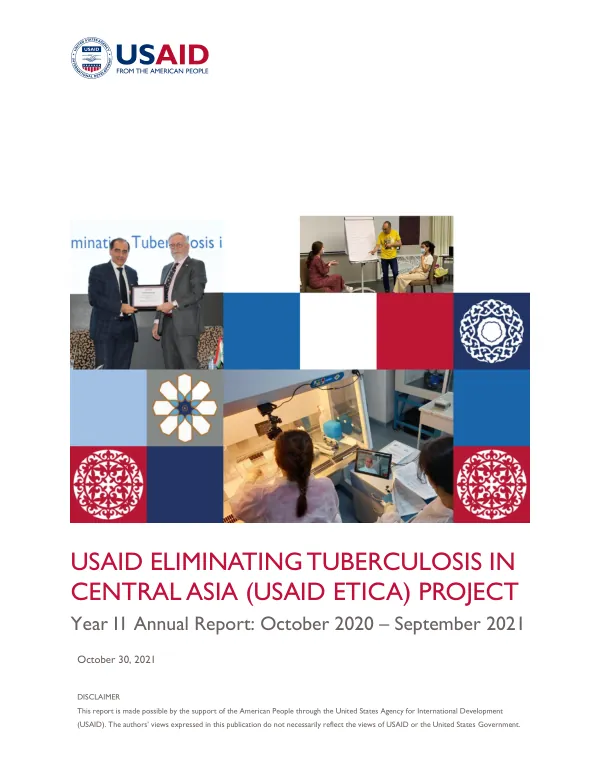
USAID ELIMINATING TUBERCULOSIS IN CENTRAL ASIA (USAID ETICA) PROJECT Year I1 Annual Report: October 2020 – September 2021
Open record 2019
2019USAID DEC