USAID DEC
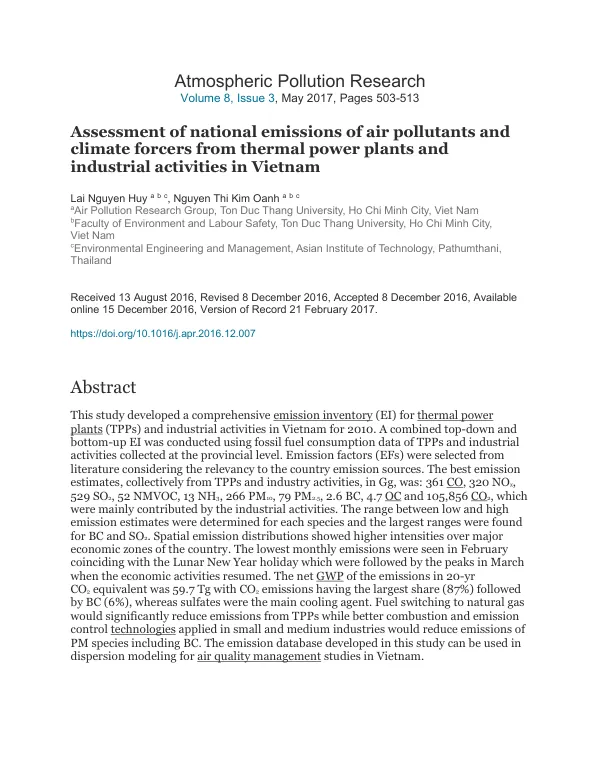
Assessment of national emissions of air pollutants and climate forcers from thermal power plants and industrial activities in Vietnam
Sign inUSAID DEC
Assessment of national emissions of air pollutants and climate forcers from thermal power plants and industrial activities in Vietnam
Thermal power plants and industrial activities in Vietnam are significant contributors to national emissions of air pollutants and climate forcers.
2017 · 1 pages
Sign in to readA free account is required to download.
Abstract
A comprehensive emission inventory was developed for 2010, combining top-down and bottom-up approaches using fossil fuel consumption data collected at the provincial level. Emission factors were selected from literature, considering relevance to country-specific emission sources. The best emission estimates for thermal power plants and industrial activities in 2010 were: 361 gigagrams (Gg) of carbon monoxide (CO), 320 Gg of nitrogen oxides (NOx), 529 Gg of sulfur dioxide (SO2), 52 Gg of non-methane volatile organic compounds (NMVOC), 13 Gg of ammonia (NH3), 266 Gg of particulate matter less than 10 micrometers in diameter (PM10), 79 Gg of PM2.5, 2.6 Gg of black carbon (BC), 4.7 Gg of organic carbon (OC), and 105,856 Gg of carbon dioxide (CO2). Industrial activities were the primary contributors to these emissions. Spatial emission distributions showed higher intensities over major economic zones in the country. Monthly emissions were lowest in February, coinciding with the Lunar New Year holiday, and peaked in March when economic activities resumed. The net global warming potential (GWP) of the emissions in 20-year CO2 equivalent was 59.7 teragrams, with CO2 emissions accounting for 87% of the total, followed by BC (6%). Sulfates were the primary cooling agent. Fuel switching to natural gas would significantly reduce emissions from thermal power plants, while improved combustion and emission control technologies applied in small and medium industries would reduce emissions of PM species, including BC. The emission database developed in this study can be used in dispersion modeling for air quality management studies in Vietnam.
Related documents
Documents in this collection
 2018
2018USAID DEC
Carbon Payment for Forest Environmental Services (C-PFES) A Feasibility Study Identifying Opportunities, Challenges, and Proposed Next Steps for Application in Vietnam
Open record 2023
2023USAID DEC