USAID DEC
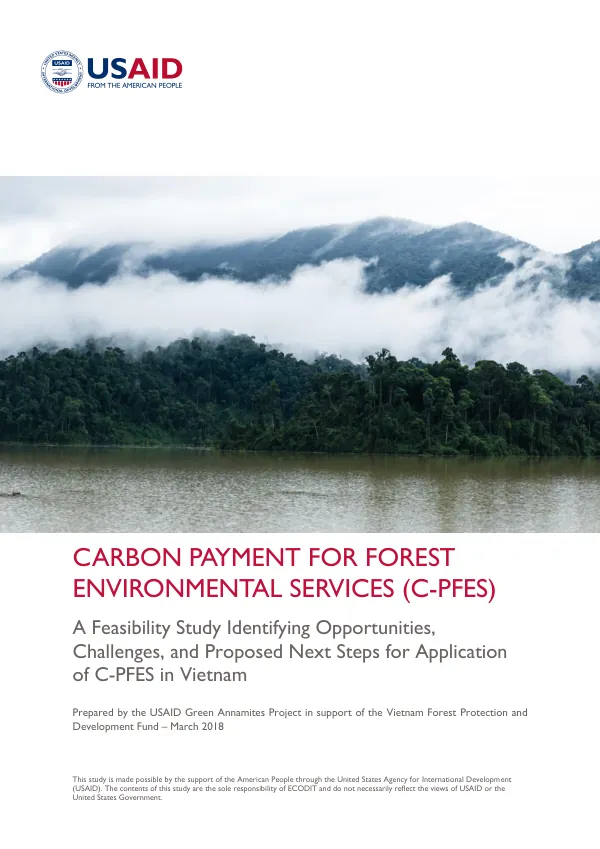
Carbon Payment for Forest Environmental Services (C-PFES) A Feasibility Study Identifying Opportunities, Challenges, and Proposed Next Steps for Application in Vietnam
Sign inECODIT, INC.
Carbon Payment for Forest Environmental Services (C-PFES) A Feasibility Study Identifying Opportunities, Challenges, and Proposed Next Steps for Application in Vietnam
The Vietnam Forest Protection and Development Fund (VNFF) initiated a collaborative effort with the United States Agency for International Development (USAID) in 2017 to assess the potential for Carbon-Payment for Forest Environmental Services (C-PFES).
2018 · 76 pages
Sign in to readA free account is required to download.
Abstract
This effort aimed to expand Vietnam's Payment for Environmental Services (PFES) program to include the service of sequestering and storing carbon dioxide (CO2) emissions in Vietnam's forest environments. The USAID Green Annamites Project, implemented by ECODIT, LLC, contracted a consultant team to produce a comprehensive feasibility study on the potential to expand Vietnam's PFES program to include C-PFES. The study involved a thorough assessment of the feasibility of institutionalizing different policy options for C-PFES and their implications for VNFF and provincial Forest Protection and Development Funds (FPDFs), as well as for prospective "payers" and different groups of forest and land owners that could benefit. The overall objective of the study is to provide policy recommendations to relevant governmental institutions for piloting and institutionalizing C-PFES. The study also aimed to determine if and how C-PFES could be piloted in Quang Nam and Thua Thien Hue provinces, the project area of USAID Green Annamites. This document provides perspectives and recommendations based on extensive consultations on the potential scenarios for C-PFES with key stakeholders and resource experts. The enabling national policy framework for C-PFES is crucial for its successful implementation. The study identified several key policy options, including the development of a national policy framework, the establishment of a C-PFES program, and the creation of a payment mechanism. The study also highlighted the importance of ensuring that C-PFES is coherent and complementary to other climate change mitigation policies and programs in Vietnam, notably the country's emerging carbon pricing initiatives. The study's findings and recommendations are based on a thorough analysis of the current policy and institutional framework for PFES in Vietnam, as well as an assessment of the potential benefits and challenges of implementing C-PFES. The study's conclusions and recommendations are intended to inform policy decisions and guide the implementation of C-PFES in Vietnam. The study's analysis of the current policy and institutional framework for PFES in Vietnam revealed several key challenges and opportunities. The study noted that Vietnam's PFES program has been successful in promoting sustainable forest management and reducing deforestation, but it also faces several challenges, including limited funding and inadequate institutional capacity. The study's assessment of the potential benefits and challenges of implementing C-PFES in Vietnam identified several key opportunities and challenges. The study noted that C-PFES has the potential to provide significant benefits for forest owners and communities, including increased income and improved livelihoods. However, the study also highlighted several challenges, including the need for a robust payment mechanism and the potential for leakage and perverse incentives. The study's recommendations for the implementation of C-PFES in Vietnam are based on a thorough analysis of the potential benefits and challenges of the program. The study recommends that the government of Vietnam establish a national policy framework for C-PFES, develop a payment mechanism, and establish a program to promote sustainable forest management and reduce deforestation. The study also recommends that the government of Vietnam provide support for the development of institutional capacity and the implementation of C-PFES at the provincial level.
Related documents