USAID DEC
Assessment of Open Aid Data in Honduras: Phase I and Phase II Findings
The Open Aid Data initiative in Honduras aimed to increase transparency, accountability, and coordination in development investments.
2018 · 19 pages
Sign in to readA free account is required to download.
Abstract
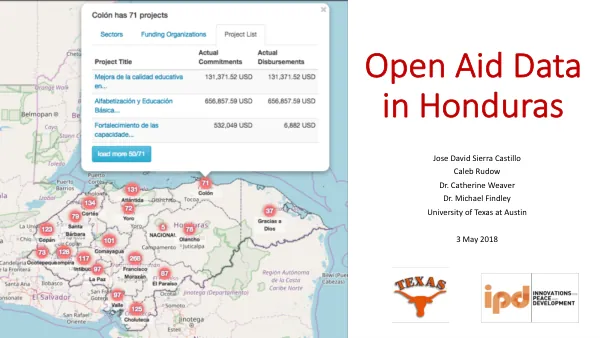
The project, led by researchers from the University of Texas at Austin, was conducted in two phases from 2016 to 2018. The primary objectives were to understand the data ecology around development investments in Honduras, assess the awareness and use of open aid data, and identify strategies to enhance awareness and use of open data among key decision-makers and stakeholders. The researchers conducted desk research on the data environment, actor landscape, history of aid, and the Aid Management Platform (PGC) in Honduras. They also conducted 69 key informant interviews with 91 individuals from government agencies, development partners, civil society organizations, national and international NGOs, academics, and think tank experts. The interviews aimed to gather information on the influence of key actors and organizations involved in decision-making, the use of data and evidence by decision-makers, and the barriers and incentives to using data. The Phase I findings revealed a lack of data-driven decision-making culture in Honduras, frequent transitions and restructuring of organizations, and low investment by the government in data collection and improving data systems and access. The data was found to be "siloed" and not shared, and there was a lack of capacity to use data, poor quality of data, and high dependence on donor funding for data collection and capacity building. The researchers also found that the Aid Management Platform (PGC) was overshadowed by SIAFI data as the primary source, despite the absence of key information and subnational, disaggregated data in SIAFI. The PGC was not mandated, and its reporting was voluntary for donors and NGOs. The platform lost political support when it moved from SEPLAN to SECRI under MoFR, and multiple reporting requirements muddled donor incentives. The Phase II objectives were to gather more comprehensive information on data awareness and use, understand the conditions under which open aid data from the PGC could be enhanced among key decision-makers and stakeholders, and conduct a lab-in-field experiment to test the effectiveness of information and training treatments in increasing awareness and use of PGC data. The researchers conducted a representative survey of over 500 decision-makers or stakeholders of aid data in the government, development partners, and civil society organizations. The survey aimed to gather information on the most frequently used sources of data, biggest issues with data, where donor information was found, what use was given to donor data, awareness of the PGC, issues with the PGC, and influence of the PGC. The baseline survey results showed that only 8% of respondents passed a test of basic statistical knowledge, validating the Phase I findings regarding low capacity for data analysis. Less than 10% of respondents had knowledge of the PGC, and of this 10%, half did not trust it due to outdated data and lack of information. Approximately 50% reported no interest in using information on aid projects in their own planning. The lab-in-field experiment aimed to test the effectiveness of information and training treatments in increasing awareness and use of PGC data. The researchers conducted a survey of over 500 respondents and randomly assigned them to one of three treatment groups: low information, medium information, and high information. The high information group received robust information on the PGC, including what kinds of output could be created with the online tool and instructions on how to use the platform. The training treatment consisted of a one-day workshop on how to use the PGC to analyze donor activities in the country. The workshop included hands-on exercises as a team and individually, and at the end of the workshop, subjects had created maps and answered policy questions with the PGC. The end-line survey results showed that the high information group had a higher awareness and use of PGC data compared to the low information and medium information groups. The results also showed that the training treatment had a significant effect on the awareness and use of PGC data, and that the high information group had a higher propensity to use PGC data in subsequent aid decision-making.