USAID DEC
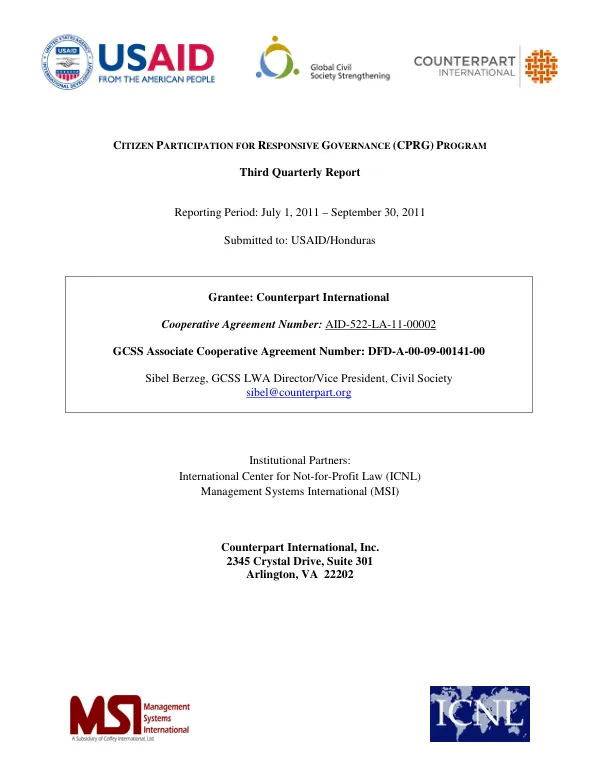
Third Quarterly Report: Citizen Participation for Responsive Governance (CPRG) Program
Sign inCOUNTER PART INTERNATIONAL
Third Quarterly Report: Citizen Participation for Responsive Governance (CPRG) Program
The Citizen Participation for Responsive Governance (CPRG) program is a five-year initiative funded by USAID and implemented by Counterpart International in partnership with the International Center for Not-for-Profit Law (ICNL) and Management Systems International (MSI).
2011 · 15 pages
Sign in to readA free account is required to download.
Abstract
The program, known locally in Honduras as Impactos, consists of two independent but intertwined components: the CPRG component, which aims to increase transparency and accountability of public institutions through support for civil society-led initiatives, and the Community Action for Prosperity (CAP) component, which aims to improve citizen and community safety by strengthening local communities' and governments' ability to prevent threats from gangs and narco-trafficking. The program goal is framed by five programmatic objectives: (1) Improved effectiveness of civil society to advocate for transparency and accountability of public institutions; (2) Improved capacity of public institutions to address gaps in the enabling environment for transparency and accountability; (3) To improve multi-sectoral capacity to provide coordinated and comprehensive responses to changing security needs; (4) To improve municipal capacity to provide effective crime prevention services; and (5) To expand opportunities for community-led initiatives. The Impactos approach consists of supporting Honduran civil society in a sustained effort to increase transparency and public accountability of public institutions, employing a non-partisan and non-confrontational approach toward engaging the national government, understanding and engaging existing transparency institutions, integrating public transparency and accountability activities into sector-specific development programming, and designing and disseminating targeted and transparent program grants. The program is now in its third quarter, and after completing initial start-up activities, has begun initiating important programmatic activities. The political context in Honduras is challenging, especially due to the 2009 coup, which resulted in a fracture in civil society organization across the country. However, the context presents new opportunities for program implementation, both for civil society and the public sector. The national government entity known as the Truth and Reconciliation Commission presented its final report in early July, detailing factual events of the 2009 political crisis and providing recommendations to avoid a repetition of future crises of this nature. The report affirms that former president Manuel Zelaya propitiated a political crisis that led to the ousting of his power, but that he was also a victim of a coup d'état of the Executive Branch. The 88 recommendations presented focus on the constitutional level, institutional, human rights, strengthening of the rule of law, political elections, media, international environment, and fighting corruption. The report was generally accepted by different sectors in Honduran society. As part of an effort to improve transparency and curb corruption, the Government of Honduras has initiated different actions, including the approval of the 2011-2014 Transparency and Anti-Corruption Plan, training of public officials on good practices of budget management, and promoting sectorial dialogues to discuss political, economic, and social changes demanded by different sectors of Honduran society. The country's traditional political parties have begun to mobilize their agendas, seeking unity within the parties prior to the planned 2012 primary elections. These primary elections present a challenge, as they are foreseen to be very complex and costly due to the diversity of new political parties and independent political movements that are arising. The Superior Electoral Tribunal (TSE) has presented to the National Congress a draft Law for Political and Electoral Participation, which seeks to replace the current Electoral and Political Organizations Law and establish the legal framework to improve citizen participation in election processes by creating more awareness and effectiveness for the benefit of the entire country. This law proposes to create a Citizen Training Institute that would promote civic culture and active and informed political participation with interaction between the government and civil society. The most recent political perception survey carried out by the Center for Democracy Studies (CESPAD) revealed that while there continues to be a sentiment of disenchantment with Honduran democracy, most people do not identify with right or left ideologies. In fact, the greater preference among citizens is to maintain a more centered position, and many citizens report that they are adverse to confrontations and believe strongly in negotiated solutions. There has also been a significant loss of trust in social and public institutions, a perception of deterioration of human rights, and a belief that during 2012 the level of social conflict may either be sustained or increased. During this third quarter, President Lobo posed a challenge to the private sector through the approval of a Security Tax Law, which aims to raise funds to fight crime and reduce violence in the country. Many citizens perceive that, similar to other public funds, these will also be used to finance political campaigns and to further enrich corrupt government officials.