FHI360
Snapshot of Migration Learning at USAID/Honduras
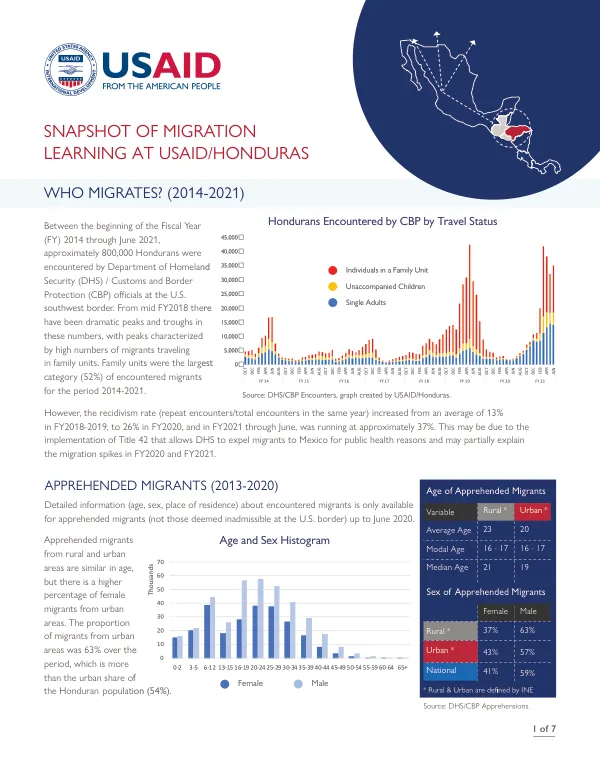
Approximately 800,000 Hondurans were encountered by Department of Homeland Security (DHS) / Customs and Border Protection (CBP) officials at the U.S.
2021 · 7 pages
Sign in to readA free account is required to download.
Abstract
southwest border between the beginning of the Fiscal Year (FY) 2014 through June 2021. Family units were the largest category (52%) of encountered migrants for the period 2014-2021. Apprehended migrants from rural and urban areas are similar in age, but there is a higher percentage of female migrants from urban areas. The proportion of migrants from urban areas was 63% over the period, which is more than the urban share of the Honduran population (54%). The recidivism rate (repeat encounters/total encounters in the same year) increased from an average of 13% in FY2018-2019, to 26% in FY2020, and in FY2021 through June, was running at approximately 37%. This may be due to the implementation of Title 42 that allows DHS to expel migrants to Mexico for public health reasons and may partially explain the migration spikes in FY2020 and FY2021. Women cite violence as their reason for migrating at almost twice the rate of men, and they made up the majority of Honduran asylum seekers in the U.S. Migration in Honduras is a national phenomenon, with encountered migrants coming from all municipalities. Returnees' residence municipalities closely correspond with those of encountered migrants, although the numbers are much lower. Both encountered migrants and returnees are reflected in the map below. Very few of the Honduran migrants returned by the U.S. between January 2016 and June 2020 were under the age of 18, accounting for only 2% of the returned migrants, even though they make up 21% of those apprehended in the period. The drivers of migration are multi-dimensional and depend on global, national, municipal, community, family, and individual factors. Migration patterns are similar across the Northern Triangle Countries. Within Honduras, municipal-level migration patterns mostly follow the national trends, suggesting that national and international factors affect municipal migration rates uniformly and are crucial drivers of migration patterns. Economic factors, including food insecurity, unemployment, and insufficient household income, are critical reasons for intending to migrate. In the NVSM 2021, respondents with intentions to migrate cited economic factors in 94% of cases. Those who are food insecure and unemployed are 376% more likely to intend to migrate than those who are food and income secure. Returned migrants are less likely to work in salaried sectors than the general population. For example, there are far more returned migrants in the construction sector, characterized by casual day labor, than in the more formal manufacturing sector, and there are more returned migrants working in agriculture than there is in the general population. Eighty-four percent of those who intend to migrate to the U.S. are willing to do so without documents or a visa. This is even higher among 18-30 year olds at 88%.