BANYAN GLOBAL
USAID/Honduras COVID-Specific Gender Analysis
The COVID-19 pandemic has had a significant impact on the labor market in Honduras, particularly for young people.
2021 · 50 pages
Sign in to readA free account is required to download.
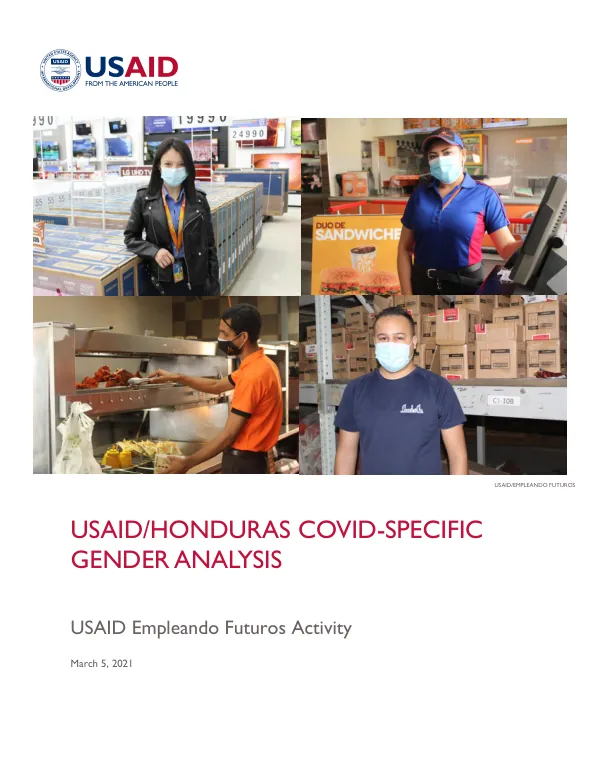
Abstract
As the pandemic continues, young people are experiencing increased feelings of sadness and anxiety, and their sense of well-being and mental health are deteriorating. This is affecting both male and female youth, with a greater impact on women and girls. The workloads of women, female youth, and girls have intensified with the lockdown, school closures, and reduced capability of hospitals and health centers to care for the sick. Before the pandemic, women spent nearly four times as much time on unpaid work within the home than men. Girls who are home from school are more likely than boys to do domestic work, including caring for younger siblings. As a result, they miss out on home-based learning. Women are also more likely to be encouraged or coerced to take leave from paid work to provide unpaid care and support homeschooling. Economic recovery will be likely slow and prolonged, and younger workers may be hired only after the recovery is well underway. Prolonged periods of inactivity increase risks of dangerous or precarious work and exclusion from labor markets—reducing levels of educational attainment and earnings and limiting employment and career options. Forms of discrimination in the labor market remain widespread and have become more accentuated due to the pandemic because of imbalances in supply and demand of workers, with increased unemployment and reduced demand for labor. Some employers discriminate against women and lesbian, gay, bisexual, transgender, and intersex (LGBTI) applicants, based on their appearance or the possibility of pregnancy and, in some cases, the belief that women are not capable of carrying out certain functions. Many employers require women to take pregnancy tests as a condition for applying for a job, and all applicants (male and female) must submit an approved, negative COVID-19 test, which is prohibitively expensive. The pandemic has accentuated already existing gender inequalities and harmful social norms that perpetuate occupational segmentation, limiting the scope of talent and career options, increasing wage gaps for equal work, which affects worker performance, and normalizing GBV, which threatens worker safety. To address these challenges, it is recommended that existing labor orientation services be continued, with mental health components to enable processing of experiences of trauma. Additionally, implementing partners should work to address forms of discrimination in the labor market, including requiring employers to provide equal opportunities for all applicants, regardless of their appearance, pregnancy status, or other factors. Furthermore, efforts should be made to promote women's economic empowerment and reduce occupational segmentation, which will help to increase wage gaps for equal work and promote worker safety. The Empleando Futuros Project, a short-term remote labor bridging pilot program, aims to better position project participants for economic reactivation and recovery through labor orientation, intermediation, and job placement for high school seniors who must choose a pathway into the workforce or continue their education. The project's key objectives include increasing the level of services provided for labor orientation, increasing job placement rates, and increasing return to education rates. The COVID-19 pandemic has had a significant impact on the labor market in Honduras, particularly for young people. The workloads of women, female youth, and girls have intensified with the lockdown, school closures, and reduced capability of hospitals and health centers to care for the sick. Economic recovery will be likely slow and prolonged, and younger workers may be hired only after the recovery is well underway. Forms of discrimination in the labor market remain widespread and have become more accentuated due to the pandemic because of imbalances in supply and demand of workers, with increased unemployment and reduced demand for labor. Some employers discriminate against women and LGBTI applicants, based on their appearance or the possibility of pregnancy and, in some cases, the belief that women are not capable of carrying out certain functions. To address these challenges, it is recommended that existing labor orientation services be continued, with mental health components to enable processing of experiences of trauma. Additionally, implementing partners should work to address forms of discrimination in the labor market, including requiring employers to provide equal opportunities for all applicants, regardless of their appearance, pregnancy status, or other factors.
Related documents