USAID DEC
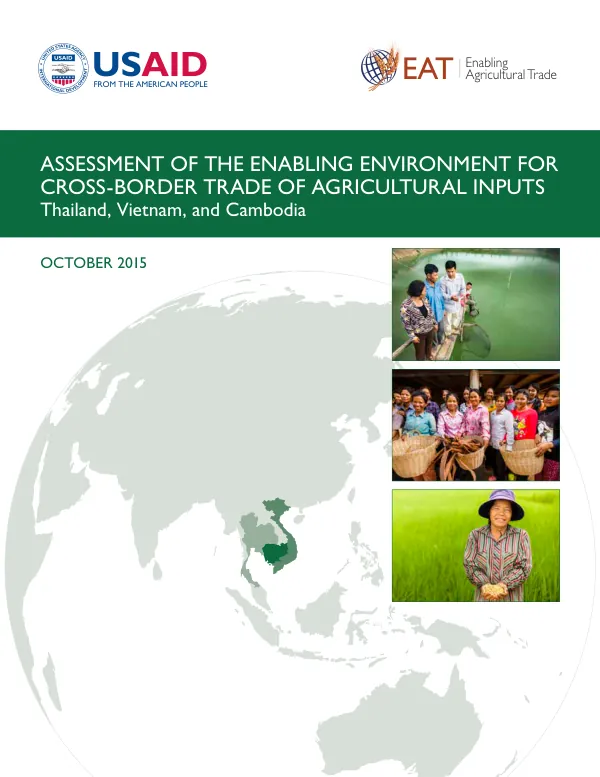
Assessment of the Enabling Environment for Cross-Border Trade of Agricultural Inputs
Sign inUSAID
Assessment of the Enabling Environment for Cross-Border Trade of Agricultural Inputs
The agricultural input trade in Thailand, Vietnam, and Cambodia is a complex process influenced by various factors, including administrative efficiency, transaction costs, and the strength of the legal and regulatory framework.
2015 · 43 pages
Sign in to readA free account is required to download.
Abstract
The assessment team employed a combination of research, surveys, and interviews to examine the country-level and regional issues affecting trade in these countries. Administrative efficiency varies significantly across inputs and countries. For instance, Vietnam has a streamlined and efficient system for obtaining licenses and permissions to operate as an importer or exporter, while Cambodia has the lowest official costs. In contrast, pesticide traders face higher time and financial burdens compared to traders of seed, fertilizer, or fish fry. The time required to prepare licenses and documents for importing a shipment of inputs differs across countries. Cambodia has the shortest average preparation time, while Vietnam has the longest. Additionally, Vietnam requires the highest number of documents for importation. Transaction costs, including time and money spent on setting up businesses, also vary across countries and inputs. Pesticide traders incur higher costs and time expenditures compared to traders of other agricultural inputs. The costs of importing a shipment of inputs are also influenced by the number of documents required, with Vietnam having the highest number of documents. The legal framework for obtaining licenses and permissions to operate as an importer or exporter diverges across countries. Vietnam has a more streamlined system, while Cambodia has the lowest official costs. The complexity of the trade-related activities measured in this study also varies across inputs and countries. The assessment team found considerable variation across inputs and countries with respect to the time needed, cost, and complexity of the trade-related activities measured in this study. Each of the three studied countries has strengths and weaknesses, with Vietnam having a more efficient system, Cambodia having lower official costs, and Thailand having a more complex trade process. The ASEAN Economic Community (AEC) aims to establish ASEAN as a single market and production base, making it more dynamic and competitive. The AEC will accelerate regional integration in priority sectors, facilitate the movement of business persons, skilled labor, and talents, and strengthen institutional mechanisms. The signing of the "Naypyidaw Declaration" in May 2014 recognized the importance of realizing these goals by 2015. The study's findings have implications for agriculture sector decision-makers, highlighting the need to address the prevailing constraints to trade, investment, and economic growth. The assessment team's research, surveys, and interviews provide valuable insights into the country-level and regional issues affecting trade in Thailand, Vietnam, and Cambodia.
Related documents