USAID DEC
Being LGBT in Asia: A Participatory Review and Analysis of the Legal and Social Environment for Lesbian, Gay, Bisexual and Transgender (LGBT) Persons and Civil Society
Sign inUNITED NATIONS ENVIRONMENTAL PROGRAMME , NAIROBI
Being LGBT in Asia: A Participatory Review and Analysis of the Legal and Social Environment for Lesbian, Gay, Bisexual and Transgender (LGBT) Persons and Civil Society
In Asia, the legal and social environment for lesbian, gay, bisexual, and transgender (LGBT) persons is a critical concern.
2013 · 2 pages
Sign in to readA free account is required to download.
Abstract
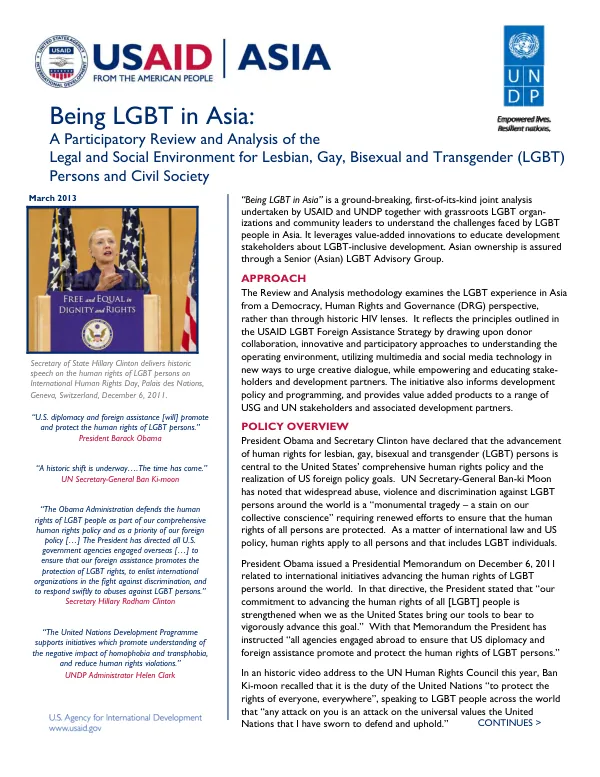
The United States and the United Nations have committed to promoting and protecting the human rights of LGBT persons. In 2011, President Barack Obama issued a Presidential Memorandum instructing all agencies engaged abroad to ensure that US diplomacy and foreign assistance promote and protect the human rights of LGBT persons. The "Being LGBT in Asia" initiative is a joint analysis undertaken by USAID and UNDP, in collaboration with grassroots LGBT organizations and community leaders. The review and analysis methodology examines the LGBT experience in Asia from a Democracy, Human Rights, and Governance (DRG) perspective. The initiative aims to build a knowledge baseline of the legal, social, political, and institutional environments in which LGBT rights advocates and organizations operate. The analysis covers six priority countries: China, Cambodia, Indonesia, the Philippines, Thailand, and Vietnam. In addition to these countries, the initiative draws on resources and experiences from East and Southeast Asia, including Burma/Myanmar, Chinese Taipei/Taiwan, the Hong Kong Special Administrative Region, Japan, the Republic of Korea, Malaysia, Singapore, Timor-Leste, regional civil society organizations, academic institutions, and private sector partners. The results of this initiative will educate USAID, UNDP staff, and development partners on critical rights issues facing LGBT people, inform decision-making, and lead to new programming and mainstreaming through existing programming. The initiative employs innovative learning processes and social and multi-media resources to improve understanding of LGBT issues and empower young LGBT leaders. The outcomes of this collaborative effort will inform RDMA and UNDP-APRC strategic approaches, result in value-added services and products for RDMA client Missions and Country Offices, and develop critical networks amongst USAID, UNDP, and other development partners' staff and country teams/offices. The initiative aims to advance the human rights of LGBT people and civil society through LGBT-inclusive development and targeted development programming for LGBT civil society.