USAID DEC
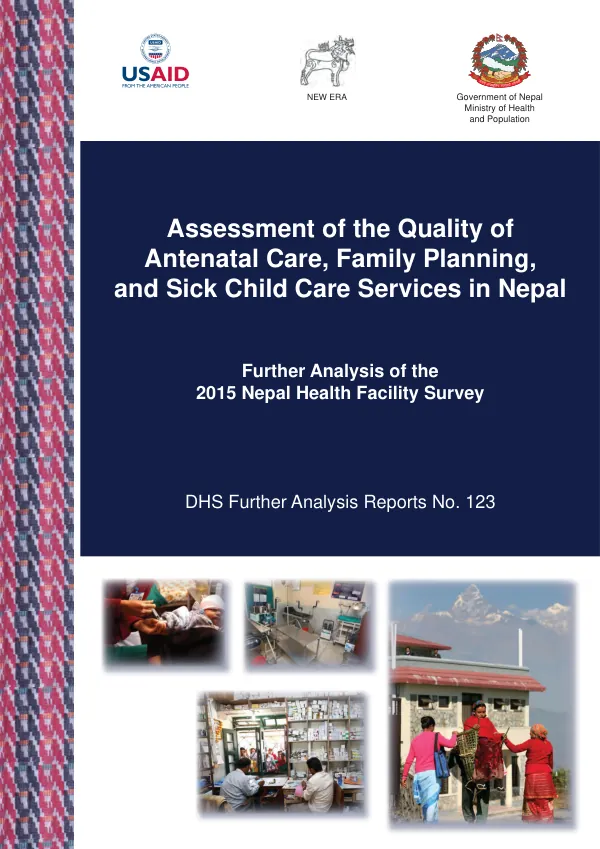
Assessment of the Quality of Antenatal Care, Family Planning, and Sick Child Care Services in Nepal: Further Analysis of the 2015 Nepal Health Facility Survey
Sign inICF
Assessment of the Quality of Antenatal Care, Family Planning, and Sick Child Care Services in Nepal: Further Analysis of the 2015 Nepal Health Facility Survey
The assessment of the quality of antenatal care, family planning, and sick child care services in Nepal was conducted as part of the further analysis of the 2015 Nepal Health Facility Survey.
2019 · 144 pages
Sign in to readA free account is required to download.
Abstract
The study aimed to evaluate the quality of care provided in these services, focusing on eight dimensions: effective, efficient, timely, client-centered, safe, reliable, appropriate, and equitable. Data for the analysis were obtained from the 2015 Nepal Health Facility Survey, which collected information from a representative sample of health facilities in Nepal. The survey measured the quality of care provided in antenatal care, family planning, and sick child care services using a set of indicators that assessed each dimension. The analysis revealed that the quality of antenatal care services in Nepal was generally low, with significant variations across different dimensions. The effectiveness of antenatal care services was found to be low, with only 22% of facilities providing all recommended antenatal care services. The efficiency of antenatal care services was also low, with long waiting times and high costs associated with the services. In contrast, the quality of family planning services in Nepal was found to be relatively high, with 85% of facilities providing all recommended family planning services. However, the efficiency of family planning services was found to be low, with long waiting times and high costs associated with the services. The quality of sick child care services in Nepal was found to be generally low, with significant variations across different dimensions. The effectiveness of sick child care services was found to be low, with only 30% of facilities providing all recommended sick child care services. The efficiency of sick child care services was also low, with long waiting times and high costs associated with the services. The analysis also found that there were significant disparities in the quality of care provided across different geographic regions and socioeconomic groups. The quality of care was found to be lower in rural areas and among disadvantaged socioeconomic groups. Based on the findings of the analysis, the authors recommend several improvements to the antenatal care, family planning, and sick child care services in Nepal. These recommendations include increasing the availability and accessibility of antenatal care services, improving the efficiency and effectiveness of family planning services, and strengthening the quality of sick child care services. The authors also recommend that the government of Nepal take steps to address the disparities in the quality of care provided across different geographic regions and socioeconomic groups. This can be achieved through targeted interventions and policies that aim to improve access to quality health care services for disadvantaged populations. Overall, the assessment of the quality of antenatal care, family planning, and sick child care services in Nepal highlights the need for significant improvements in the quality of care provided in these services. The recommendations made by the authors provide a roadmap for improving the quality of care and reducing disparities in access to health care services in Nepal. The study's findings have important implications for policymakers, program managers, and health care providers in Nepal. The results of the analysis can be used to inform the development of policies and programs aimed at improving the quality of care provided in antenatal care, family planning, and sick child care services. The study's methodology and results are presented in detail in the report, which includes a comprehensive analysis of the data and a discussion of the implications of the findings. The report also includes recommendations for improving the quality of care provided in antenatal care, family planning, and sick child care services in Nepal. The study's findings are based on a rigorous analysis of the data from the 2015 Nepal Health Facility Survey. The analysis was conducted using a set of indicators that assessed the quality of care provided in antenatal care, family planning, and sick child care services. The study's results are presented in a clear and concise manner, making it easy for readers to understand the findings and implications of the analysis. The report includes a comprehensive discussion of the methodology and results, as well as recommendations for improving the quality of care provided in antenatal care, family planning, and sick child care services in Nepal. The study's findings have important implications for the health care system in Nepal, and the recommendations made by the authors provide a roadmap for improving the quality of care and reducing disparities in access to health care services in Nepal.
Related documents
![Changes in Service Availability, Readiness, Process of Care, and Client Satisfaction with Family Planning Services: A Comparison between the 2015 and 2021 Nepal Health Facility Surveys (FA147) - Analysis Brief [AB41]](https://covers.devme.ai/gen/138852.webp)