USAID DEC
Technical Brief - Analysis of Barriers to Utilization of Maternal, Newborn, and Child Health and Family Planning Services in Karnali Province
Sign inABT ASSOCIATES
Technical Brief - Analysis of Barriers to Utilization of Maternal, Newborn, and Child Health and Family Planning Services in Karnali Province
The agricultural development initiative in Karnali Province, Nepal, began with a qualitative study to explore the social, cultural, economic, and equity-related factors influencing the utilization of maternal, newborn, and child health and family planning services.
2023 · 11 pages
Sign in to readA free account is required to download.
Abstract
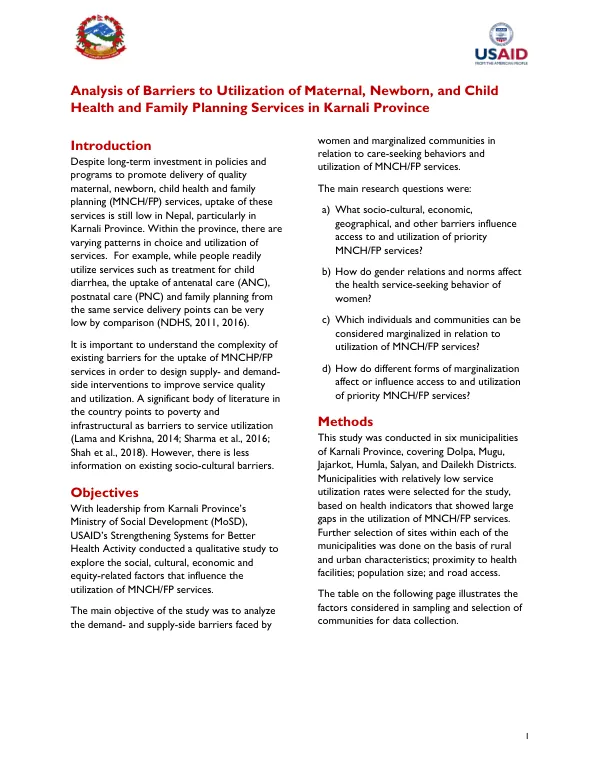
The study was conducted in six municipalities of Karnali Province, covering Dolpa, Mugu, Jajarkot, Humla, Salyan, and Dailekh Districts. Municipalities with relatively low service utilization rates were selected for the study, based on health indicators that showed large gaps in the utilization of MNCH/FP services. The study employed a qualitative approach, using key informant interviews and focus group discussions to collect data. Data collectors conducted interviews with different levels of health service providers and local political leaders, and organized focus groups with groups of users, non-users, husbands, and mothers-in-law. The researchers transcribed all recordings, translated the transcripts into English, and performed coding and analysis using MAXQDA software. The study found that barriers to the use of MNCH/FP services are largely related to physical accessibility, people's awareness of the importance of seeking timely services, perceptions of the quality of care and prior negative experiences from services utilized, and decision-making power of the concerned service-seekers within households. Geographic and transportation barriers were identified as a strong factor in relation to the use of MNCH/FP services. Pregnant women in remote communities may have to walk hours in difficult terrain to reach the nearest health facility, and women reported not regularly attending ANC check-ups after the initial appointment unless their health situation was critical. Economic barriers were also identified, with respondents reporting that they visit local public health facilities where services are largely provided for free, and thus lack of money did not emerge as an important barrier in the utilization of maternal health services. However, when critical illness required secondary or tertiary-level hospital care, financing this care became a challenge for many. Respondents reported greater willingness to pay for newborn- and child health-related services than for women's healthcare. Awareness-related barriers were also identified, with key informants sharing that there has been a tremendous improvement in people's awareness of the benefits of seeking timely and formal health services for newborns and children. However, there is still greater reluctance to seek out qualified care for maternal health issues. Some respondents reported seeking care from nearby health posts, hoping that this more formal care would help them recover quickly, while others stated that they would seek care initially from a shaman or traditional healer in their communities before going to the health post. The study found that older mothers were less knowledgeable regarding risks during pregnancy and delivery and tended to have strong negative attitudes towards health facilities and reluctance to seek care as a result. Women reported not going for their ANC check-ups consistently, except in a few instances where geographic access was not a significant barrier. Women reported seeking care when they experienced problems such as bleeding during pregnancy, pain or prolonged labor. The study's findings suggest that there is a need to improve the accessibility and quality of MNCH/FP services, particularly in rural and remote areas. The study recommends increasing the availability of transportation services, improving the quality of care, and increasing awareness of the importance of seeking timely and formal health services for maternal health issues. The study also recommends targeting older mothers and women with low knowledge and negative attitudes towards health facilities with specific interventions to improve their awareness and utilization of MNCH/FP services.
Related documents