USAID DEC
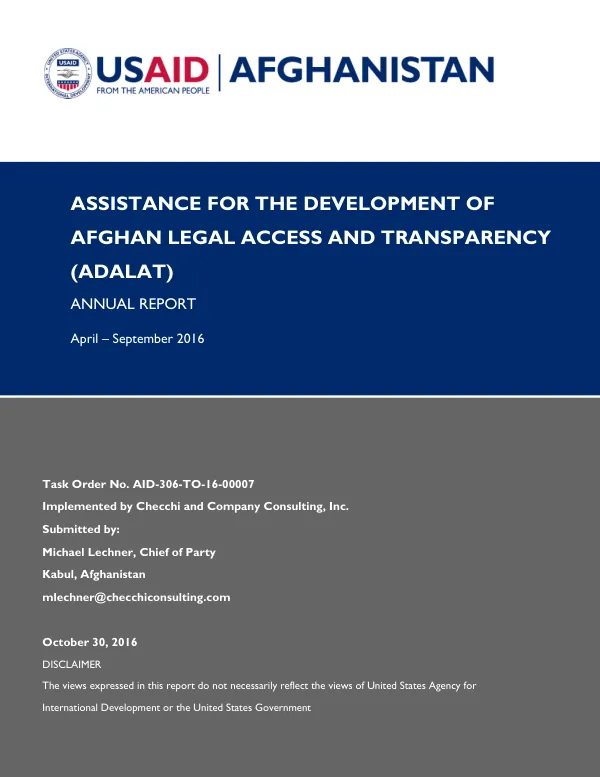
Assistance for the Development of Afghan Legal Access and Transparency (ADALAT) Annual Work Plan April 2016 – March 2017
Sign inCHECCHI AND COMPANY, CONSULTING, INC.
Assistance for the Development of Afghan Legal Access and Transparency (ADALAT) Annual Work Plan April 2016 – March 2017
The Afghan Legal Access and Transparency (ADALAT) project aims to increase formal justice sector effectiveness, strengthen formal-traditional justice sector linkages, and increase citizen demand for quality legal services.
2016 · 73 pages
Sign in to readA free account is required to download.
Abstract
ADALAT's approach is built on the concept of sustainable solutions, focusing on data-driven decision-making and capacity building for Afghan counterparts. To achieve its objectives, ADALAT will support judicial education in Year One by observing and evaluating the judicial Stage, a post-graduate, mandatory legal training program. The project will work closely with the Supreme Court and the Judicial Education Department to assess training needs, with a focus on civil law matters. ADALAT will also support regional judicial conferences and review the judicial conduct regulation in Afghanistan and other countries in the region. ADALAT will conduct Human Institutional Capacity Development (HICD) assessments for the Human Resources and Finance and Administration Departments of the Supreme Court and the Afghan Independent Bar Association. The assessments will determine what support ADALAT will offer to courts in future years, including a strategic plan for non-judicial staff. ADALAT will also carry out a detailed court level assessment of the caseload data captured by the Afghanistan Court Administration System and deliver refresher trainings on ACAS along with supplies. In addition, ADALAT will strengthen formal-traditional justice sector linkages by conducting an HICD assessment of the Huquq Department of the Ministry of Justice. The assessment will provide critical detail on the Department's functioning, training, and staffing needs. ADALAT will encourage recruitment of female Huquq staff and design a comprehensive training program for newly hired and experienced officers. The Huquq Stage will include modules on women's rights, with a particular focus on civil disputes such as divorce and property rights. To promote traditional dispute resolution (TDR) compliance with Afghan law, ADALAT grantee The Liaison Organization (TLO) will provide training to the Huquq Department on TDR recording requirements in the draft Jirga/Conciliation Law. ADALAT will also review Huquq case management practices and GIZ's ACAS-derived pilot system to recommend adjustments to ensure harmonization between court and Huquq case management. ADALAT's approach to gender integration is built on the concept of sustainable solutions, focusing on data-driven decision-making and capacity building for Afghan counterparts. The ADALAT Gender Specialist will ensure gender balance in hiring, including in senior positions, and all project staff will receive gender training and support a gender-friendly work environment. ADALAT will also conduct a gender analysis to identify areas where women's rights are marginalized by tradition and develop recommendations for increasing the number of women entering the legal profession.
Related documents