USAID. BUR. FOR AFRICA. OFC. OF REGIONAL AFFAIRS
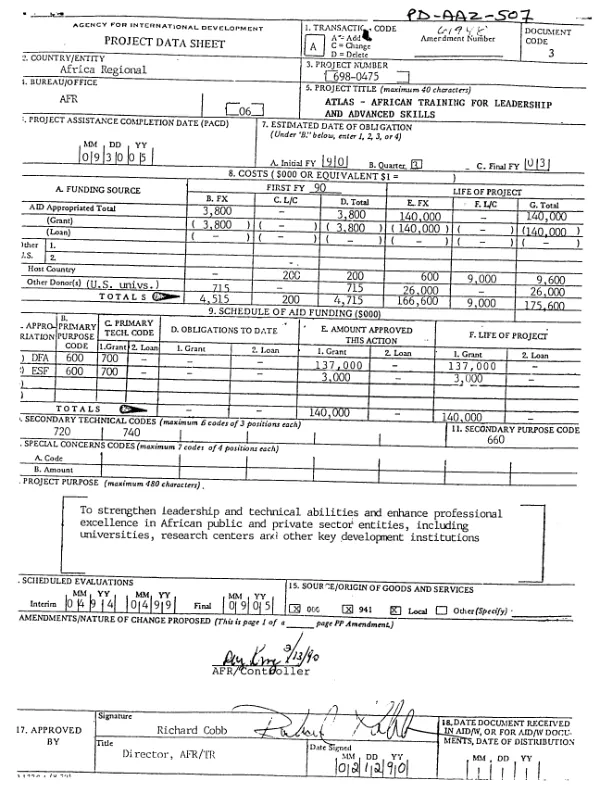
ATLAS - African training for leadership and advanced skills
Project, follow-on to project 6980455 under the African Graduate Fellowship (AFGRAD) Program, to provide professional and technical training to African public and private sector personnel.
1990
Sign in to readA free account is required to download.
Abstract
The project will support: (1) U.S. scholarships, (2) a post-training program, and (3) a training impact study. The project will finance U.S. training for 1,500 African students at three academic levels, including: (1) Ph.D. degrees for 250 high-level personnel who require advanced academic, analytical, or technical skills, e.g., teaching faculty at universities, staff of national and regional research institutions, and senior members of planning agencies; (2) Masters degrees for 1,000 participants; and (3) Bachelors degrees for 250 students (100 persons from countries with no national universities and 150 women studying in traditionally male-dominated fields such as engineering). Overall, at least 30% of the participants are expected to be women. The post-training component will enhance the performance of returned participants and help establish or strengthen networks among African professionals. Short-term non-degree study will be available to some 350 persons with Masters or Ph.D. degrees who are fluent in English and who have made contributions to their country"s development for at least 4 years. Approximately 40 support grants will be given to national and regional professional organizations in Africa (including women"s groups) for activities which promote networking and direct attention to development concerns (e.g., conferences, publications, and TA). Additional post-training activities will include: semi-annual national and regional symposia for 30 participants per session; dissemination of an alumni directory and other informative materials to graduates and interested institutions; modest cash awards to alumni who are making significant contributions to their country"s development; and enrollment of each returning graduate in an appropriate U.S. professional society (including a three-year subscription to the society"s journal). Finally, the training impact study component will assess the long-term effectiveness of A.I.D. sponsored U.S. academic training. All U.S. participant training programs will be in the scope of the study, including this project and other AFGRAD programs. The project differs from the AFGRAD III project in two key areas. (1) All training is now paid through bilateral funds only; no more regionally funded scholarships are provided. (2) Follow-up activities for returning participants are much more comprehensive than before.
Related documents
![CLASP II [Caribbean and Latin American scholarship program]](https://covers.devme.ai/gen/33211.webp)