USAID DEC
Beginnings of a Grain Revolution – A Senegalese success story of an EAS private-public partnership in cereal value chain development
Sign inMICHIGAN STATE UNIVERSITY FOUNDATION
Beginnings of a Grain Revolution – A Senegalese success story of an EAS private-public partnership in cereal value chain development
The agricultural development initiative in Senegal focused on cereal value-chain development, with a particular emphasis on millet production.
2012 · 8 pages
Sign in to readA free account is required to download.
Abstract
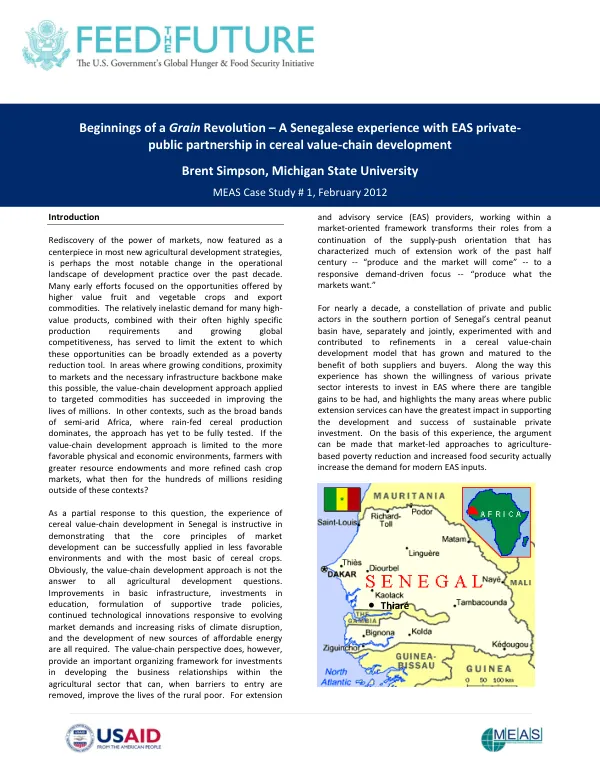
The experience of the Thiaré community in the Kaolack region demonstrated the potential for market-led approaches to improve the lives of rural farmers. Local women entrepreneurs, such as Madame Coulibaly, owner-operator of La Vivriere, a Dakar-based processor, played a crucial role in establishing independent, reliable sources of quality millet for their milling operations. Madame Coulibaly initially approached the Thiaré community with a request for access to land where she could contract local labor to produce millet under her specifications. Although the community denied her request for land, they expressed interest in supplying her with millet. In response, Madame Coulibaly agreed to supply a group of 13 farmers with 20 MT of fertilizer to cultivate 130 hectares of millet, with the cost of the fertilizer loan to be repaid in cereal at harvest. The farmers formed a groupement d'intérêt économique (GIE) to consolidate their efforts and coordinate their new business venture. The experience of the Thiaré GIE showed that market-led approaches can improve the lives of rural farmers. The farmers repaid Madame Coulibaly 100 percent for the loan, and the following year, 40 MT of fertilizer were supplied on similar terms of credit, supporting the involvement of 25 farmers. However, rainfall during the 2002 growing season was reportedly poor, leading to low yields and higher market prices. As a result, the farmers and/or the intermediary through whom they worked failed to supply Madame Coulibaly with sufficient grain to reimburse her for the loan of fertilizer. The experience of the Thiaré community highlights the importance of partnerships between private and public sector actors in agricultural development. The national extension agency, Agence Nationale de Conseil Agricole et Rural (ANCAR), played a crucial role in assisting Madame Coulibaly in establishing a contract with the Thiaré GIE. ANCAR field agents also provided crop monitoring and advisory services to the Thiaré farmers, which helped to improve the quality of the millet produced. The participating processors, such as the ATCL members, took a great deal of comfort in the fact that ANCAR field agents were involved to ensure that "things were done correctly." They also appreciated the fact that ANCAR field agents collected local market information upon which price premiums were based. The processors' primary challenge was sourcing a sufficient quantity of quality grain, which contained on average 15 percent "impurities." The Thiaré Union was the only farmers' group from which the ATCL members purchased grain, and they consistently provided high-quality grain at an acceptable price. The experience of the Thiaré community demonstrates that market-led approaches can improve the lives of rural farmers in Senegal. The initiative showed that private sector interests are willing to invest in extension services where there are tangible gains to be had, and highlights the many areas where public extension services can have the greatest impact in supporting the development and success of sustainable private investment.