WORLD WILDLIFE FUND INTERNATIONAL
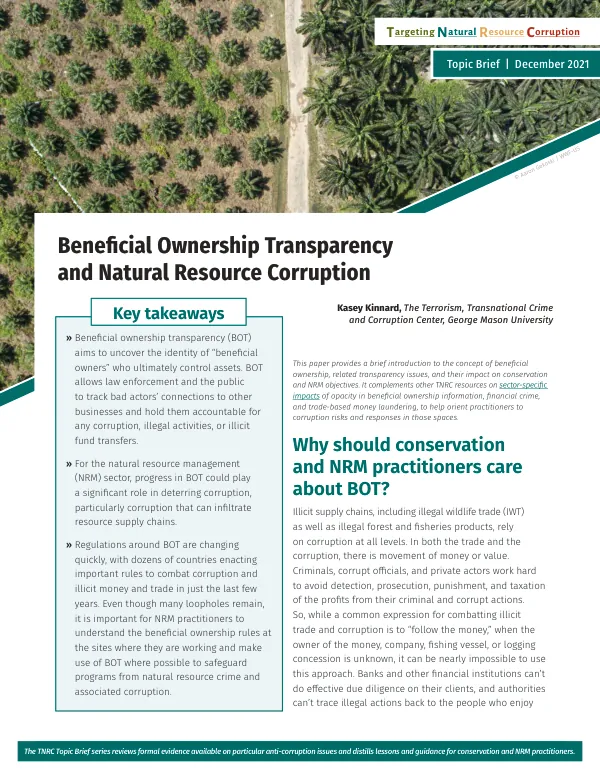
Beneficial Ownership Transparency and Natural Resource Corruption
Beneficial ownership transparency is a critical concept in the fight against corruption and illicit activities in the natural resource management (NRM) sector.
2021 · 6 pages
Sign in to readA free account is required to download.
Abstract
The concept refers to the availability of information about who ultimately owns or controls a company or entity, allowing law enforcement and the public to track bad actors' connections to other businesses and hold them accountable for any corruption, illegal activities, or illicit fund transfers. The Financial Action Task Force (FATF) defines a beneficial owner as the natural person(s) who ultimately own(s) or control(s) a customer and/or the natural person on whose behalf a transaction is being conducted. This definition includes those persons who exercise ultimate effective control over a legal person or arrangement. In simpler terms, a beneficial owner of a company or entity is the human person who ultimately controls the decisions of the company and/or benefits from its success. Beneficial ownership transparency is essential in the NRM sector because it can help deter corruption, particularly corruption that can infiltrate resource supply chains. Regulations around beneficial ownership transparency are changing quickly, with dozens of countries enacting important rules to combat corruption and illicit money and trade in just the last few years. Even though many loopholes remain, it is crucial for NRM practitioners to understand the beneficial ownership rules at the sites where they are working and make use of beneficial ownership transparency where possible to safeguard programs from natural resource crime and associated corruption. There are many methods to obscure the true ownership of a company, including using a shell company, listing a proxy as owner, or splitting ownership among multiple people, companies, or jurisdictions. These methods can make it complicated to determine the beneficial owner(s) of any company, even though they are often legal. For example, a shell company is an incorporated company that does not have significant operations, assets, business activities, or employees, but it can provide an air of legitimacy and shield the identity of the beneficial owner. The use of shell companies and other complex corporate structures has been linked to various illicit activities, including wildlife trafficking, fisheries crime, and land grabbing. In one notable case, a Chinese company and a company in East Timor were used to conceal payments and launder the proceeds of illicit activities in the fisheries sector. Similarly, in another case, political elites created shell companies to sell themselves enormous tracts of land at a fraction of market value, with the real payments taking place offshore in financial secrecy jurisdictions. The lack of beneficial ownership transparency has significant consequences, including the inability to track illicit funds and hold individuals accountable for their actions. In the NRM sector, this can lead to the continued exploitation of natural resources and species, perpetuating corruption and undermining efforts to conserve and manage natural resources sustainably. Therefore, it is essential for NRM practitioners to understand the importance of beneficial ownership transparency and to advocate for stronger regulations and greater transparency in this area.