INTER-AMERICAN DEVELOPMENT BANK
Benefits of Customs Reform: The Evidence from Albania
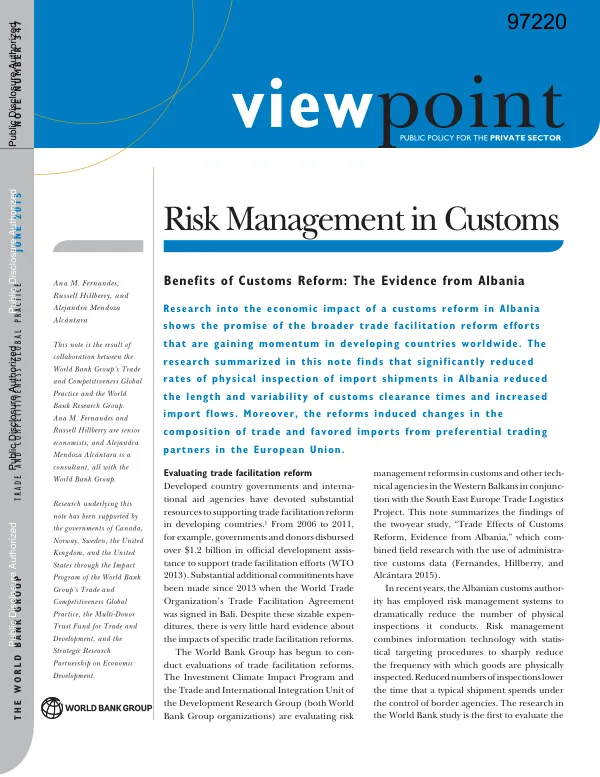
The Albanian customs authority has implemented a risk management system to reduce the number of physical inspections it conducts.
2015 · 4 pages
Sign in to readA free account is required to download.
Abstract
This system combines information technology with statistical targeting procedures to sharply reduce the frequency with which goods are physically inspected. As a result, the time that a typical shipment spends under the control of border agencies has decreased. The World Bank study, "Trade Effects of Customs Reform, Evidence from Albania," evaluated the impacts of the substantial reduction in physical inspections by the Albanian customs authorities on time spent in customs and on import activity. The study used administrative data tracking individual import transactions for the period of 2007 to 2012. This highly disaggregated data included a numeric identifier for each importing firm, a product code, the exporting country, the inspection type, the date of submission of administrative documents, the date of release of goods from customs, import value and weight, and penalties paid for customs infractions. The methodology used for the analysis was developed by economists Christian Volpe Martincus and Alejandro Graziano of the Inter-American Development Bank, and Jerónimo Carballo of the University of Maryland. The methodology allows the effects of reduced inspections on customs clearance time to be isolated from other effects on clearance time and trade patterns. The analysis estimated causal impacts of reduced clearance times on import levels and on the composition of imports. The key message is that Albania customs reform had statistically significant short-term positive effects on imports. The inferred cost savings to the private sector were modest but real. The median number of days a shipment was expected to spend in Albanian customs fell by 7 percent when the probability it would be inspected dropped below 50 percent. This was the case for about 21 percent of the shipments in the sample during the period 2007 to 2012. A 7-percent reduction in median days in customs generated a 7-percent increase in the value of annual imports by a particular firm of a particular product from a particular source country. This estimate of the causal relationship between time in customs and imports gives a sense of the order of magnitude that can be attributed to this type of reform even though the ratio would not always be one-to-one as it was here. The reduction of inspections had an impact on import value that was roughly equivalent to an across-the-board tariff reduction of approximately 0.36 percentage points, the study estimates. The implied cost savings are much larger than for a tariff cut of that size. The estimate suggests that the reforms saved the private sector approximately $12 million in 2012 in reduced trade costs. The decline in customs clearance time related to improved inspections practices led to stronger growth in imports from high-income countries and from preferential trading partners, especially EU members, primarily because imports from the EU were more sensitive to time savings than imports from other high-income countries. Separate results for 2007-09 and 2010-12 indicate that the sensitivity of customs clearance time to inspections falls over time, while sensitivity of imports to customs clearance time rises. The first finding suggests that as reforms proceeded, the time required to process goods subject to random inspection fell. The second finding may indicate that firms rearranged their supply chains in a manner that made their imports more time-sensitive, as the firms came to understand that the probability of a delay in customs had fallen substantially. The reforms increased the quantity of imports and average unit prices, as well as the number of shipments per year. The increase in average unit prices likely reflects increases in the quality of goods imported into Albania. There is evidence of reform-induced growth along extensive margins of trade, defined as the number of importing firms (per product-country pair) and the number of source countries (per firm-product pair).