USAID DEC
Budget Reallocation Provides Access to Food Aid in Times of Crisis - Success Story
Budget Reallocation Provides Access to Food Aid in Times of Crisis USAID engages at the local level to strengthen communities and build resiliency.
2020 · 1 pages
Sign in to readA free account is required to download.
Abstract
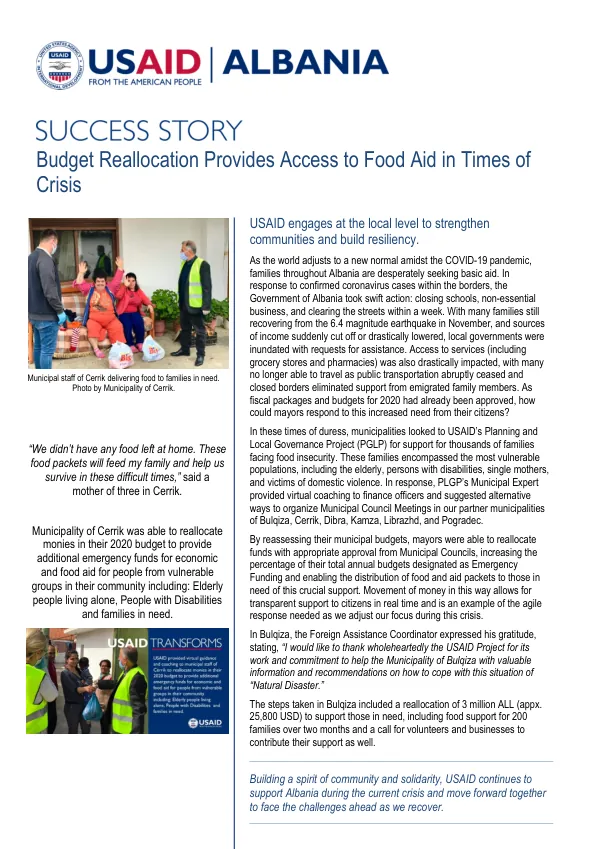
In response to confirmed coronavirus cases within Albania's borders, the Government of Albania took swift action, closing schools, non-essential businesses, and clearing the streets within a week. With many families still recovering from the 6.4 magnitude earthquake in November, and sources of income suddenly cut off or drastically lowered, local governments were inundated with requests for assistance. Access to services, including grocery stores and pharmacies, was also drastically impacted, with many no longer able to travel as public transportation abruptly ceased and closed borders eliminated support from emigrated family members. In these times of duress, municipalities looked to USAID's Planning and Local Governance Project (PGLP) for support for thousands of families facing food insecurity. These families encompassed the most vulnerable populations, including the elderly, persons with disabilities, single mothers, and victims of domestic violence. In response, PLGP's Municipal Expert provided virtual coaching to finance officers and suggested alternative ways to organize Municipal Council Meetings in partner municipalities of Bulqiza, Cerrik, Dibra, Kamza, Librazhd, and Pogradec. By reassessing their municipal budgets, mayors were able to reallocate funds with appropriate approval from Municipal Councils, increasing the percentage of their total annual budgets designated as Emergency Funding. The steps taken in Bulqiza included a reallocation of 3 million ALL (approximately 25,800 USD) to support those in need, including food support for 200 families over two months and a call for volunteers and businesses to contribute their support as well. In Cerrik, the municipality was able to reallocate monies in their 2020 budget to provide additional emergency funds for economic and food aid for people from vulnerable groups in their community, including elderly people living alone, people with disabilities, and families in need. The distribution of food and aid packets to those in need of this crucial support was made possible through the movement of money in a transparent and timely manner. The efforts of USAID and the municipalities have been met with gratitude from the affected communities. In Bulqiza, the Foreign Assistance Coordinator expressed his appreciation for the USAID Project's work and commitment to help the Municipality of Bulqiza cope with the situation. The reallocation of funds has enabled the distribution of food support to families in need, as exemplified by a mother of three in Cerrik, who stated, "We didn't have any food left at home. These food packets will feed my family and help us survive in these difficult times."