CHEMONICS
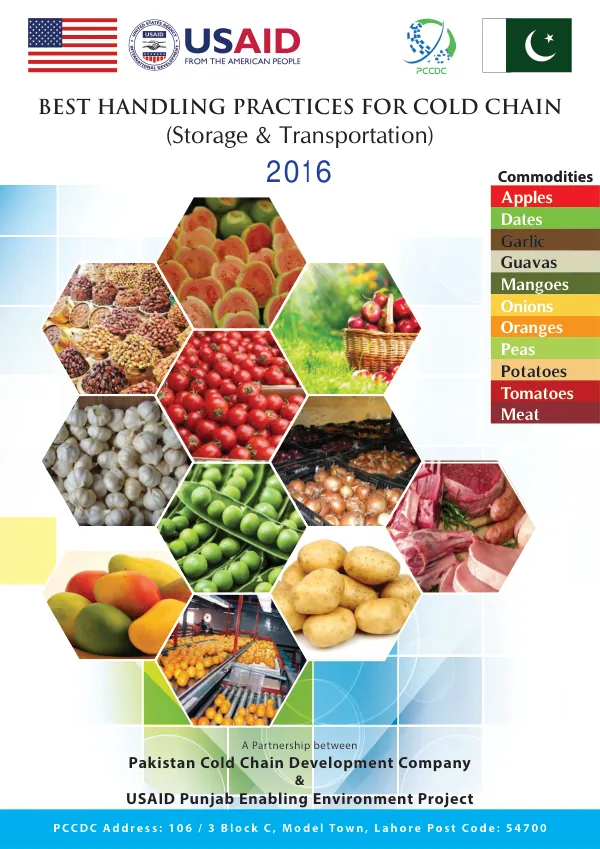
Best Handling Practices for Cold Chain (Storage & Transportation)
Apples are a highly perishable commodity, requiring careful handling to maintain quality and prevent losses.
2016 · 162 pages
Sign in to readA free account is required to download.
Abstract
Post-harvest handling practices are crucial to ensure the apples remain fresh for a longer period. The recommended temperature for storing apples is between 32°F to 40°F (0°C to 4°C), with relative humidity ranging from 80% to 90%. Apples should be stored in a well-ventilated area to prevent moisture buildup and prevent the buildup of ethylene gas, which can cause ripening. Proper cooling techniques are essential to prevent spoilage and maintain quality. Forced air cooling is a widely used method, where cold air is blown over the apples to lower their temperature. Hydro cooling involves spraying cold water over the apples to rapidly lower the temperature. Room pre-cooling is another method, where apples are cooled in a room with a controlled temperature. Storage conditions play a significant role in maintaining the quality of apples. The ideal storage duration for apples is between 6 to 12 months, depending on the variety. Preventing decay is crucial, and this can be achieved by maintaining the optimal temperature and humidity levels. Apples should be stored in a way that allows for air circulation to prevent moisture buildup. Transportation of apples requires careful planning to prevent damage and maintain quality. The desired transit temperature for apples is between 32°F to 40°F (0°C to 4°C), with relative humidity ranging from 80% to 90%. Apples should be transported in a way that prevents mechanical influences, such as vibration and impact. Risk factors and prevention measures are essential to prevent losses during transportation. Humidity and moisture buildup can cause spoilage, and ventilation is crucial to prevent this. Biotic activity, such as insect infestation, can also cause damage to apples. Self-heating and spontaneous combustion can occur if apples are not stored properly, and odor can be a significant issue if apples are not handled correctly. Transportation to the market requires careful planning to ensure that apples are delivered in good condition. The transportation process should be designed to prevent mechanical influences, such as vibration and impact, and to maintain the optimal temperature and humidity levels. Apples should be transported in a way that prevents contamination and maintains their quality. The recommended temperature for storing apples is between 32°F to 40°F (0°C to 4°C), with relative humidity ranging from 80% to 90%. Apples should be stored in a well-ventilated area to prevent moisture buildup and prevent the buildup of ethylene gas, which can cause ripening. Proper cooling techniques, such as forced air cooling, hydro cooling, and room pre-cooling, are essential to prevent spoilage and maintain quality. Dates are a highly perishable commodity, requiring careful handling to maintain quality and prevent losses. Post-harvest handling practices are crucial to ensure the dates remain fresh for a longer period. The recommended temperature for storing dates is between 32°F to 40°F (0°C to 4°C), with relative humidity ranging from 80% to 90%. Dates should be stored in a well-ventilated area to prevent moisture buildup and prevent the buildup of ethylene gas, which can cause ripening. Transportation of dates requires careful planning to prevent damage and maintain quality. The desired transit temperature for dates is between 32°F to 40°F (0°C to 4°C), with relative humidity ranging from 80% to 90%. Dates should be transported in a way that prevents mechanical influences, such as vibration and impact. Garlic is a highly perishable commodity, requiring careful handling to maintain quality and prevent losses. Post-harvest handling practices are crucial to ensure the
Related documents