USAID DEC
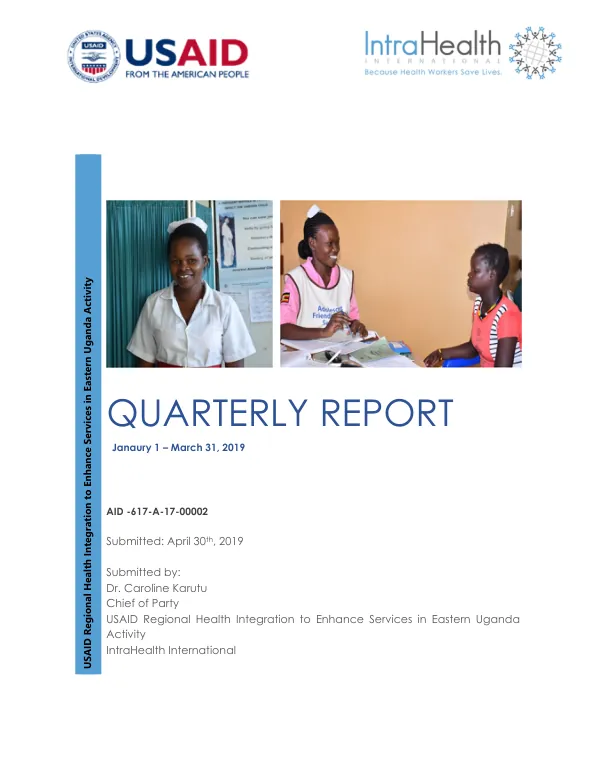
Quarterly Report: USAID Regional Health Integration to Enhance Services in Eastern Uganda Activity
Sign inINTRAHEALTH
Quarterly Report: USAID Regional Health Integration to Enhance Services in Eastern Uganda Activity
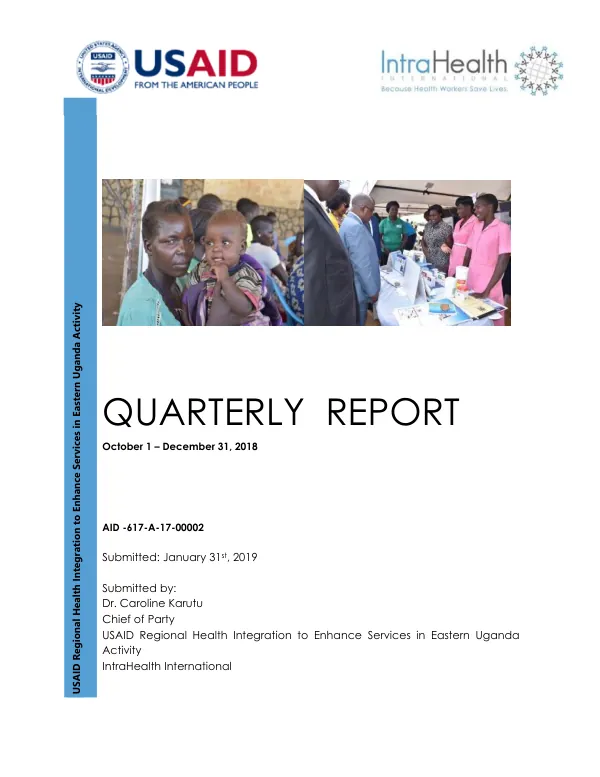
The USAID Regional Health Integration to Enhance Services in Eastern Uganda Activity is a health program implemented in Eastern Uganda, with the goal of improving the availability and quality of health services.
2019 · 78 pages
Sign in to readA free account is required to download.
Abstract
The program is led by IntraHealth International and is funded by the United States Agency for International Development (USAID). The program focuses on five key outcomes: increased availability and access to health services, improved quality of health services, increased availability of resources for public sector health services, improved organization and management of health service delivery, and increased adoption of healthy behaviors and positive child development practices by households and communities. One of the key areas of focus for the program is family planning (FP). According to data from the program, the number of new FP users and revisits increased from FY18 Q4 to FY19 Q1. The program also reported a quarterly comparison of new FP users by age group and method type, showing a trend of increased uptake of LARCS FP methods. Additionally, the program reported a significant increase in contraceptives use by age group in 24 mentored sites. The program also focuses on maternal and child health services, with a goal of improving access to these services. The program reported a quarterly trend comparison of MCH indicator cascade, showing an improvement in access to maternal and child health services. Additionally, the program reported a significant increase in DPT3 coverage and access to nutrition assessment using MUAC at facilities. In terms of HIV and AIDS, the program reported a significant increase in HIV testing services, with a cascade of 11,111 individuals tested, 3,111 of whom were newly diagnosed with HIV. The program also reported a significant increase in ART initiation against target, with 2,111 individuals initiated on ART. Additionally, the program reported a significant increase in viral load suppression, with 1,909 patients achieving viral load suppression. The program also focuses on tuberculosis (TB) and TB-HIV co-infection, with a goal of improving access to TB diagnosis and treatment. The program reported a significant increase in TB case notification trend in NTLP Mbale and Karamoja regions. Additionally, the program reported a significant increase in Gene Xpert utilization among identified presumptive TB cases. In terms of implementation, the program worked with 24 mentored sites across 14 districts, providing training and support to health workers. The program also established a functional Integrated Human Resource Information System (IHRIS) to track health worker data. Additionally, the program implemented a rolling out of sexual harassment response mechanisms to improve the work climate. Overall, the USAID Regional Health Integration to Enhance Services in Eastern Uganda Activity has made significant progress in improving the availability and quality of health services in Eastern Uganda. The program has increased access to family planning, maternal and child health services, and HIV and AIDS services, and has improved the quality of health services through training and support to health workers.