USAID DEC
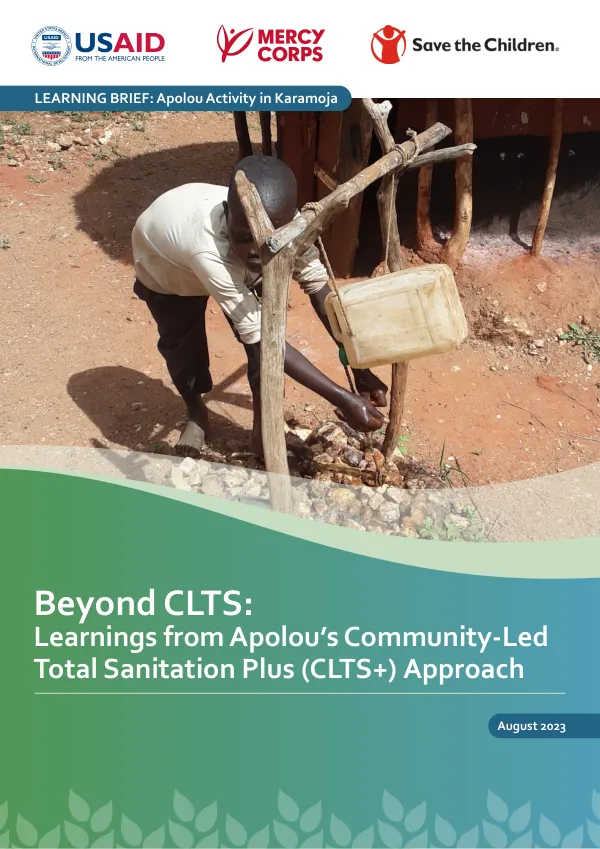
Beyond CLTS: Learnings from Apolou’s Community-Led Total Sanitation Plus (CLTS+) Approach
Sign inMERCY CORPS INTERNATIONAL
Beyond CLTS: Learnings from Apolou’s Community-Led Total Sanitation Plus (CLTS+) Approach
The Apolou Resilience Food Security Activity (RFSA) was a United States Agency for International Development (USAID) Bureau for Humanitarian Assistance (BHA) initiative that aimed to boost food and nutrition security for 310,000 people in the Kaabong, Karenga, Kotido, Moroto, and Amudat districts of Karamoja, Uganda.
2023 · 15 pages
Sign in to readA free account is required to download.
Abstract
From 2017–2023, Mercy Corps led a consortium of partners to implement the activity, working with households, community leaders, the Ministry of Karamoja Affairs, the Government of Uganda, the private sector, and others to address underlying causes of chronic food and nutrition insecurity and build community and household resilience. The Apolou WASH component aimed to improve the availability and use of household and community WASH services. Apolou's WASH strategy was divided into two components: sanitation and hygiene, and water point sustainability. The sanitation and hygiene component was the focus of this learning brief, which highlighted the lessons learned from Apolou's Community-Led Total Sanitation Plus (CLTS+) approach. Karamoja has the worst access to improved sanitation in Uganda, with 66% of households having no toilet at all. Entrenched customs of open defecation and high costs to improve sanitation have been challenging to overcome despite strong awareness and promotion of latrine use. In 2017, 58% of households in the Karamoja sub-region did not have any toilet facilities, and among those with facilities, 8% of households used shared latrines. To promote WASH behavior adoption and practices within the Karamoja context, Apolou adopted a mix of strategies building on Community-led Total Sanitation (CLTS). CLTS was blended with Sanitation Marketing (SanMark) and the Clean Household Approach (CHA), resulting in the "CLTS+" approach. Each of the three approaches focused on a different level of engagement: the household, the village, and the private sector working across communities (zones). The three approaches were underpinned by the activity's Gender and Youth Integration strategy and the Social Behavior Change Strategy. Within Apolou's five working districts, sanitation and hygiene programming was layered onto other community-based interventions in 545 villages. To focus and target activities, the project aimed to layer at least three Apolou activities in each village, including WASH activities. The project adopted two different models to improve sanitation and hygiene access and behaviors: a 'heavy touch' model and a 'light touch' model. The 'light' and 'heavy touch' models did not overlap in geography, but villages for the two models were selected to overlap with Apolou's Mother Care Groups (MCGs) villages. The 'heavy touch' model centered around CLTS and SanMark, while the 'light touch' model focused on the Clean Household Approach. The 'heavy touch' model was implemented in 270 villages, while the 'light touch' model was implemented in 275 villages. The 'heavy touch' model showed a 55% reduction in the number of days from triggering to open defecation free certification, from 720 days to 322 days. The learnings from Apolou's CLTS+ approach highlighted the importance of multi-sectoral programming, integration, layering, and sequencing, and opportunities to adapt CLTS strategies. Future programs in Karamoja would do well to focus on latrine coverage and use rather than open defecation alone, embed latrine savings schemes into saving groups, and employ holistic market-based approaches. The learnings from Apolou's CLTS+ approach can inform the design and implementation of future WASH programs in Karamoja and other contexts.
Related documents