USAID DEC
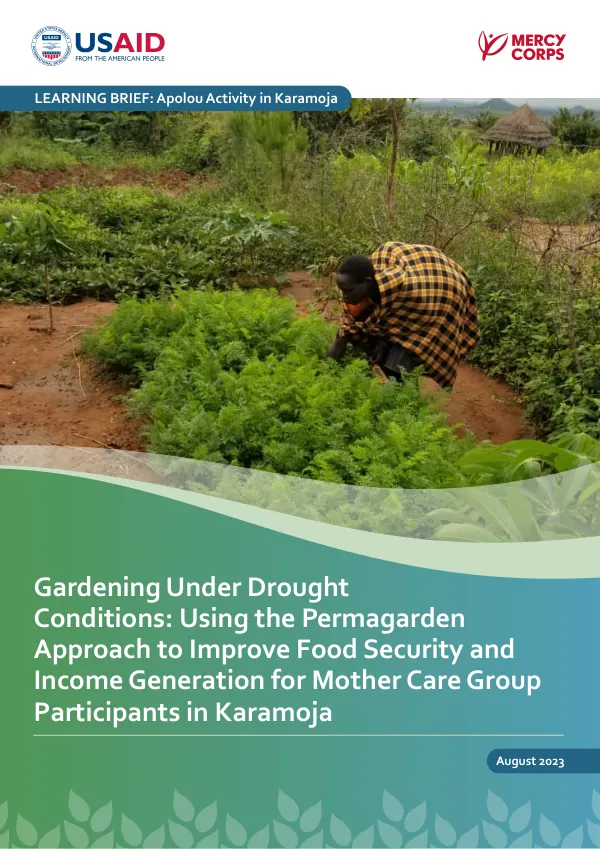
Gardening Under Drought Conditions: Using the Permagarden Approach to Improve Food Security and Income Generation for Mother Care Group Participants in Karamoja
Sign inMERCY CORPS INTERNATIONAL
Gardening Under Drought Conditions: Using the Permagarden Approach to Improve Food Security and Income Generation for Mother Care Group Participants in Karamoja
The Apolou Resilience Food Security Activity (RFSA) was a United States Agency for International Development (USAID) Bureau for Humanitarian Assistance (BHA) initiative that worked to boost food and nutrition security for 310,000 people in the Kaabong, Karenga, Kotido, Moroto, and Amudat districts of Karamoja, Uganda.
2023 · 12 pages
Sign in to readA free account is required to download.
Abstract
From 2017–2023, Mercy Corps led a consortium of partners to implement the activity. Apolou worked with households, community leaders, the Ministry of Karamoja Affairs, the Government of Uganda, the private sector, and others to address underlying causes of chronic food and nutrition insecurity and build community and household resilience. Apolou adopted four purposes grounded in social and behavioral change to support gender-transformative and resilience outcomes. These purposes included inclusive and effective governance contributing to food and nutrition security, adolescent girls, pregnant and lactating women, and children under five being nutritionally secure, reduced incidences of water, sanitation, and hygiene (WASH)-related diseases, and improved livelihoods and income supporting household food security. Apolou operates in Uganda's Karamoja region, a semi-arid area inhabited primarily by pastoralists and agropastoralists. Karamoja is in the midst of a social, political, ecological, and economic transition as it continues its recovery from decades of conflict and instability. Despite relative peace, food and nutrition insecurity persist. Changing climatic patterns are increasing the frequency and duration of droughts and dry spells, which strain traditional food production systems. Karamoja is the most nutritionally vulnerable region in Uganda and is the third most vulnerable to stunting in East Africa. In response to deteriorating food security in the region due to persistent drought, Apolou conducted a Permagarden Approach training program for 1,500 mothers engaged in its Mother Care Groups (MCGs). The Permagarden Approach is a combination of permaculture and biointensive agricultural techniques honed and adapted by Mercy Corps and partners for the smallholder farmer context. The Permagarden Approach prioritizes fundamental agricultural best practices, such as building soil health, increasing biodiversity, and efficiently using all available water sources to improve crop health and raise productivity. Apolou first conducted an intensive 5-day Training of Trainers workshop to prepare community-based trainers to cascade permagarden techniques to mothers within their communities. Local government extension workers provided additional support to the trainers and mothers, with the intent to continue integrating improved soil and water conservation techniques into the community after project completion. After the initial training, Apolou provided trainers with a voucher to claim a small amount of seeds and a watering can from local agro-dealers as encouragement. Trainers were expected to conduct trainings and follow-up visits with the mothers in their area to provide technical assistance as they established and maintained their permagardens. Mothers with expressed interest in improving their food security and who had access to a small piece of land were selected from villages classified in Phase 2 and 3 of the Integrated Food Security Phase Classification scale. Because the selected mothers were already engaged in MCGs, trainers were also able to encourage them to use the funds from their permagarden sales to increase their MCG-related Savings and Internal Lending Community (SILC). In total, 50 trainers and 1,500 mothers were targeted across the five Apolou districts. Permagardens were established in the wet season starting March 2022. The Permagarden Approach has shown promising results in improving food security and income generation for Mother Care Group participants in Karamoja. The approach has been effective in increasing household access to food, particularly in water-scarce areas. The use of permagardens has also been shown to improve crop health and raise productivity, leading to increased income generation for participating households. Additionally, the approach has been effective in promoting gender-transformative and resilience outcomes, including improved livelihoods and income supporting household food security. The results of the Apolou Resilience Food Security Activity (RFSA) demonstrate the effectiveness of the Permagarden Approach in improving food security and income generation for Mother Care Group participants in Karamoja. The approach has been effective in increasing household access to food, improving crop health and raising productivity, and promoting gender-transformative and resilience outcomes. The results of the activity provide valuable insights for development practitioners considering permagardens as a way to improve food security and household resilience in semi-arid regions.