USAID DEC
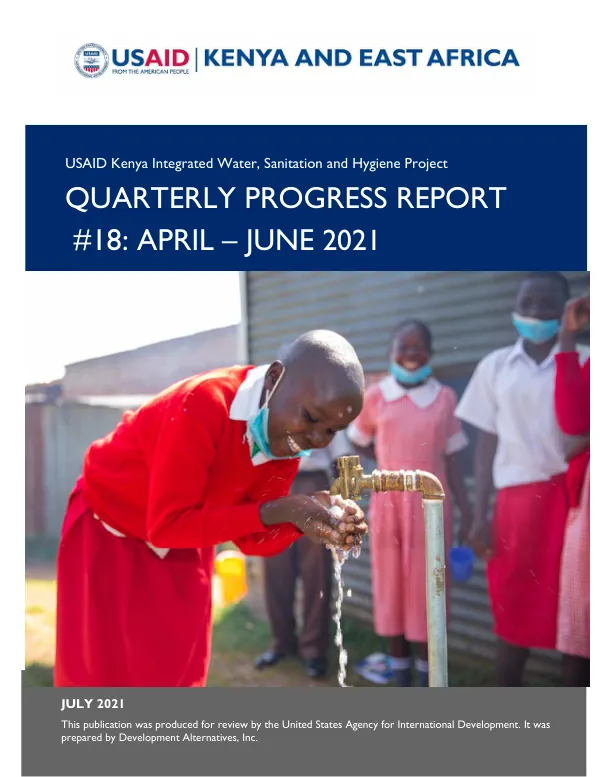
USAID Kenya Integrated Water, Sanitation and Hygiene Project Quarterly Progress Report #18: April – June 2021
Sign inDEVELOPMENT ALTERNATIVES, INC./FINNET
USAID Kenya Integrated Water, Sanitation and Hygiene Project Quarterly Progress Report #18: April – June 2021
The Kenya Integrated Water, Sanitation, and Hygiene Project (KIWASH) is implementing a one-year response and recovery program to the coronavirus disease of 2019 (COVID-19) pandemic.
2021 · 75 pages
Sign in to readA free account is required to download.
Abstract
This extension of the KIWASH project focuses on improving access to water, sanitation, and hygiene services (WASH) for 140,000 Kenyan citizens while helping to reduce the spread of COVID-19 in the country. During the reporting period, KIWASH completed nine infrastructure projects to provide water services to selected institutions and neighboring households. Additionally, KIWASH completed and disseminated county-specific water mapping reports, which will enable partner county governments to plan and make informed decisions towards improving water access in unserved and underserved areas. KIWASH also fast-tracked the implementation of priority activities planned in collaboration with nine county governments. The project's impact narrative highlights the promotion of clean energy sources in water supply services. The Kyatune Borehole Water Project, for instance, is no longer using a diesel water pump thanks to the installation of solar power by KIWASH. This installation has not only reduced water supply costs but also made the project environmentally friendly. The project experienced frequent pump breakdowns occasioned by an aged engine, thereby interrupting water services. KIWASH supported the enterprise through pipeline extensions and a 10,000-liter water storage tank, guaranteeing access to improved water services for 4,500 people. In the quarter, KIWASH supported the solarization of four water projects: Lubao in Kakamega County, Kanoto in Makueni County, and Kyatune and Katanu in Kitui County. Solar power has halved the electricity bill for the Lubao Water Project in Kakamega County, which previously incurred an average monthly electricity bill of USD 550 against a monthly revenue of USD 560. The reduced water pumping costs mean increased savings and ability to sustainably undertake service extension to underserved areas and other maintenance and repairs. The project serves about 2,000 people around Kakamega town. KIWASH also installed solar panels at Kyatune Borehole Water Project, enabling students of St. Monica Secondary School, one of the enterprise's biggest customers, to enjoy clean water within their institution. Furthermore, KIWASH transferred equipment to support rural water mapping in all project counties. Essential packages of equipment, including desktop computers, printers, and uninterrupted power supply units, were handed over to the respective county departments of water. These computers will enable the county governments to continuously update and store rural water facilities/service maps to inform investment planning in the future. KIWASH also supported a water enterprise in securing a USD 45,000 vehicle loan. The Chyulu Valley Water Enterprise based in Makueni County procured a mini-lorry for their water bottling business through a USD 45,000 loan from Family Bank. KIWASH provided coaching and mentoring support to the enterprise to sustain the gains made in operations and service delivery. The technical assistance focused on improving the utility's ability to manage and maintain its water supply services.