INNOVATIONS FOR POVERTY ACTION
BHA Emergency M&E Guidelines: Rapid Review Findings and Recommendations
The Bureau for Humanitarian Assistance (BHA) is the lead funder and coordinator for the United States Government's international humanitarian and disaster assistance.
2023 · 3 pages
Sign in to readA free account is required to download.
Abstract
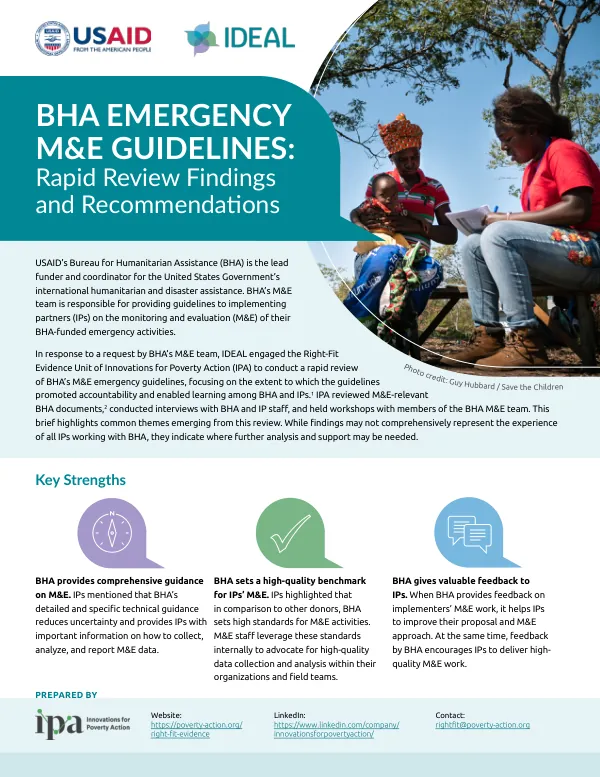
BHA's M&E team is responsible for providing guidelines to implementing partners (IPs) on the monitoring and evaluation (M&E) of their BHA-funded emergency activities. BHA provides comprehensive guidance on M&E, which is detailed and specific, reducing uncertainty and providing IPs with important information on how to collect, analyze, and report M&E data. BHA sets a high-quality benchmark for IPs' M&E, which is reflected in the high standards for M&E activities. IPs leverage these standards internally to advocate for high-quality data collection and analysis within their organizations and field teams. BHA gives valuable feedback to IPs, which helps them to improve their proposal and M&E approach. Feedback from BHA encourages IPs to deliver high-quality M&E work. However, some indicator requirements create a significant burden for IPs, and it is unclear how they inform programming decisions. BHA requires various indicators for inputs, outputs, and different levels of outcomes, which can be burdensome to collect, especially when the data is not always actionable. To address this challenge, BHA should review current indicator requirements to focus only on the most insightful data. BHA should assess the list of indicators with each sector team to identify the most insightful indicators, optimizing the balance of required output and outcome indicators, and moving many "required" final outcomes to "optional" to allow IPs to track them only if they are meaningful for their work. Recalibrating the overall requirements for data collection could reduce the total burden on IPs, especially for smaller, local IPs. BHA's guidelines are challenging for IPs to read and navigate, with IPs indicating that the length and complexity of current M&E guidelines are "intimidating," especially for new IPs. To address this challenge, BHA could structure guidelines to clearly emphasize key points and make requirements more user-friendly for IPs to navigate. BHA could integrate supplemental visual elements, such as flowcharts and checklists, to highlight critical elements and explain important nuances. Evaluations focus on accountability, but rarely contribute to internal and sector-wide learning. BHA's current requirements aim to ensure accountability through evaluations that are based on length of grant award (or period since previous award in the same country). IPs frequently choose to conduct performance evaluations to fulfill this evaluation requirement. BHA could explore ways to tailor evaluation requirements both to answer key learning questions about the implementation of humanitarian programs, as well as to fill sectoral evidence gaps related to impact. BHA could also revisit current criteria for emergency evaluations, considering expanding the role of evaluations to generate more and better evidence. Loosening the current triggers for evaluations based on duration of award and previous award could help ensure that evaluation resources focus on the areas that are most impactful for IPs' and BHA's learning, while also remaining a tool for serving accountability goals. IPs report substantial amounts of data to BHA, but they are not shared back with IPs or the wider humanitarian community. BHA requires IPs to report significant volumes of indicator data and narrative reports to ensure accountability to the agency's mission and stakeholders. This creates a huge repository of data on the humanitarian responses that BHA funds, but IPs report that they rarely see any data or synthesized insights shared back to them, describing BHA's M&E as a "black box."