USAID DEC
Blended Finance for Family Planning: Mobilizing Private Capital for Persisting Challenges
Sign inUSAID
Blended Finance for Family Planning: Mobilizing Private Capital for Persisting Challenges
Blended finance, as defined by the U.S.
2020 · 10 pages
Sign in to readA free account is required to download.
Abstract
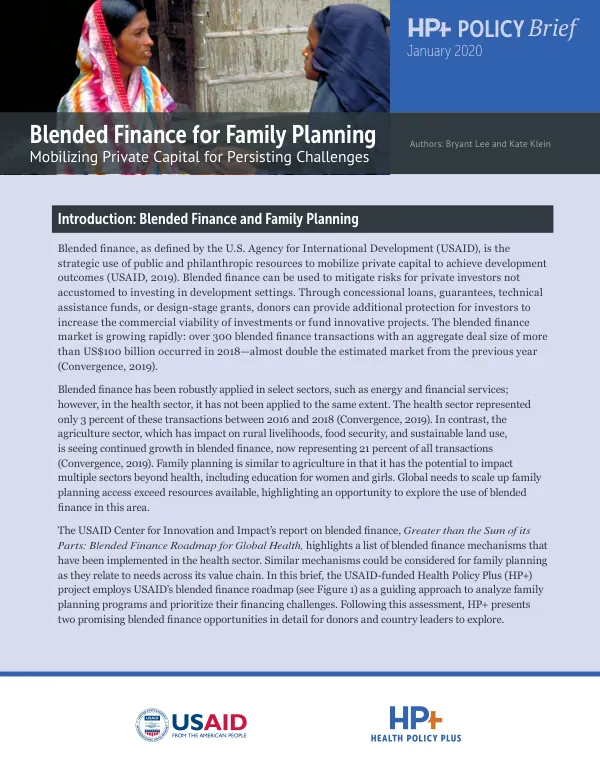
Agency for International Development (USAID), is the strategic use of public and philanthropic resources to mobilize private capital to achieve development outcomes. This approach can mitigate risks for private investors not accustomed to investing in development settings. Through concessional loans, guarantees, technical assistance funds, or design-stage grants, donors can provide additional protection for investors to increase the commercial viability of investments or fund innovative projects. The blended finance market is growing rapidly, with over 300 blended finance transactions with an aggregate deal size of more than US$100 billion occurring in 2018. However, the health sector has not been a significant recipient of blended finance, representing only 3 percent of transactions between 2016 and 2018. In contrast, the agriculture sector, which has a similar potential to impact multiple sectors beyond health, is seeing continued growth in blended finance, now representing 21 percent of all transactions. Family planning is a sector that has the potential to impact multiple sectors beyond health, including education for women and girls. Global needs to scale up family planning access exceed resources available, highlighting an opportunity to explore the use of blended finance in this area. The USAID Center for Innovation and Impact's report on blended finance, Greater than the Sum of its Parts: Blended Finance Roadmap for Global Health, highlights a list of blended finance mechanisms that have been implemented in the health sector. Similar mechanisms could be considered for family planning as they relate to needs across its value chain. The Health Policy Plus (HP+) project employs USAID's blended finance roadmap as a guiding approach to analyze family planning programs and prioritize their financing challenges. The roadmap consists of six steps: Identify the country archetype, Define the health issue, Prioritize financing challenges, Evaluate potential for blended finance, Shortlist blended finance instruments, and Identify activities for further engagement. Following this assessment, HP+ presents two promising blended finance opportunities in detail for donors and country leaders to explore. The country archetype is a critical component of the blended finance approach, as it refers to the country's health system status and attractiveness to investors. The health issue is identified by assessing the underlying issues leading to poor health outcomes. Prioritizing financing challenges involves assessing supply- and demand-side challenges involving limited capital, absence of risk diversification, and misaligned incentives. The five core components of family planning programs are Quality Services, Supply Chain & Logistics, Supervision, Monitoring, & Accountability, Policy & Enabling Environment, and Demand Creation. Each of these components is critical to the effective functioning of a family planning market. Barriers and challenges to an effectively functioning family planning market include health worker skills and training, client-provider interaction, convenience, cost, and privacy, commodity storage and distribution, commodity availability, quantification and forecasting, information and awareness, mass media communication, sociocultural factors, interpersonal communication, supportive supervision, adherence to standards, performance incentives/health worker motivation, data quality and use, policies affecting quality, choice, specific populations, health insurance benefits packages, regulation and taxation, government contribution to family planning, and private sector engagement. Following analysis of the underlying barriers and challenges within family planning programs, HP+ assessed whether these challenges and barriers were financing issues. For challenges that were determined to be primarily related to financing, HP+ explored whether blended finance mechanisms could be used to address these barriers. After identifying the financing issues underlying family planning challenges, HP+ developed a comprehensive list of challenges with the potential for blended finance application. Some challenges were then eliminated from consideration because blended finance instruments seemed unlikely to scale, the addition of development finance was unnecessary for an already fully privately financed solution, or efficiency gains would not likely be achieved. Table 1 presents the leading blended finance opportunities that were identified, matched with the family planning issues that they address. The top two opportunities will be more fully explained in the following sections.
Related documents