USAID DEC
Boosting Family Planning within the Sustainable Development Goals Framework: A Way Forward for Sindh, Pakistan
Sign inGOVERNMENT OF TAJIKISTAN
Boosting Family Planning within the Sustainable Development Goals Framework: A Way Forward for Sindh, Pakistan
In Sindh, Pakistan, investing in family planning is critical for achieving broader development goals and objectives.
2016 · 6 pages
Sign in to readA free account is required to download.
Abstract
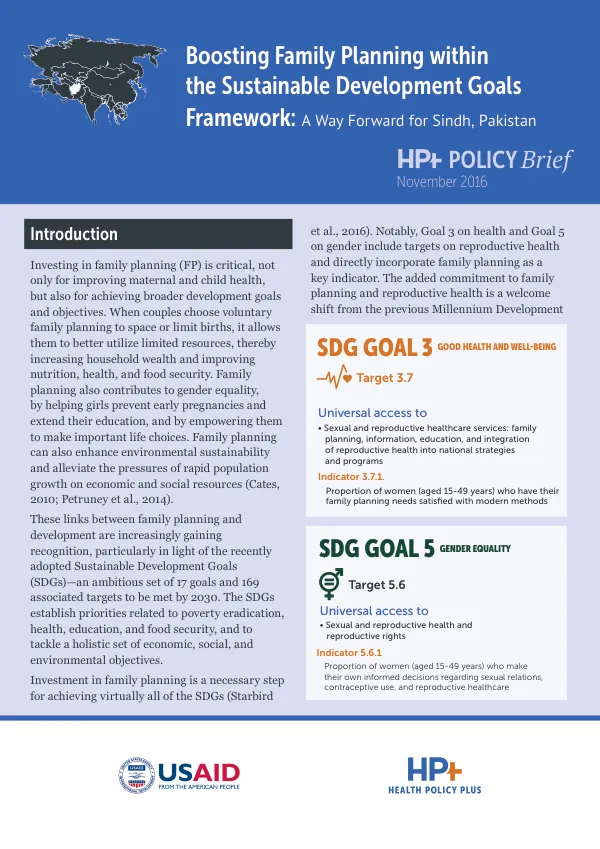
When couples choose voluntary family planning to space or limit births, it allows them to better utilize limited resources, thereby increasing household wealth and improving nutrition, health, and food security. Family planning also contributes to gender equality by helping girls prevent early pregnancies and extend their education, and by empowering them to make important life choices. The Sustainable Development Goals (SDGs) framework recognizes the importance of family planning for health, economic prosperity, and national development. Goal 3 on health and Goal 5 on gender include targets on reproductive health and directly incorporate family planning as a key indicator. The SDGs establish priorities related to poverty eradication, health, education, and food security, and to tackle a holistic set of economic, social, and environmental objectives. Key actions to boost family planning in Sindh include taking ownership of the SDGs, drawing attention to the broader health, economic, and development benefits of family planning, and translating existing policies into action. Decisionmakers in Sindh can apply a key lesson from the MDG experience in Pakistan: ensure that objectives and priorities around the SDGs are locally relevant and realistic. One way to do this is to work through the newly established SDG Unit, supported by the United Nations Development Programme. Sindh's rapid population growth will inevitably strain the province's infrastructure and ability to provide adequate social services. Reducing unintended pregnancies through voluntary family planning is one clear way to ease such pressures. Decisionmakers in Sindh can draw from the SDG linkages outlined in Vision 2025 and similarly align provincial-level development goals with the SDGs. To further take ownership, decisionmakers can ensure that objectives and priorities around the SDGs are locally relevant and realistic, and work through the SDG Unit to prioritize the FP-related goals, targets, and indicators. Increasing attention to and support for family planning will be critical to ensure mobilization of the needed financial and operational resources to achieve the FP-related SDGs. Decisionmakers in Sindh can bring greater attention to the role of family planning in birth spacing and the related benefits, such as reducing death and illness rates among mothers and infants, and contributing to the well-being of older children. Evidence shows that well-spaced births can also contribute to the well-being of families and society, and decisionmakers can use this argument to persuade stakeholders to increase their support for family planning and development.