USAID DEC
Boletin Enero 2016: Comportamiento pago de Transferencia Municipal 2011-2015
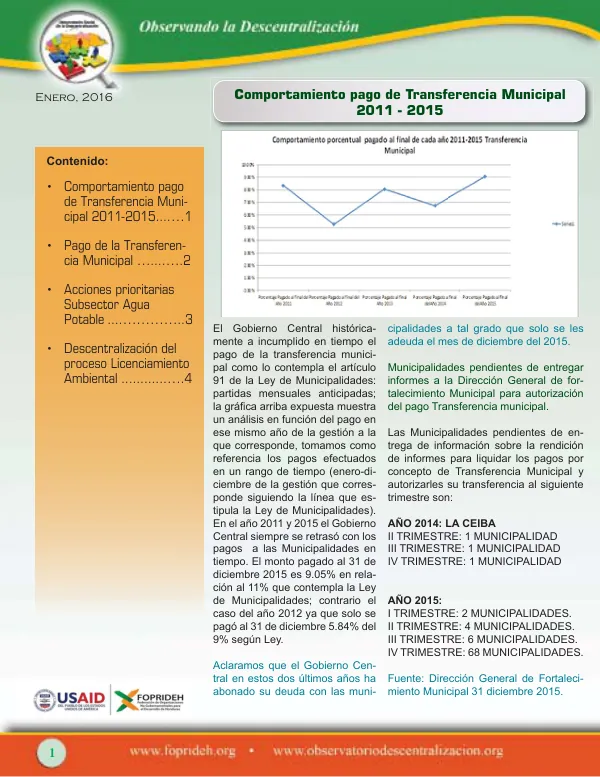
The payment behavior of the Transferencia Municipal from 2011 to 2015 is characterized by the Government Central's historical failure to meet the payment deadline as stipulated in Article 91 of the Ley de Municipalidades.
2016 · 4 pages
Sign in to readA free account is required to download.
Abstract
The article requires monthly advance payments, but the Government Central has consistently delayed payments to municipalities. In 2011 and 2015, the Government Central failed to make timely payments, with the amount paid by December 31, 2015, being 9.05% of the 11% required by law. In contrast, the 2012 payment was only 5.84% of the 9% required. Municipalities pending the delivery of reports to the Dirección General de Fortalecimiento Municipal for authorization of the Transferencia Municipal payment are listed for 2014 and 2015. For 2014, one municipality was pending, while for 2015, 2, 4, 6, and 68 municipalities were pending in the first, second, third, and fourth quarters, respectively. The payment of the Transferencia Municipal for 2015 was budgeted by the SEFIN and approved by the Congreso Nacional for the SDHJGD to execute L.4,200,006,000.00 million lempiras. However, a compensation municipal agreement was signed between the AMHON and the SE-DIS for L.600 million lempiras to execute municipal projects according to the "Por Una Vida Mejor" program. This amount is not a real adjustment to the Transferencia Municipal, as it does not directly reach all 298 municipalities, and it was not implemented in 2015. A mechanism will be established in the first semester of 2016 to invest these resources. The Government has made payments to municipalities for the 2015 management, totaling L.3,456,461,530.61 million lempiras from January to December 2015. The percentage of execution of the transfer of resources from the Government Central to the municipalities is 9.05% for 2015, as stipulated by the Ley de Municipalidades in Article 91, based on data up to December 31, 2015. The SDHJGD, through the SEFIN, has made payments of L.1,323 million lempiras corresponding to the debt of the 2014 management. The prioritized actions for the Subsector Agua Potable include the implementation of a decentralized process for the evaluation of environmental impact, which was delegated to municipalities by the Ley General del Ambiente. The Secretaría de Estado en los Despachos de Recursos Naturales y Ambiente (SERNA) has been delegated to maintain the competences decentralized in municipalities. A new system of evaluation of environmental impact (SINEIA) was established, but its regulation was later derogated, contravening the article 28-A of the Ley General del Ambiente. The Asociación de Municipios de Honduras (AMHON) has requested the Consejo de Ministros to reform the Regulation Decreto Ejecutivo 008-2015, which contravenes the article 28-A of the Ley General del Ambiente. The reform should include the fulfillment of the article 28-A, which establishes that municipalities delegated will perform the evaluation of environmental impact for the execution of projects, installations, or any other public or private activity within their territorial scope.
Related documents