USAID DEC
Boletín Informativo del Proyecto PROLAGO
The PROLAGO project, implemented in Bolivia, aims to improve environmental health and the health of local populations and biodiversity in the Lake Titicaca region.
2011 · 13 pages
Sign in to readA free account is required to download.
Abstract
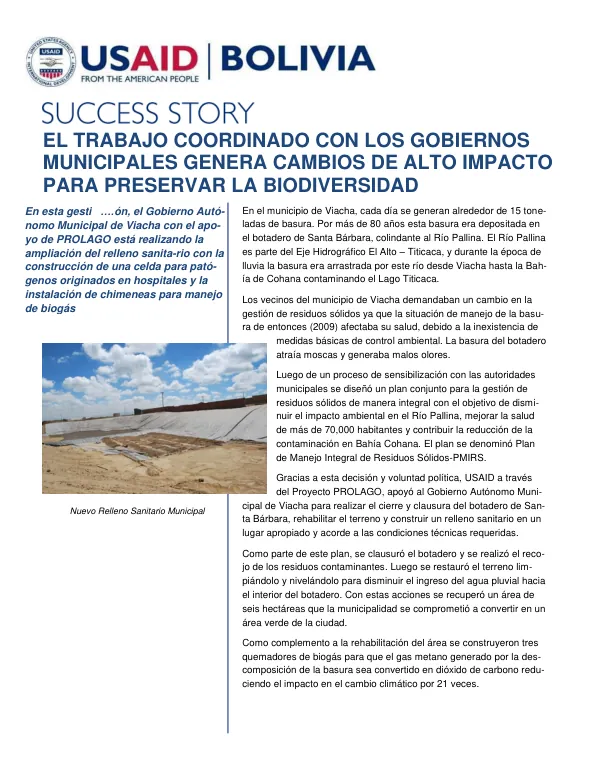
The project began in 2008 with a cooperation agreement between the governments of the United States and Bolivia. Initial assessments identified a lack of awareness and understanding of the contamination problem among local communities. The project implemented interventions to demonstrate the need and viability of waste management activities with the participation of all sectors in urban areas. In rural areas, the project demonstrated to farmers that waste has value and can be transformed into energy and organic fertilizer. The project also implemented a campaign to inform and sensitize the population about the need to avoid dumping waste in rivers and streets. The PROLAGO project implemented a strategy to reduce industrial contamination in the city of El Alto. The project identified four industrial sectors that are potentially the most contaminating and provided technical assistance to these sectors. The project also implemented a plan to monitor and evaluate the implementation of recommendations for sustainable production practices. The project also implemented a plan to reduce the risks associated with the disposal of waste in the Pallina River, which flows into Lake Titicaca. The project constructed a sanitary landfill in the municipality of Viacha, which serves over 41,000 families and generates around 8 tons of waste per day. The landfill has a surface area of approximately six hectares and is expected to last for 15 years. The project also conducted a third campaign of water quality monitoring in the El Alto-Lake Titicaca watershed. The campaign was conducted in collaboration with the University Mayor of San Andrés and involved the collection of water samples from 21 points, including four new points in the municipality of Viacha and two points in the Katari River. The samples were analyzed for 25 parameters of water quality, including physical, biological, and chemical indicators.
Related documents