INTERNATIONAL MONETARY FUND
Bosnia and Herzegovina Gap Analysis
Economic and democratic reform progress in Bosnia and Herzegovina (BH) has been slow compared to the Southern Tier Central and Eastern Europe (CEE) average.
2011 · 43 pages
Sign in to readA free account is required to download.
Abstract
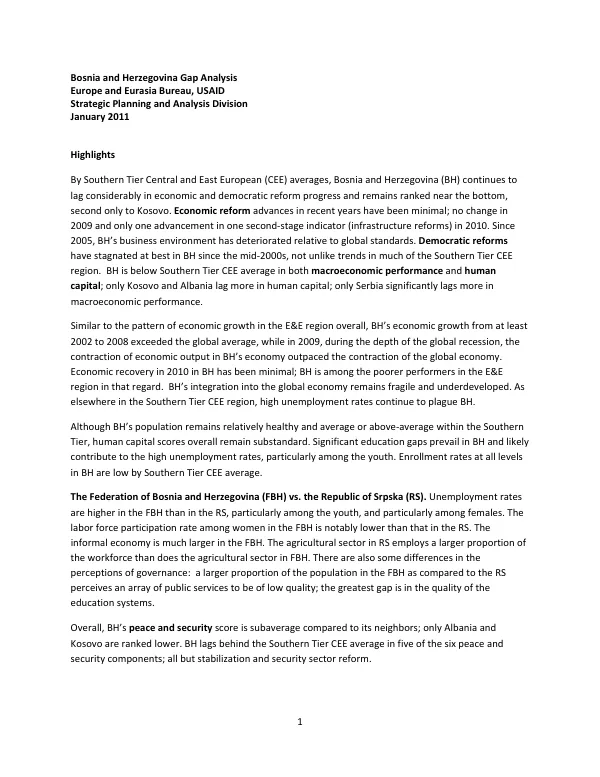
BH ranks second to last among the 29 transition countries in economic reform progress, with only Kosovo lagging more. The country has made slight advancements in economic reforms since early 2009 but has regressed in democratization. Economic reforms in BH are categorized into two stages. First-stage reforms involve price liberalization, trade, and foreign exchange reforms, as well as small- and large-scale privatization. These reforms aim to reduce government intervention in the economy. Second-stage reforms, on the other hand, focus on building government capacity to regulate and oversee the private sector. This includes enterprise governance, competition policy, banking reform, infrastructure reform, and non-bank financial reform. BH has notable gaps in second-stage economic reforms, particularly in enterprise governance, competition policy, and financial reform outside of banking. The country also lags behind in first-stage economic reforms, specifically in small-scale privatization. Among the 29 transition countries, only Belarus and Turkmenistan lag more in small-scale privatization. BH's economic reform progress has been minimal since 1997-1998, with no change in 2009 and only one advancement in one second-stage indicator (infrastructure reforms) in 2010. The country's ranking in ease of doing business is 110 out of 183 countries worldwide, according to the World Bank's Doing Business 2011 analysis. This ranking is based on ten microeconomic aspects of the business environment influenced by government interventions. BH's ranking is considerably low by most standards, with a score of 24 out of 29 transition countries. The country scores poorly in aspects such as starting a business, employing workers, registering a business, accessing credit, paying taxes, and closing a business. BH's economic growth from 2002 to 2009 exceeded the global average, but the contraction of economic output in 2009 outpaced the global contraction. The country's economic recovery in 2010 was minimal, and BH remains among the poorer performers in the E&E region. BH's integration into the global economy remains underdeveloped, and the country's unemployment rates continue to be high. The labor force participation rate among women in BH is lower than in the Republic of Srpska, and the informal economy is larger in BH. The agricultural sector in BH employs a larger proportion of the workforce than in the Republic of Srpska. BH's peace and security score is subaverage compared to its peers, with only Albania and Kosovo ranked lower. The country lags behind the Southern Tier CEE average in five of the six peace and security components, with the exception being security sector reform. BH's human capital score is also substandard, with low enrollment rates at all levels and significant education gaps contributing to high unemployment rates, particularly among the youth. The Federation of Bosnia and Herzegovina (FBH) and the Republic of Srpska (RS) have different economic and demographic characteristics. Unemployment rates are higher in the FBH than in the RS, particularly among the youth and females. The labor force participation rate among women in the FBH is lower in the RS. The informal economy is larger in the FBH, and the agricultural sector in the RS employs a larger proportion of the workforce than in the FBH. BH's economic and democratic reform progress has been slow, and the country lags behind its peers in various aspects. The country's integration into the global economy remains underdeveloped, and unemployment rates continue to be high. BH's human capital score is substandard, with significant education gaps contributing to high unemployment rates, particularly among the youth.