USAID DEC
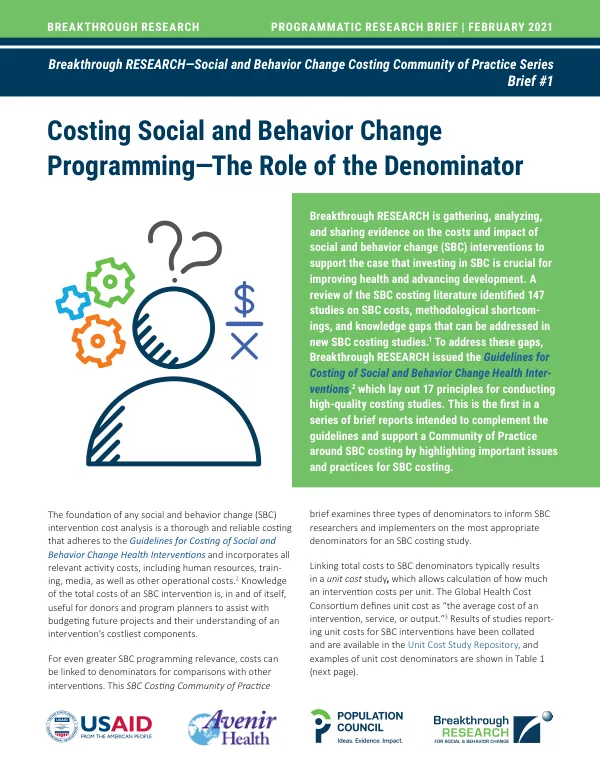
Breakthrough RESEARCH—Social and Behavior Change Costing Community of Practice Series Brief #1: Costing social and behavior change programming—the role of the denominator
Sign inBREAKTHROUGH RESEARCH
Breakthrough RESEARCH—Social and Behavior Change Costing Community of Practice Series Brief #1: Costing social and behavior change programming—the role of the denominator
The foundation of any social and behavior change (SBC) intervention cost analysis is a thorough and reliable costing that adheres to the Guidelines for Costing of Social and Behavior Change Health Interventions.
2021 · 6 pages
Sign in to readA free account is required to download.
Abstract
This costing incorporates all relevant activity costs, including human resources, training, media, as well as other operational costs. Knowledge of the total costs of an SBC intervention is useful for donors and program planners to assist with budgeting future projects and understanding an intervention's costliest components. Linking total costs to SBC denominators typically results in a unit cost study, which allows calculation of how much an intervention costs per unit. The Global Health Cost Consortium defines unit cost as the average cost of an intervention, service, or output. Results of studies reporting unit costs for SBC interventions have been collated and are available in the Unit Cost Study Repository. Examples of unit cost denominators include program outputs, health behaviors, and health impacts. Program outputs are a common denominator for SBC interventions, with unit costs often calculated as the cost per person exposed, participating, or receiving counseling. For example, a study in Bangladesh examined the costs of women's participation in individual SBC counseling for maternal and child mortality reduction, revealing different unit costs based on when during her pregnancy a woman participated in the intervention. Another study in South Africa compared the costs of public health SMS campaigns for deaf clients using internal resources to contracting with private providers, finding that the "in house" approach was considerably more cost-efficient. Health behaviors can also be used as a denominator, allowing examination of the relative costs of behavior change among two or more SBC interventions. For instance, a study in Northern India compared different components of a behavior change communication campaign on the cost per additional person using a condom and the cost per additional person engaging in interpersonal communication. Calculating the cost per behavior change allows for the assessment of impacts across SBC interventions in multiple health areas. Health impacts are another type of denominator, often used in cost-effectiveness analyses (CEAs). CEAs examine denominators that represent health gains, such as lives saved or deaths averted. Other examples of health impact denominators include cost per malaria infection averted, cost per child wasting prevented, and cost per HIV infection averted. An important health outcome used in CEAs for SBC is the cost per disability-adjusted life year (DALY) averted, which combines years of life lost due to early death and years of healthy life lost due to disability. When choosing the right denominator for an SBC costing study, several factors are important. The primary purpose of the study should be considered, as well as the type of SBC intervention and the desired outcome. Additionally, the availability of data and the feasibility of the study should be taken into account. By carefully selecting the denominator, researchers and implementers can ensure that their SBC costing study provides accurate and useful information for decision-making.
Related documents