USAID
Briefing on the Agribusiness Enabling Environment
Agriculture occupies a critical space in most economies, particularly in developing nations where it is the dominant source of employment for a large share of the population.
2011 · 4 pages
Sign in to readA free account is required to download.
Abstract
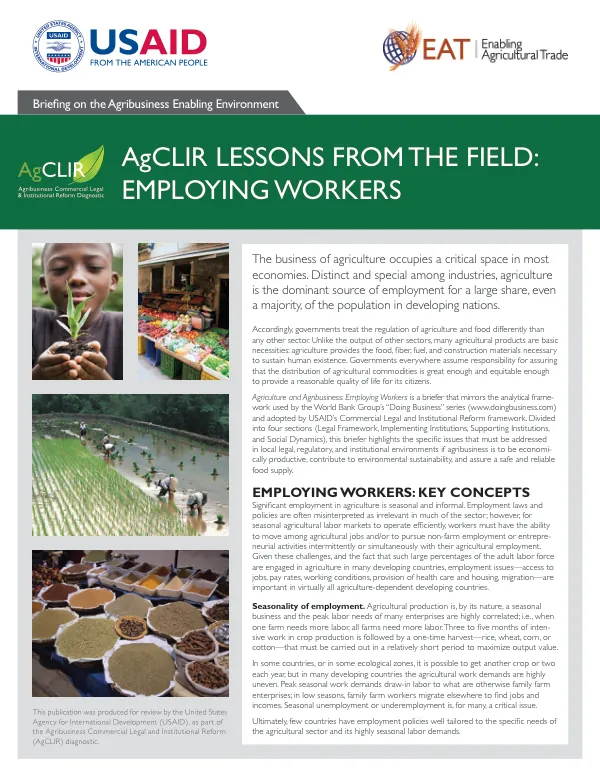
Governments treat the regulation of agriculture and food differently than other sectors, assuming responsibility for ensuring a reasonable quality of life for citizens through the distribution of agricultural commodities. The regulation of agriculture and agribusiness is complex, with significant employment in the sector being seasonal and informal. Employment laws and policies are often misinterpreted as irrelevant in much of the sector, but for seasonal agricultural labor markets to operate efficiently, workers must have the ability to move among agricultural jobs and/or pursue non-farm employment or entrepreneurial activities intermittently or simultaneously with their agricultural employment. Seasonality of employment is a critical issue in agriculture, with peak labor needs of many enterprises being highly correlated. Three to five months of intensive work in crop production are followed by a one-time harvest, which must be carried out in a relatively short period to maximize output value. In some countries or ecological zones, it is possible to get another crop or two each year, but in many developing countries, the agricultural work demands are highly uneven. Successful farm enterprises are able to manage the seasonality of their businesses by developing more capital-intensive and complex farm enterprises that smooth out their production and income streams. On-farm investments in irrigation facilities permit double- or triple-cropping of staple crops each year or nearly continuous production of tropical flowers, fruits, and vegetables. Diversification of production enterprises, such as poultry and dairy production, also tends to occupy labor more fully and generate a steadier stream of income for agribusinesses. Off-farm employment is another strategy used by farm owners/operators to smooth out their income streams. Empirical evidence shows that while off-farm employment can be important as a source of income for very poor rural households, the higher-income farm household operations often are also most successful in pursuing off-farm employment. Migration is also a critical issue, with some farm enterprises being so small and unprofitable that workers from these households must rent out their labor to better-off neighbors, even where doing so reduces the productivity of their own agricultural production enterprises. Permanent employment is also a critical aspect of agribusiness, with non-farm agribusinesses that purchase and store raw product and transform or process it for sale throughout the year bridging the gap between the periodic flood of raw product into the market and the continuous, daily needs of consumers. Most developing countries envision an expanding share of agricultural employment going into the visible "value added" agribusiness segment of the economy, processing raw commodities into diverse food, feed, and fiber products for local consumption and export. The quality of the local labor force is a critical factor in the growth of value-adding jobs, as is the availability of capital and technology for local production facilities. Agribusiness firms that process commodities year-round compete for labor with other manufacturing and service firms of comparable size and are likely to be subject to the same labor costs, labor force rigidities, and firing costs as other firms. Gender disparities are also an important aspect of agricultural employment, with pay, treatment, and working conditions not being equal. Business environment assessments most frequently focus on medium- to large-scale enterprises located in urban and peri-urban areas, but several areas of legislation and regulation are likely to be relevant to even small-scale agribusinesses. Basic workers' rights include freedom of association, the right to organize, collective bargaining, abolition of forced labor and slavery, and equality of opportunity and treatment. Workers' rights have been an important issue in the negotiation of international trade agreements, and many developing countries have recognized these rights in their own labor law. However, discussions in international forums have often gone beyond basic rights to focus on other labor standards and regulations, and the sensitivities of consumers in developed countries to working conditions in developing countries have also been raised through the concerted action of human rights non-governmental organizations.
Related documents