USAID
Building Better Entrepreneurs Updated Implementation and Evaluation Plan
The project aims to develop methods of training Ugandan high school students in entrepreneurship skills that will improve their labor market outcomes and business success.
2012 · 18 pages
Sign in to readA free account is required to download.
Abstract
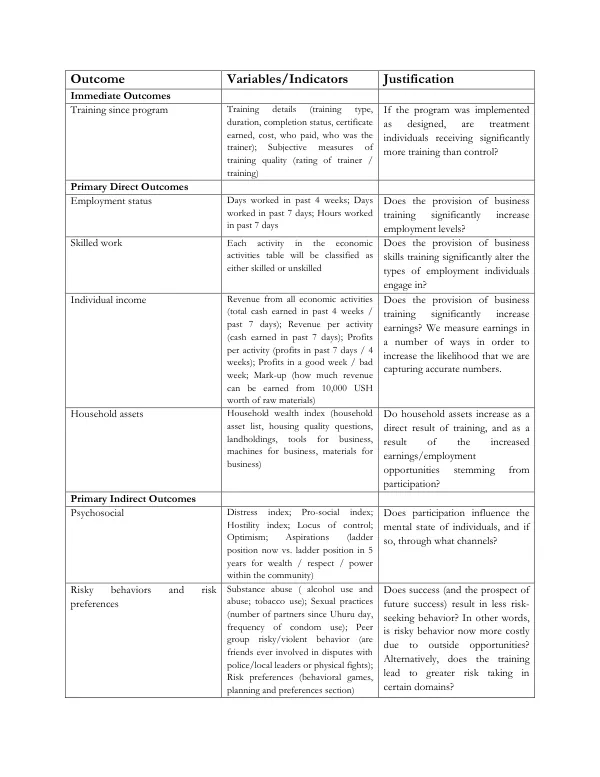
Business and labor market success are thought to depend on a series of hard skills, such as financial decision making, and soft skills, such as negotiation and communication. The project seeks to identify the most effective training methods and evaluate their impact on the participants' entrepreneurial skills and business success. The project will focus on several key outcomes, including employment status, skilled work, individual income, household assets, and psychosocial outcomes. Employment status will be measured through indicators such as days worked in the past four weeks, days worked in the past seven days, and hours worked in the past seven days. Skilled work will be classified as either skilled or unskilled based on the economic activities table. Individual income will be measured through revenue from all economic activities, revenue per activity, profits per activity, and mark-up. Household assets will be assessed through the household wealth index, which includes household asset lists, housing quality questions, landholdings, tools for business, machines for business, and materials for business. Psychosocial outcomes will include distress index, pro-social index, hostility index, locus of control, optimism, and aspirations. The project will also evaluate the impact of the training on physical health, including ADL index, subjective health assessment, and number of days sick in the past month. Additionally, the project will assess the quality of life, including number of substantial meals per day, number of times gone to bed hungry in the past week, sleep in an enclosed shelter, changes of clothing owned, and access to clean water. The project will also examine the impact of the training on household characteristics, including dependency ratio, marital status, family connectedness index, and number of biological children. Social standing and relations with the community will be assessed through the index of social support, relativity ladders, marginalization index, and relations with community and elders. The project will also evaluate the impact of the training on changes in outcomes of other household members, including enrollment of biological children in school, future relativity ladders, and increased investment in other income-generating assets. Furthermore, the project will assess the impact of the training on political participation, including voting, community meeting attendance/action, leadership, and access to public officials. Political awareness will be measured through knowledge of the month and year of the next presidential election and knowledge of the current LC3/LC5. The project will also evaluate the impact of the training on views on ethnicity, levels of conflict, transfers, perceived status and decision-making power of women in the household, and business formalization. The project will use a range of evaluation methods, including surveys, interviews, and focus groups, to collect data on the outcomes and impact of the training. The data will be analyzed using statistical software to identify the most effective training methods and evaluate their impact on the participants' entrepreneurial skills and business success.