USAID DEC
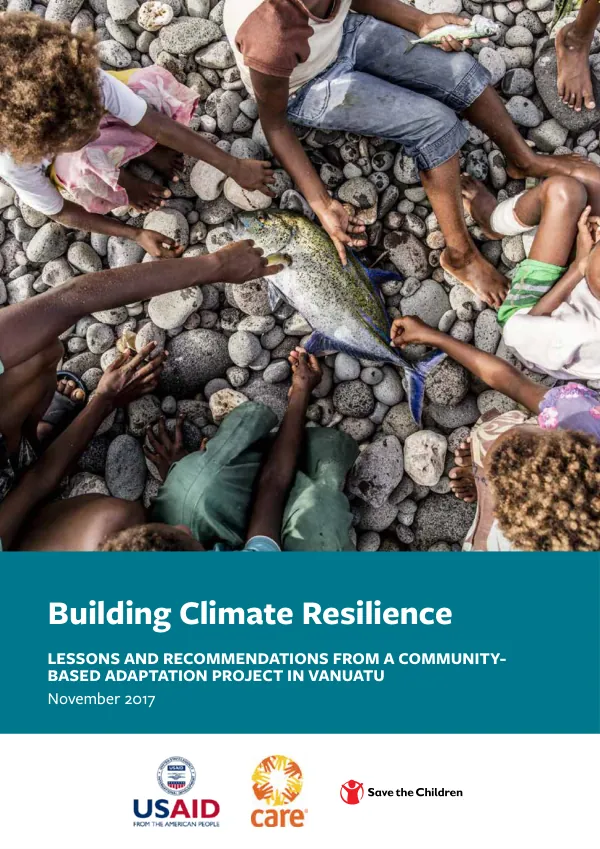
Building Climate Resilience: Lessons and Recommendations from a Community-Based Adaptation Project in Vanuatu
Sign inSAVE THE CHILDREN FUND
Building Climate Resilience: Lessons and Recommendations from a Community-Based Adaptation Project in Vanuatu
Climate change poses significant risks to Vanuatu, a country located on the Pacific 'Ring of Fire' and in a 'cyclone belt'.
2017 · 34 pages
Sign in to readA free account is required to download.
Abstract
The country is vulnerable to a wide range of climate and disaster risks, including tropical cyclones, tsunamis, droughts, coastal flooding, and sea level rise. These hazards are expected to worsen as climate change impacts increase over time, exacerbating current challenges and placing pressure on the Government of Vanuatu's ability to deliver on their sustainable development plans and policies. To address these challenges, CARE International in Vanuatu and Save the Children developed a community-based climate change adaptation project with support from the USAID Pacific American Climate Fund (PACAM). The project built on the success of a two-and-a-half-year community-based adaptation project supported by the Australian Aid program. The project was implemented over a 16-month period (January 2016 to May 2017) in the southern province of Tafea and the northern province of Sanma. The overall goal of the project was to increase the resilience of communities, especially women, young people, boys, and girls, to shocks, stresses, and future uncertainty resulting from climate change. The project achieved this goal through working towards two objectives: increasing awareness and capacity to anticipate, plan for, and respond to the impacts of climate change, and implementing and leading climate change adaptation actions, including livelihoods enhancement and income diversification, food security, natural resource management, and ecosystem management. Through this project, CARE and Save the Children supported 5,701 women, men, girls, and boys in 32 communities to implement essential, local climate change adaptation actions that build their resilience to the impacts of climate change. Support was provided through a series of community-based training programs, focusing on agriculture, food security, livelihoods, and water resource management. As a result of these trainings and workshops, communities are taking adaptation actions, such as replanting hybrid plant cuttings from demonstration plots, using solar dryers to preserve their food ahead of the cyclone season, reusing their water and cooking scraps to increase the nutrient levels of their soils, and continuing to engage with their local government departments to ensure that their economic activities and preparedness plans continue to be responsive to their changing environments. The project also developed a series of case studies to explore the key successes and challenges of the project and the strategies used to approach it. These areas of work demonstrate the importance of ensuring that climate change tools and processes reach target beneficiaries and communities. This includes ensuring integration of climate change tools into the school curriculum, providing the necessary training to school curriculum advisors and teachers, working together with key Ministries and Departments in the development and implementation of climate change adaptation activities, and supporting groups such as the community disaster climate change committees as platforms for enhancing women's participation and voice in key climate change and disaster risk reduction planning processes. The project's findings and recommendations highlight the importance of building climate resilience by considering the broader adaptation and development issues, increasing community resilience by supporting community-based disaster management structures, enhancing sustainability by deepening relationships with local authorities, achieving greater impact by investing in cross-learning opportunities, and increasing adaptation uptake by making information accessible and locally relevant. These recommendations aim to support partners and other organizations across Vanuatu and the region to take an increasingly evidenced-based approach to developing community-based climate change and disaster risk reduction programming.
Related documents