CHEMONICS
Building Safe Communities Conference Report
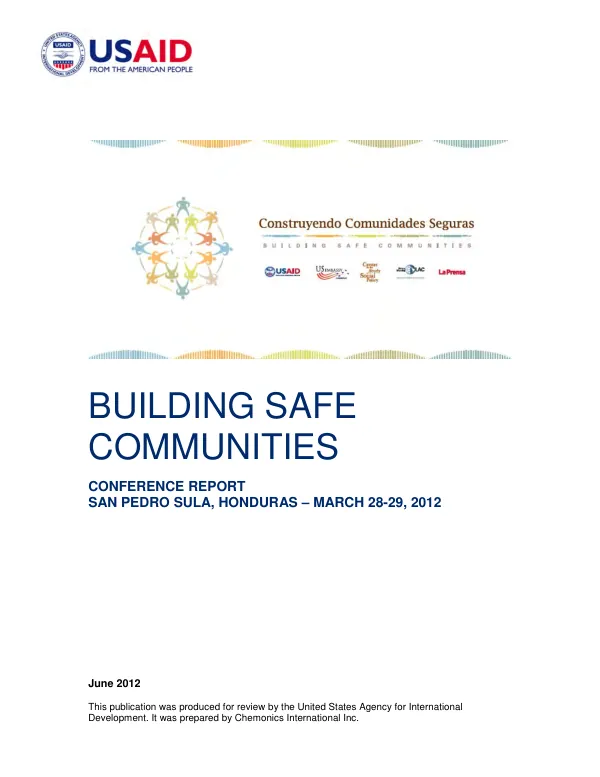
The Building Safe Communities Learning Exchange took place in San Pedro Sula, Honduras on March 28 and March 29, 2012.
2012 · 42 pages
Sign in to readA free account is required to download.
Abstract
The event was co-sponsored by USAID, the U.S. Embassy of Honduras, The World Bank, the Center for the Study of Social Policy, and the local newspaper La Prensa. The purpose of the exchange was to assemble public (at the national and municipal level), private, and NGO leaders from the U.S. and Central America to identify pressing issues, brainstorm solutions, and elicit information to aid in the development of strategies that will enhance the capacity of institutions and communities to implement interdisciplinary and inter-institutional crime and violence prevention initiatives. Keynote speeches were given by the President of Honduras, Porfirio Lobo; U.S. Ambassador to Honduras, Lisa Kubiske; World Bank Country Manager for Honduras, Giuseppe Zampaglione; USAID Deputy Assistant Administrator for Latin America and the Caribbean, Mark Lopes; and San Pedro Sula Mayor, Juan Carlos Zuniga. Representatives from Los Angeles, Boston, Chicago, Belo Horizonte, Bogota, Johannesburg, Mexico City, and across Central America shared lessons learned in crime prevention, providing alternatives to gang involvement, and fostering healthy, strong communities. Over 250 participants were part of this two-day event, and over 100 press representatives covered the event. The conference provided a unique opportunity for leaders in the field to exchange best practices and models of successfully implemented prevention strategy programs. The following were the key objectives of the Learning Exchange: Discuss and build consensus on critical elements of a strategy to Building Safe Communities that takes a whole-of-community approach to prevention. Explore opportunities to better align individual prevention efforts and knowledge, and ultimately leverage greater resources from the public and private sectors, and mobilize the community to action. Identify collaborative roles for local and national governments in prevention initiatives. Lay the foundation for forming and growing a "community of practice" to share viable information and collaborate across sectors to achieve safer, healthier communities. The event featured a live webcast social media question and answer session where moderator David Josue Medina Lopez, Communications Officer and Outreach Center Coordinator for the USAID-funded Youth Alliance, posed live questions from Facebook and Twitter to Honduran Minister of Youth Marco Midence, USAID Deputy Assistant Administrator for Latin America and the Caribbean Mark Lopes, and World Bank Senior Social Development Specialist Rodrigo Serrano. The two-day event ended with participatory small sessions to encourage dialogue and debate and help participants reflect, prioritize, and commit to action. Emergent themes included: Youth must be central actors in prevention activities. Private sector participation and partnerships between the public and private sector are vital to reducing violence. Prevention will not work without effective law enforcement, and the foundation for effective enforcement is trust in the police, which is lacking in many communities. A strong education system is the foundation to prepare youth to be part of an efficient and effective workforce, which provides alternatives to violence. Interventions which are framed in the context of family and target the family as a whole are more effective than interventions focused on the youth as an isolated individual. Media can play a role in transforming public opinion and should give space for positive news and the prevention message. Collecting and analyzing both hard and soft data is critical to successful prevention efforts for both the police and the rest of government. Funding should be based on results, and prioritization of activities should be based on solid data received from police and others working in the communities. Infrastructure and public space are important elements of creating a strong and safe community. A holistic and integrated approach to family, community, government, NGOs, and the private sector is key to effective prevention programs. No one approach will work for every community, and each unique community needs a customized, unique intervention. Municipalities have an active role to play in citizen security and crime prevention.
Related documents